
Cancer Res Treat. 2020;52(4):1178-1187.
Adjuvant Chemotherapy in Microsatellite Instability-High Gastric Cancer.
제1저자 김진원 · 교신저자 임석아
소속 (4)
- Division of Hematology and Medical Oncology, Department of Internal Medicine, Seoul National University Bundang Hospital, Seoul National University College of Medicine, Seongnam, Korea.
- Department of Biomedical Sciences, Seoul National University College of Medicine, Seoul, Korea.
- Cancer Research Institute, Seoul National University College of Medicine, Seoul, Korea.
- Division of Hematology and Medical Oncology, Department of Internal Medicine, Seoul National University Hospital, Seoul National University College of Medicine, Seoul, Korea.
Abstract
PURPOSE Microsatellite instability (MSI) status may affect the efficacy of adjuvant chemotherapy in gastric cancer. In this study, the clinical characteristics of MSI-high (MSI-H) gastric cancer and the predictive value of MSI-H for adjuvant chemotherapy in large cohorts of gastric cancer patients were evaluated.
MATERIAL AND METHODS This study consisted of two cohorts. Cohort 1 included gastric cancer patients who received curative resection with pathologic stage IB-IIIC. Cohort 2 included patients with MSI-H gastric cancer who received curative resection with pathologic stage II/III. MSI was examined using two mononucleotide markers and three dinucleotide markers.
RESULTS Of 359 patients (cohort 1), 41 patients (11.4%) had MSI-H. MSI-H tumors were more frequently identified in older patients (p < 0.001), other histology than poorly cohesive, signet ring cell type (p=0.005), intestinal type (p=0.028), lower third tumor location (p=0.005), and absent perineural invasion (p=0.027). MSI-H status has a tendency of better disease-free survival (DFS) and overall survival (OS) in multivariable analyses (hazard ratio [HR], 0.4; p=0.059 and HR, 0.4; p=0.063, respectively). In the analysis of 162 MSI-H patients (cohort 2), adjuvant chemotherapy showed a significant benefit with respect to longer DFS and OS (p=0.047 and p=0.043, respectively). In multivariable analysis, adjuvant chemotherapy improved DFS (HR, 0.4; p=0.040).
CONCLUSION MSI-H gastric cancer had distinct clinicopathologic findings. Even in MSI-H gastric cancer of retrospective cohort, adjuvant chemotherapy could show a survival benefit, which was in contrast to previous prospective studies and should be investigated in a further prospective trial.
Keywords
Adjuvant chemotherapyMicrosatellite instabilityStomach neoplasms
Figures
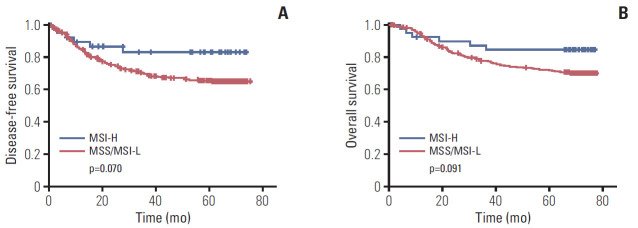
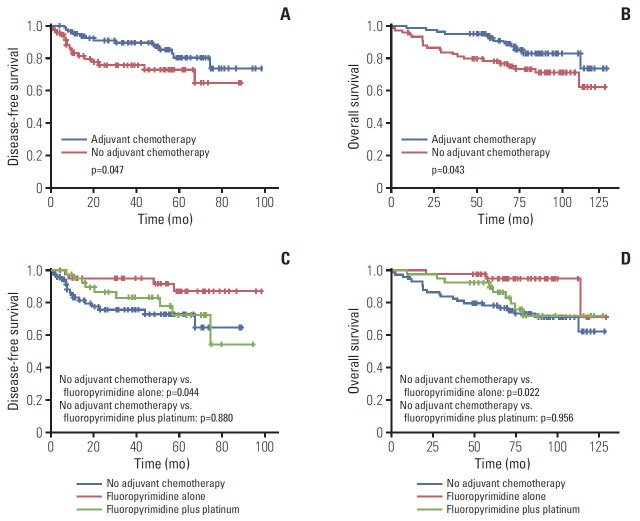
그림 출처: PubMed Central 공개 논문 (PMC7577821)
Conflict of interest statement
Conflicts of interest relevant to this article was not reported.
그 밖의 정보
- 출판 형태
- Journal Article
- 저널
- Cancer research and treatment · eISSN 2005-9256
- 전자 출판
- 2020-06-11
- MeSH
- Adult · Aged · Aged, 80 and over · Antineoplastic Combined Chemotherapy Protocols / therapeutic use · Biomarkers, Tumor / genetics · Chemotherapy, Adjuvant · Disease-Free Survival · Female · Follow-Up Studies · Gastrectomy · Humans · Male · Microsatellite Instability* · Middle Aged · Neoplasm Invasiveness · Neoplasm Recurrence, Local / epidemiology / prevention & control · Neoplasm Staging · Prognosis · Retrospective Studies · Stomach / pathology / surgery · Stomach Neoplasms / diagnosis / genetics / mortality / therapy
- Substances
- Biomarkers, Tumor
- 연구비
- SNUBH research fund 11-2012-010
- 참고문헌
- 26편