
Cancer Res Treat. 2020;52(3):945-956.
Inhibition of ATR Increases the Sensitivity to WEE1 Inhibitor in Biliary Tract Cancer.
제1저자 남아롱, 김미화 · 교신저자 오도연
소속 (2)
- Cancer Research Institute, Seoul National University College of Medicine, Seoul, Korea.
- Department of Internal Medicine, Seoul National University Hospital, Seoul, Korea.
Abstract
PURPOSE Currently, the DNA damage response (DDR) pathway represents a key target for new cancer drug development. Advanced biliary tract cancer (BTC) has a poor prognosis because of the lack of efficacious treatment options. Although DNA repair pathway alterations have been reported in many patients with BTC, little is known regarding the effects of DDR-targeted agents against BTC.
MATERIALS AND METHODS In this study, nine BTC cell lines were exposed to the WEE1 inhibitor (AZD1775). In vitro, MTT assay, colony-forming assay, cell cycle analysis, phospho-histone H3 staining assay, Transwell migration assay, and western blot were performed. Then, to enhance the antitumor effect of AZD1775, the combination treatment of WEE1 inhibitor and ataxia telangiectasia mutated and Rad3 related (ATR) inhibitor (AZD6738) was conducted using MTT assay and comet assay. Finally, HuCCT-1 and SNU2670 xenograft models were established to confirm the anti-tumor effect of AZD1775 alone. Furthermore, the combination treatment was also evaluated in SNU2670 xenograft models.
RESULTS AZD1775 blocked the phosphorylation of CDC2 and CDC25C in all cell lines, but significantly increased apoptosis and S phase arrest in sensitive cells. However, increased p-ATR and phosphorylated ataxia telangiectasia mutated levels were observed in less sensitive cells. In addition, in vitro and in vivo data illustrated that AZD1775 combined with AZD6738 exerted more potent anti-tumor effects than either drug alone. Although WEE1 inhibition has promising anti-tumor effects in some BTC cells, the addition of ATR inhibitors could enhance its efficacy.
CONCLUSION Taken together, this study supports further clinical development of DDR-targeted strategies as monotherapy or combination regimens for BTC.
Keywords
ATRBiliary tract neoplasmsDNA damage responseWEE1
Figures
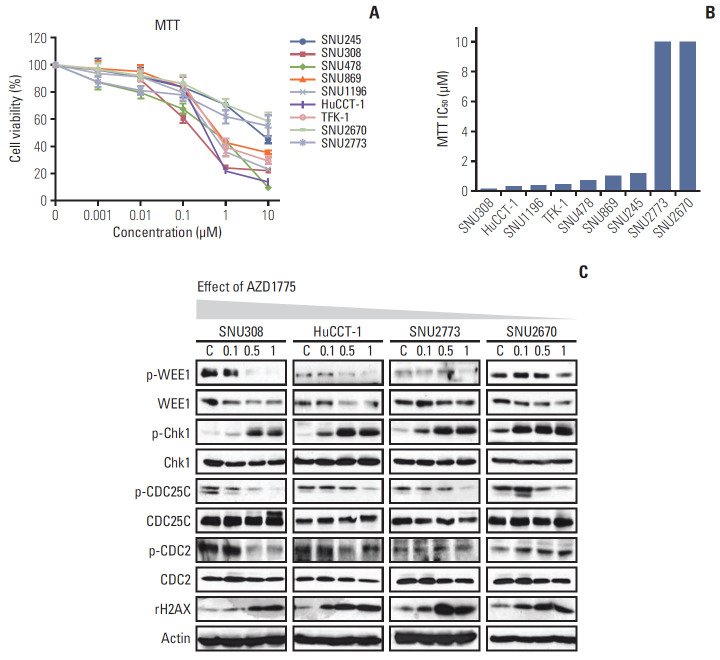
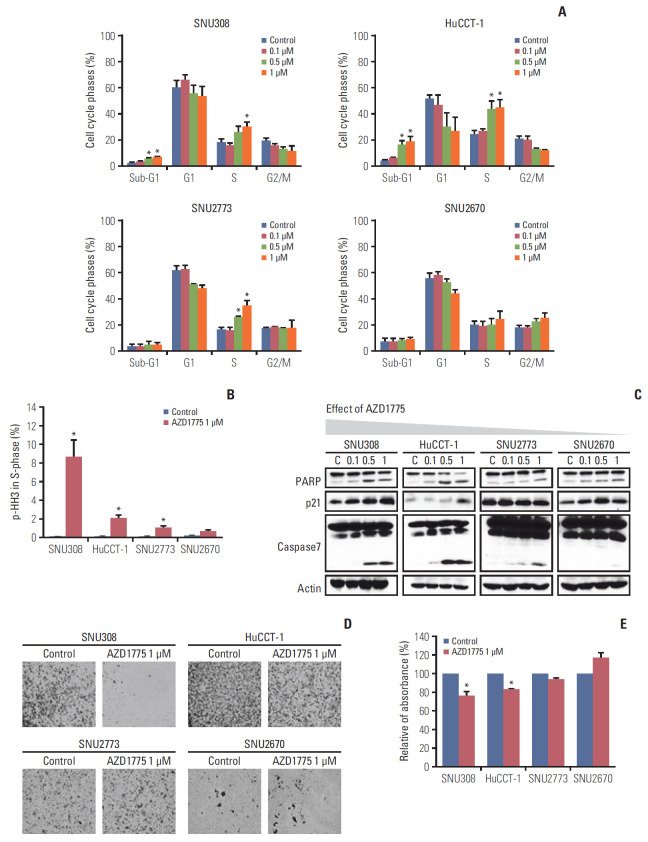
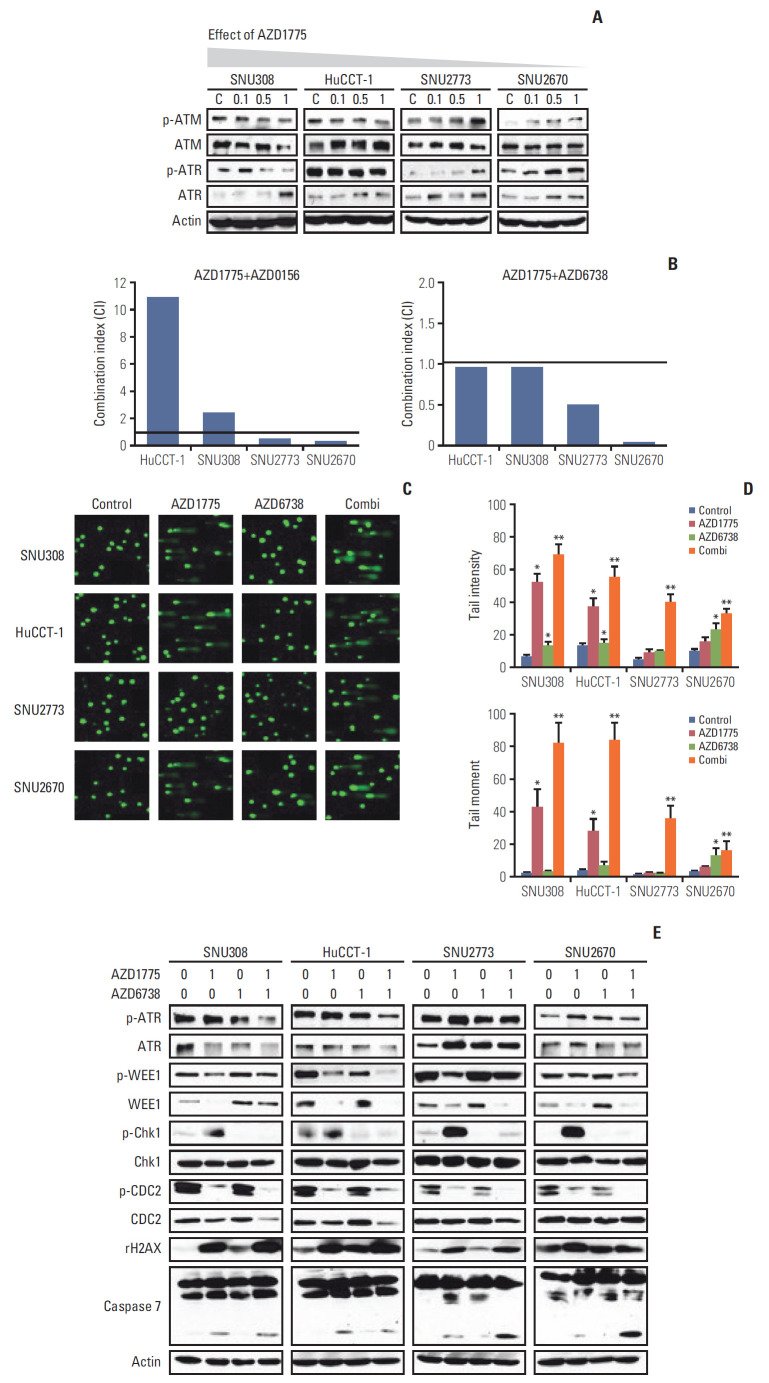
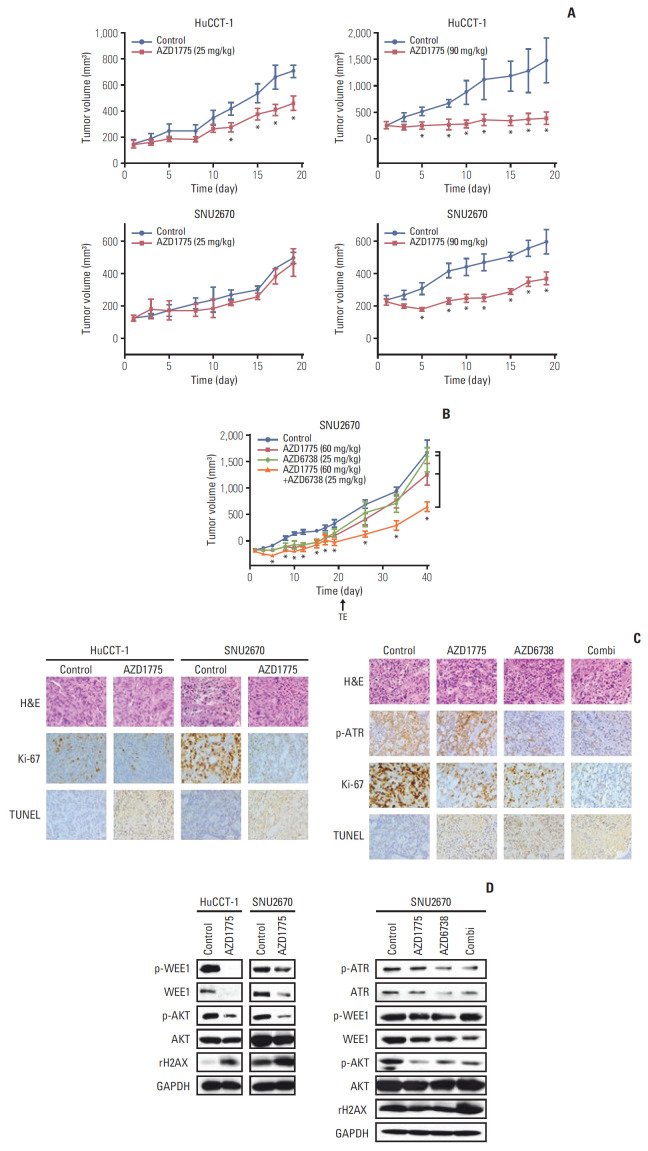
그림 출처: PubMed Central 공개 논문 (PMC7373879)
Conflict of interest statement
D-Y Oh received research grant from AstraZeneca and consultant/advisor to AstraZeneca. Y-J Bang is a consultant/advisory board member of AstraZeneca. No conflicts of interest were disclosed by the other authors.
그 밖의 정보
- 출판 형태
- Journal Article
- 저널
- Cancer research and treatment · eISSN 2005-9256
- 전자 출판
- 2020-04-17
- MeSH
- Animals · Apoptosis · Ataxia Telangiectasia Mutated Proteins / antagonists & inhibitors / genetics / metabolism · Biliary Tract Neoplasms / drug therapy / metabolism / pathology · Cell Cycle · Cell Cycle Proteins / antagonists & inhibitors / genetics / metabolism · Cell Movement · Cell Proliferation · Drug Resistance, Neoplasm* · Female · Gene Expression Regulation, Neoplastic / drug effects · Humans · Indoles · Mice · Mice, Nude · Middle Aged · Morpholines · Prognosis · Protein-Tyrosine Kinases / antagonists & inhibitors / genetics / metabolism · Pyrimidines / pharmacology · Sulfonamides · Sulfoxides / pharmacology · Tumor Cells, Cultured · Xenograft Model Antitumor Assays
- Substances
- Cell Cycle Proteins · Indoles · Morpholines · Pyrimidines · Sulfonamides · Sulfoxides · ceralasertib · Protein-Tyrosine Kinases · WEE1 protein, human · ATR protein, human · Ataxia Telangiectasia Mutated Proteins
- 연구비
- Korea Health Industry Development Institute 06-2016-2920 · Korea Health Industry Development Institute 03-2017-0100 · Seoul National University Hospital
- 참고문헌
- 25편