SCI 발표논문

SCI 발표논문

← SCI 발표논문 목록

Cancer Res Treat. 2020;52(1):149-166.

Therapeutic Co-targeting of WEE1 and ATM Downregulates PD-L1 Expression in Pancreatic Cancer.

, , , , ,

제1저자 김미화 · 교신저자 오도연

소속 (2)
  1. Cancer Research Institute, Seoul National University College of Medicine, Seoul, Korea.
  2. Department of Internal Medicine, Seoul National University Hospital, Seoul, Korea.

Abstract

PURPOSE Pancreatic cancer (PC) is one of the most lethal cancers worldwide, but there are currently no effective treatments. The DNA damage response (DDR) is under investigation for the development of novel anti-cancer drugs. Since DNA repair pathway alterations have been found frequently in PC, the purpose of this study was to test the DDR-targeting strategy in PC using WEE1 and ATM inhibitors.

MATERIALS AND METHODS We performed in vitro experiments using a total of ten human PC cell lines to evaluate antitumor effect of AZD1775 (WEE1 inhibitor) alone or combination with AZD0156 (ATM inhibitor). We established Capan-1-mouse model for in vivo experiments to confirm our findings.

RESULTS In our research, we found that WEE1 inhibitor (AZD1775) as single agent showed anti-tumor effects in PC cells, however, targeting WEE1 upregulated p-ATM level. Here, we observed that co-targeting of WEE1 and ATM acted synergistically to reduce cell proliferation and migration, and to induce DNA damage in vitro. Notably, inhibition of WEE1 or WEE1/ATM downregulated programmed cell death ligand 1 expression by blocking glycogen synthase kinase-3β serine 9 phosphorylation and decrease of CMTM6 expression. In Capan-1 mouse xenograft model, AZD1775 plus AZD0156 (ATM inhibitor) treatment reduced tumor growth and downregulated tumor expression of programmed cell death ligand 1, CMTM6, CD163, and CXCR2, all of which contribute to tumor immune evasion.

CONCLUSION Dual blockade of WEE1 and ATM might be a potential therapeutic strategy for PC. Taken toget.

Keywords

ATMDNA damage responsePD-L1Pancreatic neoplasmsWEE1

Figures

Fig. 1.
Fig. 1. Growth inhibitory effect of AZD1775 in pancreatic cancer (PC) cell lines. (A) Ten PC cell lines were exposed to control (0) or 0.001, 0.01, 0.1, 1, and 10 μM AZD1775 for 72 hours, and cell viability was measured using the MTT assay. (B) Cell lines were treated as described in A and colony formation was analyzed after 10 days. (C) Western blot analysis of total or phosphorylated signaling molecules in Capan-1, SNU213, SNU410, and SNU2913 cells treated with 0, 0.1, or 1 μM AZD1775 for 24 hours. Experiments were repeated three times. GAPDH, glyceraldehyde 3-phosphate dehydrogenase; p–NF-kB, phosphorylated nuclear factor kappa-light-chain-enhancer of activated B cells. (D) Annexin V/propidium iodide (PI) apoptosis assay of Capan-1, SNU213, SNU410, and SNU2913 cells treated with 0 or 1 μM AZD1775 for 48 hours. (E) Quantification of three independent Annexin V/PI assays. (F) Western blot analysis of apoptosis-related proteins in cells treated with 0, 0.1, or 1 μM AZD1775 for 48 hours. (G) Cell cycle analysis of PI-stained PC cells treated with 0 or 1 μM AZD1775 for 24 hours. (H) Western blot analysis of cell cycle arrest-related signaling molecules in cells treated with 0, 0.1, or 1 μM AZD1775 for 24 hours. *p < 0.05, **p < 0.01, ***p < 0.001. Experiments were repeated three times.
Fig. 2.
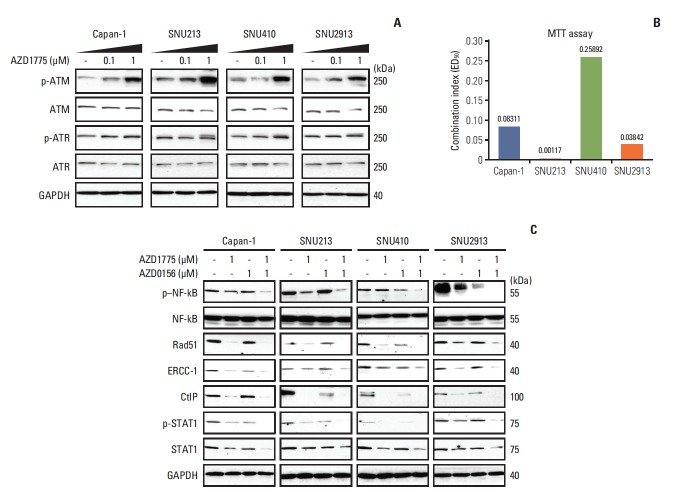
Fig. 2. Effects of combination treatment with WEE1 and ataxia telangiectasia mutated (ATM) inhibitors on cell growth. (A) Western blot analysis of total and phosphorylated ATM and ataxia telangiectasia and Rad3 related (ATR) in cells treated with 0, 0.1, or 1 μM AZD1775 for 24 hours. (B) Combination index values in the MTT assay after combination treatment with AZD1775 and AZD0156 for 72 hours. Combination index > 1, 1, < 1 indicate antagonistic, additive, and synergistic effects, respectively. (C) Western blot analysis of cells treated with 0 or 1 μM AZD1775 and/or AZD0156 for 72 hours. p–NF-kB, phosphorylated nuclear factor kappa-light-chain-enhancer of activated B cells; ERCC-1, excision repair cross-complementing protein 1; CtIP, C-terminal binding protein-interacting protein; STAT, signal transducer and activator of transcription; GAPDH, glyceraldehyde 3-phosphate dehy-drogenase.
Fig. 3.
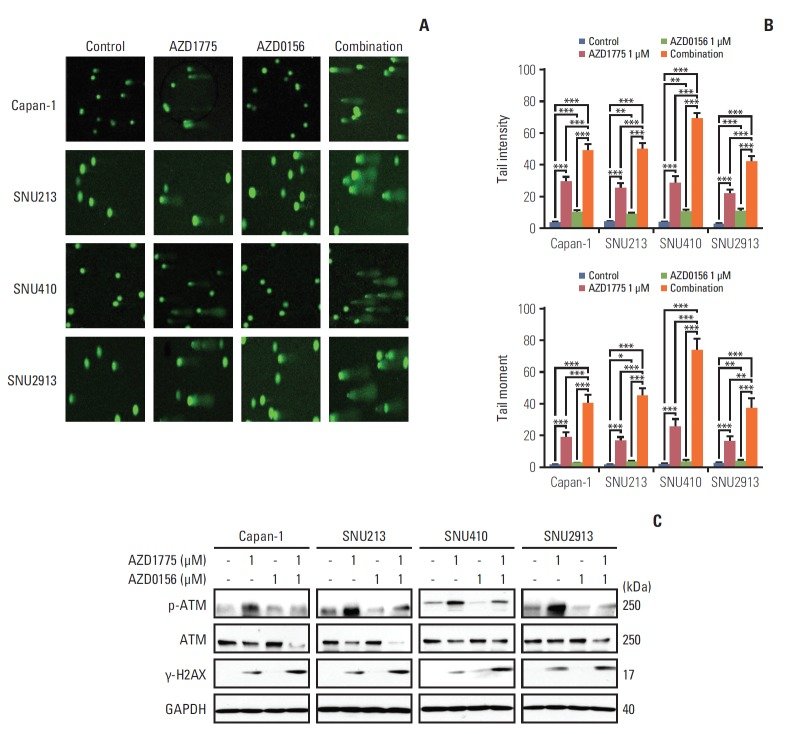
Fig. 3. Effect of WEE1 and ataxia telangiectasia mutated (ATM) co-inhibition on DNA damage. (A, B) Displayed Comet Assay results after treated with 0, AZD1775 (1 μmol/L) alone, AZD0156 (1 μmol/L) alone, or both for 24 hours. Tail intensity and moment were analyzed using the Comet Assay IV program. (C) The related DNA damage signals were detected after exposed at combination treatment setting for 24 hours. **p < 0.01, ***p < 0.001. Experiments were repeated three times. GAPDH, glyceraldehyde 3-phosphate dehydrogenase.
Fig. 4.
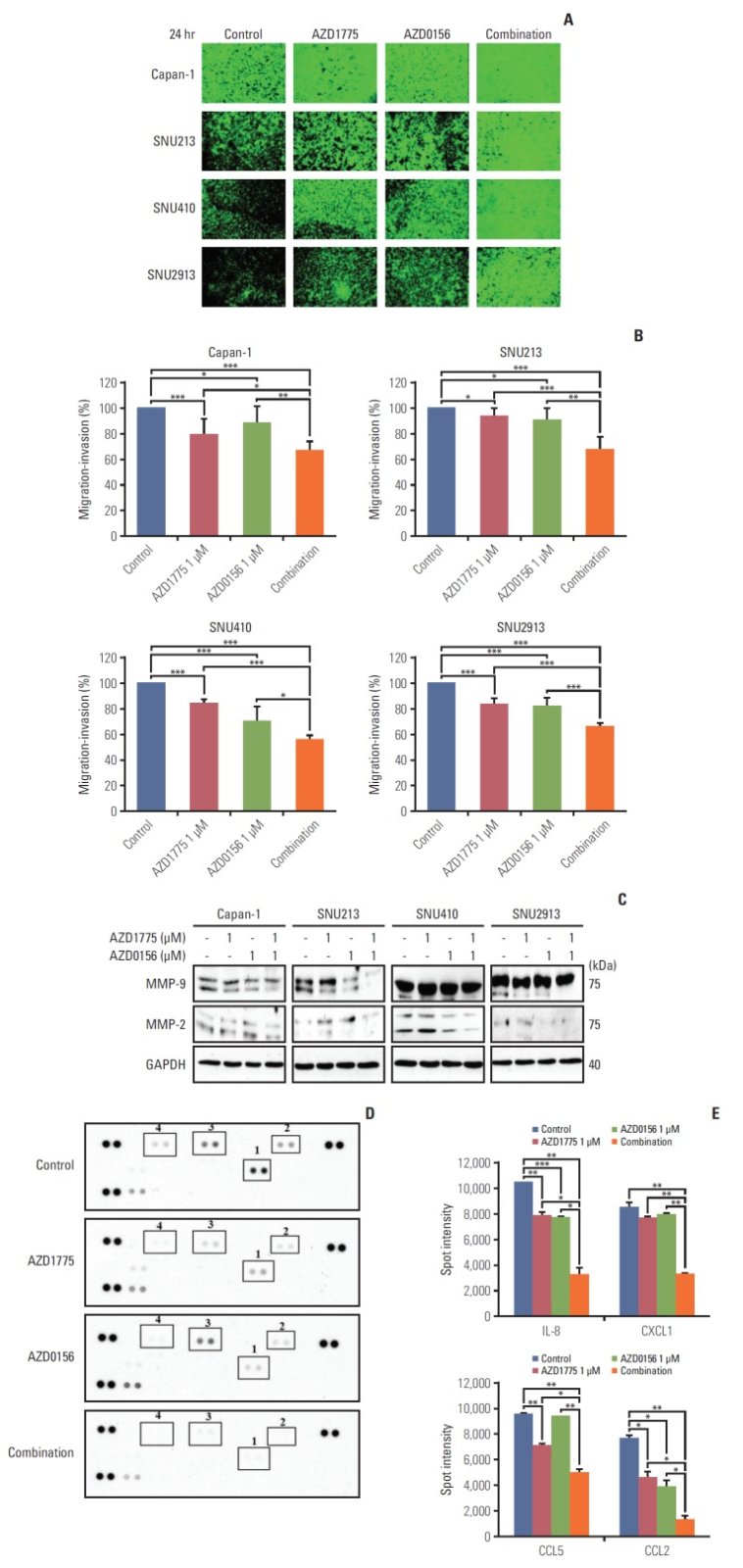
Fig. 4. Effect of WEE1 and ataxia telangiectasia mutated co-inhibition on migration of pancreatic cancer cells. (A) The antimigration effect was evaluated using cells with 0, AZD1775 1 μmol/L, or AZD0156 1 μmol/L or both. The image was captured at 24 hours after treatment. (B) The percentage of migratory cells was analyzed after image was captured. The data represents three independent times. (C) Western blot analysis of migration-related molecules in cells treated as described in panel A for 24 hours. MMP, matrix metallopeptidases; GAPDH, glyceraldehyde 3-phosphate dehydrogenase. (D, E) Human cytokine array analysis of Capan-1 cells treated as described for panel A for 24 hours. Spot intensities were quantified using ImageJ software. 1, interleukin 8 (IL-8); 2, CXCL1; 3, CCL5; 4, CCL2. *p < 0.05, **p < 0.01, ***p < 0.001.
Fig. 5.
Fig. 5. Effect of WEE1 and ataxia telangiectasia mutated co-inhibition on programmed cell death ligand 1 (PD-L1) expression. (A) Western blot analysis of PD-L1 and PD-L1–regulatory signaling molecules in pancreatic cancer (PC) cells treated with 0 or 1 μM AZD1775 and/or AZD0156 for 72 hours. GAPDH, glyceraldehyde 3-phosphate dehydrogenase. (B) Fluorescence-activated cell sorting analysis of cell surface PD-L1 expression on Capan-1 and SNU2913 cells treated as described for panel A for 72 hours. Experiments were repeated three times. (C) Western blot analysis of control IgG, anti–PD-L1, or anti-CMTM6 immunoprecipitates (IP) treated as described for (A) for 72 hours. (D, E) Human phospho-kinase array analysis of Capan-1 cells treated as described for panel A for 24 hours. Spot intensities were quantified using ImageJ software. 1, phosphorylated glycogen synthase kinase-3β (p–GSK-3β) Ser9; 2, p-CREB Ser133; 3, p-Src Tyr419; 4, p-yes Tyr426; 5, phosphorylated focal adhesion kinase (p-FAK) Tyr397; 6, phosphorylated p53 (p-p53) Ser15. *p < 0.05, **p < 0.01, ***p < 0.001.
Fig. 6.
Fig. 6. Anti-tumor effects of WEE1 and WEE1/ataxia telangiectasia mutated (ATM) co-inhibition in the Capan-1 xenograft mouse model. (A, B) Tumor growth curves (A) and mouse body weights (B) in Capan-1–xenografted mice treated with vehicle, AZD1775 (30 mg/kg), AZD0156 (30 mg/kg), or both AZD1775 and AZD0156 for up to 4 weeks. (C) Immunohistochemical analysis of programmed cell death ligand 1 (PD-L1) (×400), CD163 (×200), Ki67 (×200), and terminal deoxynucleotidyl transferase dUTP nick end labeling (TUNEL) (×200), staining in Capan-1 xenografts excised tumors. Scale bars=100 μm. (D) Western blot analysis of various proteins harvested from isolated tumors. NF-kB, phosphorylated nuclear factor kappa-light-chain-enhancer of activated B cells; GAPDH, glyceraldehyde 3-phosphate dehydrogenase. (E, F) Mouse cytokine array analysis of serum collected from xenografted mice. Spot intensities were measured using ImageJ software. 1, C5/C5a; 2, TIMP metallopeptidase inhibitor (TIMP-1); 3, macrophage colony-stimulating factor (M-CSF); 4, CD54; 5, interleukin 16 (IL-16); 6, CXCL12. *p < 0.05, **p < 0.01, ***p < 0.001.

그림 출처: PubMed Central 공개 논문 (PMC6962488)

Conflict of interest statement

D-Y Oh received AstraZeneca-KHIDI (Korea Health Industry Development Institute) Oncology Research Program and Y-J Bang is a consultant/advisory board member of AstraZeneca. No conflicts of interest were disclosed by the other authors.

그 밖의 정보
출판 형태
Journal Article
저널
Cancer research and treatment · eISSN 2005-9256
전자 출판
2019-06-25
MeSH
Animals · Antineoplastic Agents / pharmacology / therapeutic use · Apoptosis / drug effects · Ataxia Telangiectasia Mutated Proteins / antagonists & inhibitors · B7-H1 Antigen / genetics / metabolism · Biomarkers · Cell Cycle Proteins / antagonists & inhibitors · Cell Line, Tumor · Cell Movement / drug effects · Cytokines · DNA Damage / drug effects · Disease Models, Animal · Gene Expression Regulation, Neoplastic / drug effects · Humans · Immunophenotyping · Mice · Pancreatic Neoplasms / drug therapy / genetics / metabolism / pathology · Protein Kinase Inhibitors / pharmacology / therapeutic use · Protein-Tyrosine Kinases / antagonists & inhibitors · S Phase Cell Cycle Checkpoints · Xenograft Model Antitumor Assays
Substances
Antineoplastic Agents · B7-H1 Antigen · Biomarkers · CD274 protein, human · Cell Cycle Proteins · Cytokines · Protein Kinase Inhibitors · Protein-Tyrosine Kinases · WEE1 protein, human · ATM protein, human · Ataxia Telangiectasia Mutated Proteins
연구비
Korea Health Industry Development Institute 06-2016-2920 · Seoul National University · SNUH Research Fund 03-2017-0100
참고문헌
33편