
Cancer Res Treat. 2019;51(3):886-900.
Jab1 Silencing Inhibits Proliferation and Sensitizes to Cisplatin in Biliary Tract Cancer.
제1저자 남아롱, 김지원 · 교신저자 오도연
소속 (3)
- Cancer Research Institute, Seoul National University College of Medicine, Seoul, Korea.
- Department of Internal Medicine, Seoul National University Bundang Hospital, Seongnam, Korea.
- Department of Internal Medicine, Seoul National University College of Medicine, Seoul, Korea.
Abstract
PURPOSE Jab1 is a coactivator of c-Jun that enhances the transcriptional function of c-Jun. Jab1 is frequently overexpressed in various cancers and is associatedwith poor prognosis of cancer patients. Thus, Jab1 could be a potential therapeutic target in cancer. However, the role of Jab1 in biliary tract cancer (BTC) has not been studied.
MATERIALS AND METHODS We performed in vitro and in vivo experiments to evaluate the therapeutic potential ofJab1 inhibition in BTC.
RESULTS Among 8 BTC cell lines, many showed higher Jab1 expression levels. In addition, Jab1 silencing by siRNA increased p27 expression levels. SNU478 and HuCCT-1 cells exhibited profound Jab1 knockdown and increased p27 expression by Jab1-specific siRNA transfection. Jab1 silencing induced anti-proliferative and anti-migratory effects and resulted in G1 cell cycle arrest in SNU478 and HuCCT-1 cells. In addition, Jab1 silencing potentiated the anti-proliferative and anti-migratory effects of cisplatin by increasing DNA damage. Interestingly,Jab1 knockdown increased PTEN protein half-life, resulting in increased PTEN expression. In the HuCCT-1 mouse xenograft model, stable knockdown of Jab1 by shRNA also showed anti-proliferative effects in vivo, with decreased Ki-67 expression and AKT phosphorylation and increased Terminal deoxynucleotidyl transferase-mediated dUTP nick end labeling and p27 expression.
CONCLUSION Jab1 knockdown demonstrated anti-proliferative and anti-migratory effects in BTC cells by increasing DNA damage and stabilizing PTEN, resulting in G1 cell cycle arrest. In addition, Jab1 silencing potentiated the anti-proliferative effects of cisplatin. Our data suggest that Jab1 may be a potential therapeutic target in BTC that is worthy of further investigations.
Keywords
Biliary tract neoplasmsCisplatinJab1ProliferationTherapeutic target
Figures
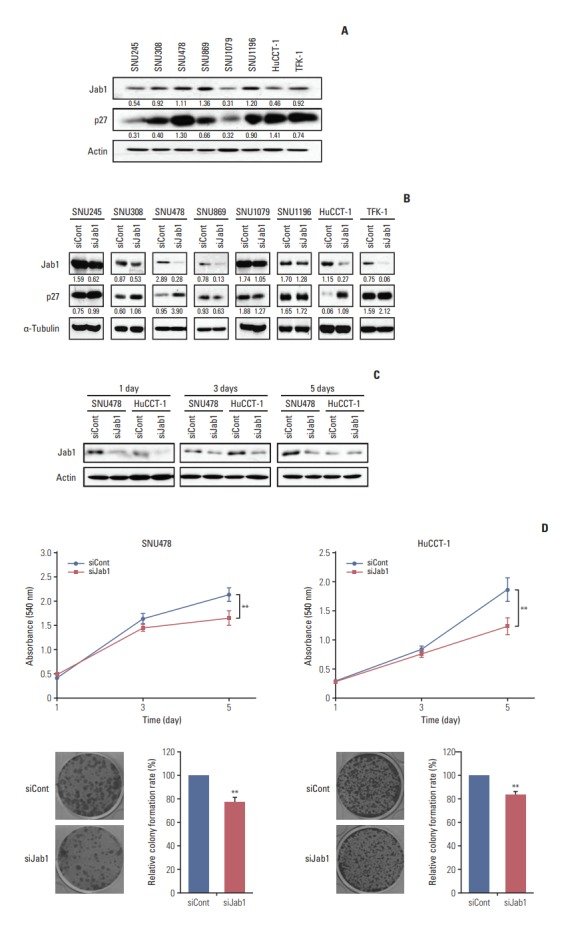
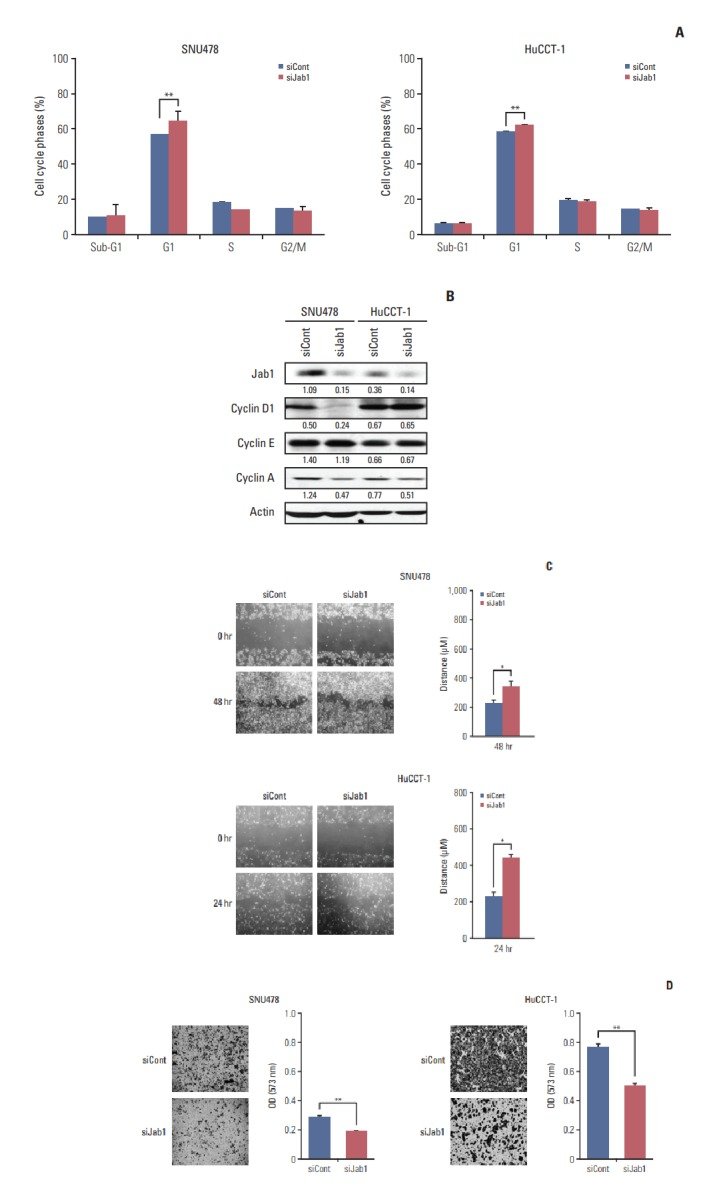
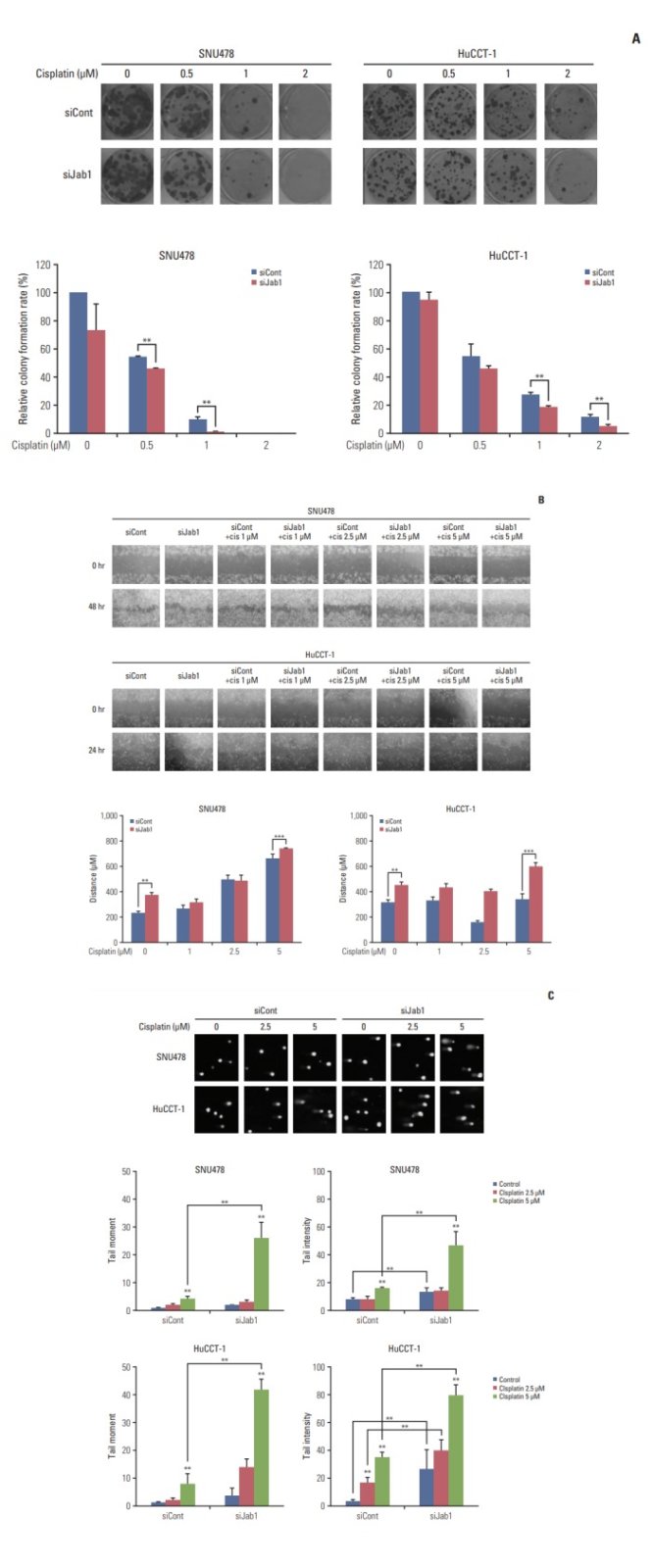
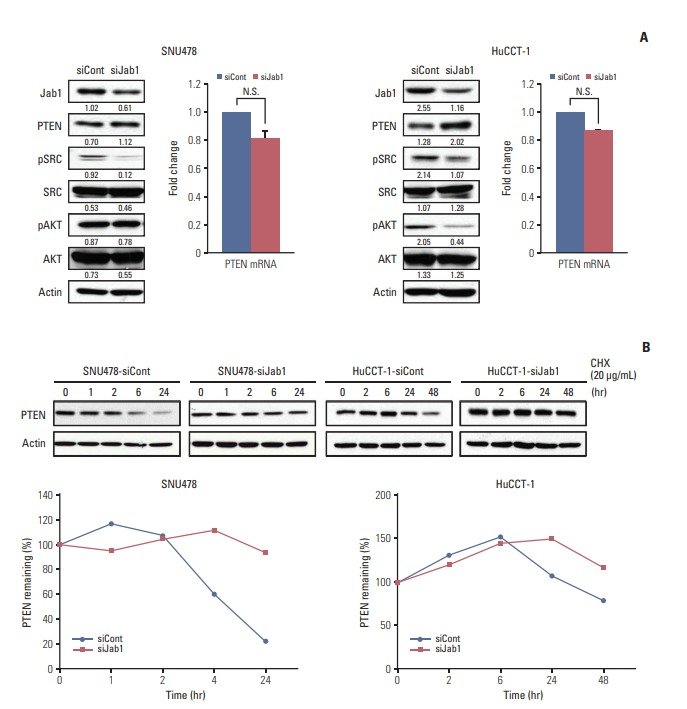
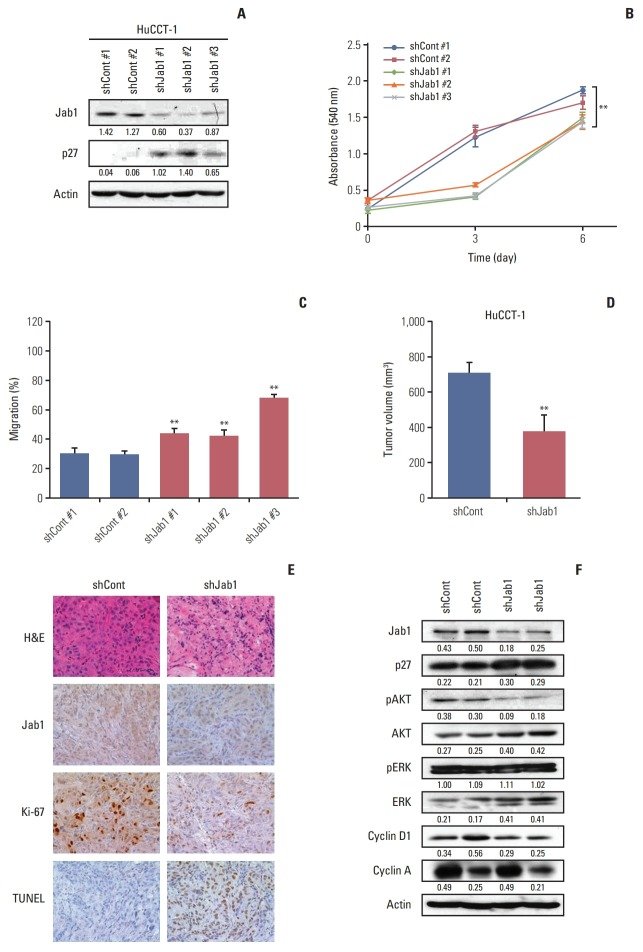
그림 출처: PubMed Central 공개 논문 (PMC6639236)
Conflict of interest statement
Conflict of interest relevant to this article was not reported.
그 밖의 정보
- 출판 형태
- Journal Article
- 저널
- Cancer research and treatment · eISSN 2005-9256
- 전자 출판
- 2018-10-01
- MeSH
- Animals · Antineoplastic Agents / administration & dosage / pharmacology · Biliary Tract Neoplasms / drug therapy / genetics / metabolism · COP9 Signalosome Complex / antagonists & inhibitors / genetics / metabolism · Cell Line, Tumor · Cell Movement / drug effects · Cell Proliferation / drug effects · Cell Survival / drug effects · Cisplatin / administration & dosage / pharmacology · Cyclin-Dependent Kinase Inhibitor p27 / metabolism · Drug Synergism · Female · Gene Expression Regulation, Neoplastic / drug effects · Humans · Intracellular Signaling Peptides and Proteins / antagonists & inhibitors / genetics / metabolism · Mice · PTEN Phosphohydrolase / chemistry / metabolism · Peptide Hydrolases / genetics / metabolism · Protein Stability / drug effects · RNA, Small Interfering / administration & dosage / pharmacology · Up-Regulation / drug effects · Xenograft Model Antitumor Assays
- Substances
- Antineoplastic Agents · CDKN1B protein, human · Intracellular Signaling Peptides and Proteins · RNA, Small Interfering · Cyclin-Dependent Kinase Inhibitor p27 · PTEN Phosphohydrolase · PTEN protein, human · Peptide Hydrolases · COPS5 protein, human · COP9 Signalosome Complex · Cisplatin
- 연구비
- Ministry of Health and Welfare A121508
- 참고문헌
- 27편