
Cancer Res Treat. 2019;51(2):451-463.
Pan-Pim Kinase Inhibitor AZD1208 Suppresses Tumor Growth and Synergistically Interacts with Akt Inhibition in Gastric Cancer Cells.
제1저자 이미소 · 교신저자 임석아
소속 (3)
- Cancer Research Institute, Seoul National University, Seoul, Korea.
- Biomedical Research Institute, Seoul National University Hospital, Seoul, Korea.
- Department of Internal Medicine, Seoul National University College of Medicine, Seoul, Korea.
Abstract
PURPOSE Pim kinases are highly conserved serine/threonine kinases, and different expression patterns of each isoform (Pim-1, Pim-2, and Pim-3) have been observed in various types of human cancers, including gastric cancer. AZD1208 is a potent and selective inhibitor that affects all three isoforms of Pim. We investigated the effects of AZD1208 as a single agent and in combination with an Akt inhibitor in gastric cancer cells.
MATERIALS AND METHODS The antitumor activity of AZD1208 with/without an Akt inhibitor was evaluated in a large panel of gastric cancer cell lines through growth inhibition assays. The underlying mechanism was also examined by western blotting, immunofluorescence assay, and cell cycle analysis.
RESULTS AZD1208 treatment decreased gastric cancer cell proliferation rates and induced autophagy only in long-term culture systems. Light chain 3B (LC3B), a marker of autophagy, was increased in sensitive cells in a dose-dependent manner with AZD1208 treatment, which suggested that the growth inhibition effect of AZD1208 was achieved through autophagy, not apoptosis. Moreover, we found that cells damaged by Pim inhibition were repaired by activation of the DNA damage repair pathway, which promoted cell survival and led the cells to become resistant to AZD1208. We also confirmed that the combination of an Akt inhibitor with AZD1208 produced a highly synergistic effect in gastric cancer cell lines.
CONCLUSION Treatment with AZD1208 alone induced considerable cell death through autophagy in gastric cancer cells. Moreover, the combination of AZD1208 with an Akt inhibitor showed synergistic antitumor effects through regulation of the DNA damage repair pathway.
Keywords
AZD1208AktAutophagyPim kinase inhibitorStomach neoplasms
Figures
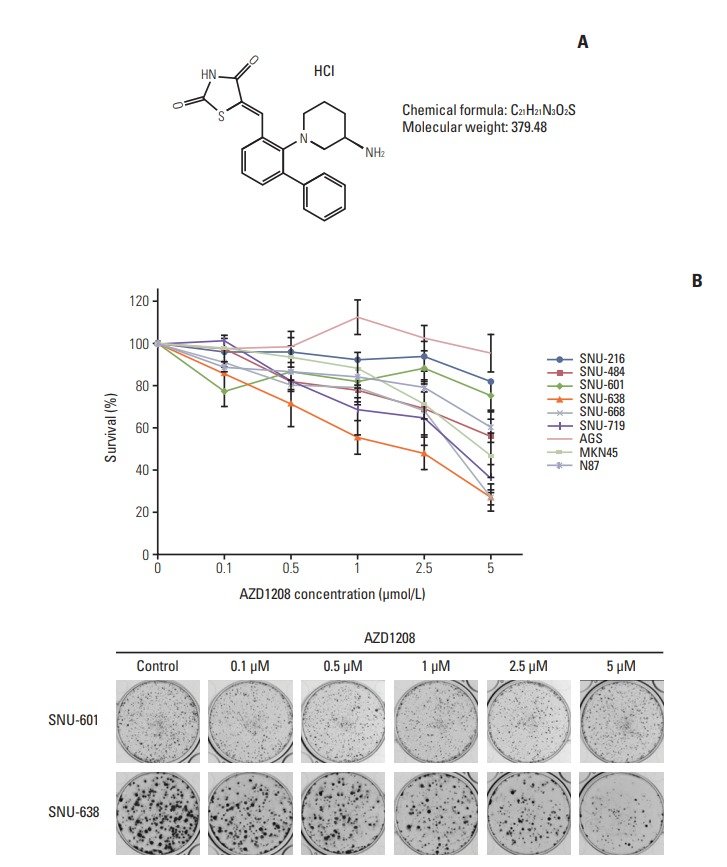
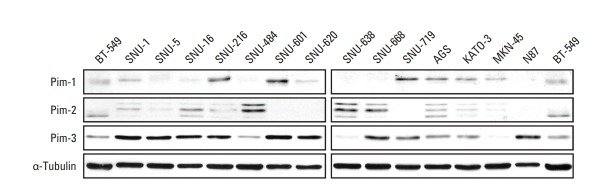
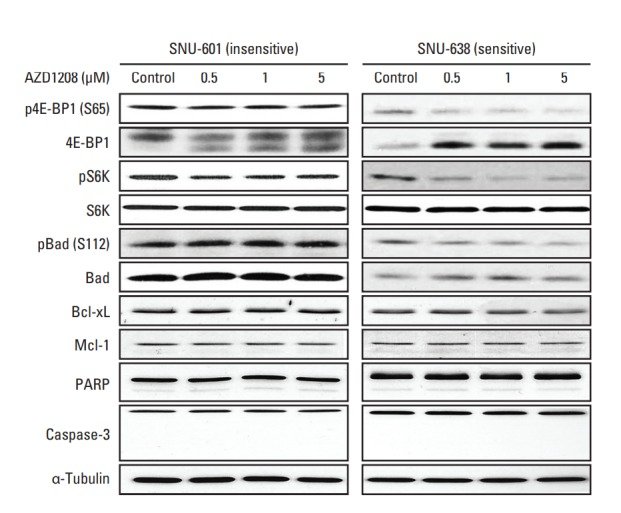
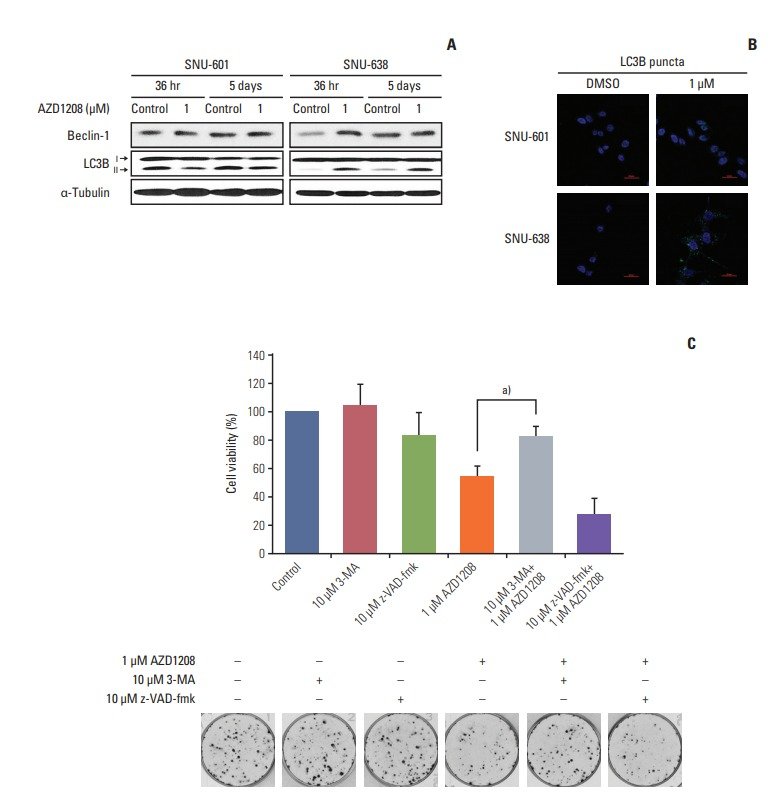
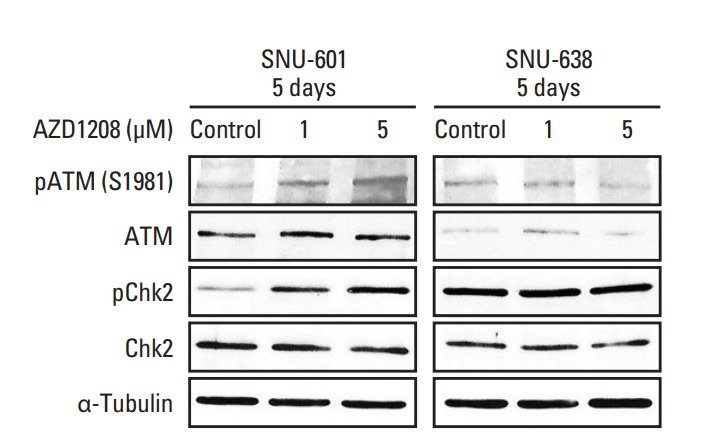
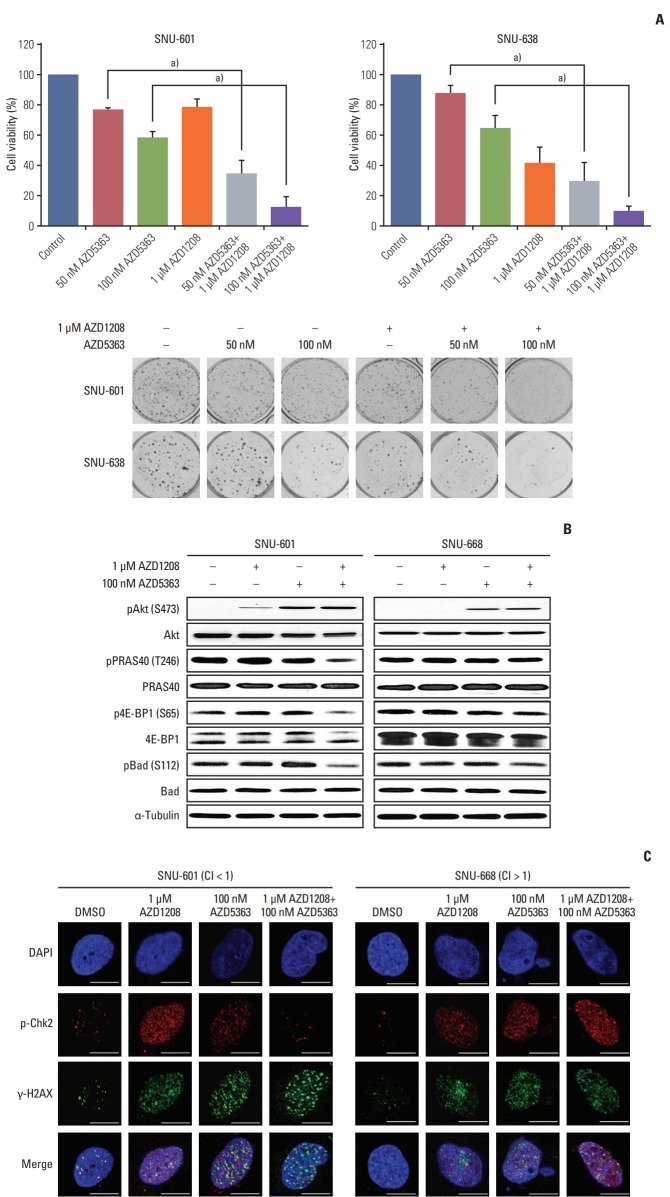
그림 출처: PubMed Central 공개 논문 (PMC6473293)
Conflict of interest statement
Yung-Jue Bang has advised or consulted for and received academic research funding from Bayer, Novartis, Boehringer-Ingelheim, Roche/Genentech, AstraZeneca, Merck Serano, MSD, BristolMyers Squibb, Eli Lilly, Pfizer, ONO, Taiho, and GreenCross. SeockAh Im is a recipient of academic research funds from AstraZeneca, Inc., and has served as a consultant and on the advisory board for AstraZeneca, Novartis, and Roche without compensation. Do-Youn Oh is a recipient of academic research funds from AstraZeneca, Inc. None of the other authors declare any potential conflicts of interest.
그 밖의 정보
- 출판 형태
- Journal Article
- 저널
- Cancer research and treatment · eISSN 2005-9256
- 전자 출판
- 2018-06-06
- MeSH
- Autophagy / drug effects · Biphenyl Compounds / chemistry / pharmacology · Cell Line, Tumor · Cell Proliferation / drug effects · Cell Survival / drug effects · DNA Damage / drug effects · Drug Resistance, Neoplasm / drug effects · Drug Synergism · Humans · Isoenzymes / antagonists & inhibitors · Phosphorylation · Protein Kinase Inhibitors / chemistry / pharmacology · Proto-Oncogene Proteins c-akt / antagonists & inhibitors · Proto-Oncogene Proteins c-pim-1 / antagonists & inhibitors · Stomach Neoplasms / metabolism · Thiazolidines / chemistry / pharmacology
- Substances
- AZD1208 · Biphenyl Compounds · Isoenzymes · Protein Kinase Inhibitors · Thiazolidines · Proto-Oncogene Proteins c-akt · Proto-Oncogene Proteins c-pim-1 · proto-oncogene proteins pim
- 연구비
- National Research Foundation of Korea 20090093820
- 참고문헌
- 30편