
Cancer Res Treat. 2019;51(2):832-840.
Dynamics of Soluble Programmed Death-Ligand 1 (sPDL1) during Chemotherapy and Its Prognostic Implications in Cancer Patients: Biomarker Development in Immuno-oncology.
제1저자 하혜림 · 교신저자 오도연
소속 (2)
- Department of Internal Medicine, Seoul National University College of Medicine, Seoul, Korea.
- Cancer Research Institute, Seoul National University College of Medicine, Seoul, Korea.
Abstract
PURPOSE The soluble programmed death-ligand 1 (sPDL1) has immunosuppressive activity and is a candidate biomarker for immuno-oncology drug development. In this study, we measured sPDL1 at pre- and post-chemotherapy and at disease progression to uncover the dynamics of sPDL1 during treatment in biliary tract cancer (BTC) patients.
MATERIALS AND METHODS From 90 BTC patients (training cohort, 53; validation cohort, 37) who were candidates for palliative first-line chemotherapy, blood was collected at pre- and post-chemotherapy (at the time of best response) and at disease progression. The sPDL1 levels were measured using an enzyme-linked immunosorbent assay. Responses to chemotherapy, overall survival (OS), and other prognostic factors including the neutrophil-lymphocyte ratio (NLR) were analyzed.
RESULTS The OS of all patients was 11.5 months (confidence interval [CI], 9.7 to 16.2). The best response was complete response in seven (7.8%), partial response in 20 (22.2%), stable disease in 52 (57.8%), and disease progression (PD) in 11 patients (12.2%). Patients with high pre-chemotherapy sPDL1 (≥ 1.30 ng/mL) showed worse OS than patients with low prechemotherapy sPDL1 (9.1 months vs. 12.5 months, p=0.003). In multivariate analyses, high pre-chemotherapy sPDL1 (hazard ratio [HR], 1.96; 95% CI, 1.2 to 3.9; p=0.011) and high pre-chemotherapy NLR (HR, 1.82; 95% CI, 1.1 to 3.0; p=0.020) were independent poor prognostic factors for OS. At the time of PD, sPDL1 was increased significantly compared with pre-chemotherapy sPDL1 (1.59 ng/mL vs. 0.72 ng/mL, p=0.003).
CONCLUSION The sPDL1 at pre-chemotherapy confers the prognostic value for OS in BTC patients under palliative chemotherapy. The dynamics of sPDL1 during chemotherapy correlate with disease burden and have prognostic value.
Keywords
BiomarkersDynamicsPDL1PrognosisSoluble PDL1
Figures
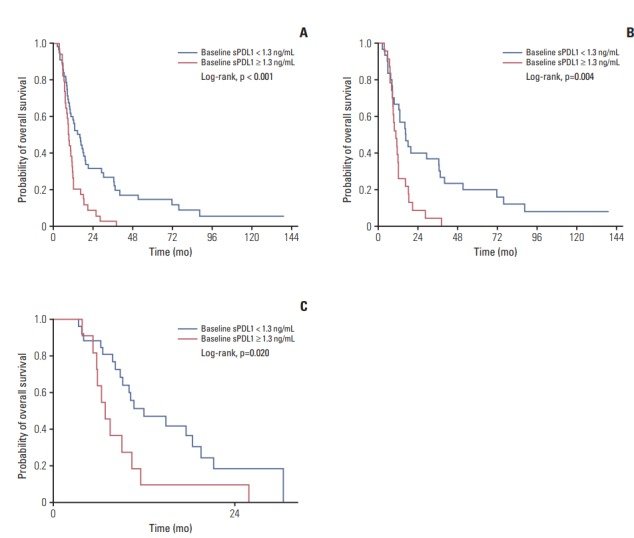
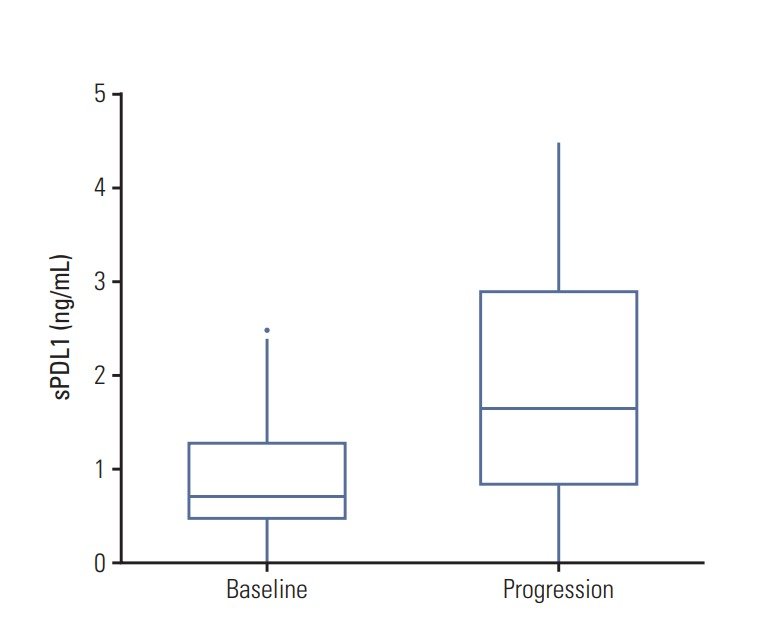
그림 출처: PubMed Central 공개 논문 (PMC6473273)
Conflict of interest statement
Conflict of interest relevant to this article was not reported.
그 밖의 정보
- 출판 형태
- Journal Article
- 저널
- Cancer research and treatment · eISSN 2005-9256
- 전자 출판
- 2018-10-05
- MeSH
- Aged · Antineoplastic Combined Chemotherapy Protocols / therapeutic use · B7-H1 Antigen / blood · Biomarkers · Biomarkers, Tumor* · Female · Humans · Male · Middle Aged · Neoplasms / blood / diagnosis / drug therapy / mortality · Prognosis · Treatment Outcome
- Substances
- B7-H1 Antigen · Biomarkers · Biomarkers, Tumor · CD274 protein, human
- 연구비
- Korea Health Industry Development Institute 06-2016-2920 · Seoul National Hospital 03-2017-0100
- 참고문헌
- 24편