
Cancer Res Treat. 2018;50(2):366-373.
Sub-classification of Advanced-Stage Hepatocellular Carcinoma: A Cohort Study Including 612 Patients Treated with Sorafenib.
제1저자 유정주, 정고은 · 교신저자 이정훈
소속 (5)
- Department of Internal Medicine and Liver Research Institute, Seoul National University College of Medicine, Seoul, Korea.
- Department of Gastroenterology and Hepatology, Soonchunhyang University Bucheon Hospital, Bucheon, Korea.
- Department of Internal Medicine, Healthcare Research Institute, Gangnam Healthcare Center, Seoul National University Hospital, Seoul, Korea.
- Department of Radiology, Seoul National University Hospital, Seoul National University College of Medicine, Seoul, Korea.
- Department of Internal Medicine, Ewha Womans University School of Medicine Liver Center, Ewha Womans University Mokdong Hospital, Seoul, Korea.
Abstract
PURPOSE Advanced hepatocellular carcinoma (HCC) is associated with various clinical conditions including major vessel invasion, metastasis, and poor performance status. The aim of this study was to establish a prognostic scoring system and to propose a sub-classification of the Barcelona-Clinic Liver Cancer (BCLC) stage C.
MATERIALS AND METHODS This retrospective study included consecutive patientswho received sorafenib for BCLC stage C HCC at a single tertiary hospital in Korea. A Cox proportional hazard model was used to develop a scoring system, and internal validationwas performed by a 5-fold cross-validation. The performance of the model in predicting risk was assessed by the area under the curve and the Hosmer-Lemeshow test.
RESULTS A total of 612 BCLC stage C HCC patients were sub- classified into strata depending on their performance status. Five independent prognostic factors (Child-Pugh score, α-fetoprotein, tumor type, extrahepatic metastasis, and portal vein invasion) were identified and used in the prognostic scoring system. This scoring system showed good discrimination (area under the receiver operating characteristic curve, 0.734 to 0.818) and calibration functions (both p < 0.05 by the Hosmer-Lemeshow test at 1 month and 12 months, respectively). The differences in survival among the different risk groups classified by the total score were significant (p < 0.001 by the log-rank test in both the Eastern Cooperative Oncology Group 0 and 1 strata).
CONCLUSION The heterogeneity of patientswith BCLC stage C HCC requires sub-classification of advanced HCC. A prognostic scoring system with five independent factors is useful in predicting the survival of patients with BCLC stage C HCC.
Keywords
Advanced-stageHepatocellular carcinomaPrognosisSorafenib
Figures
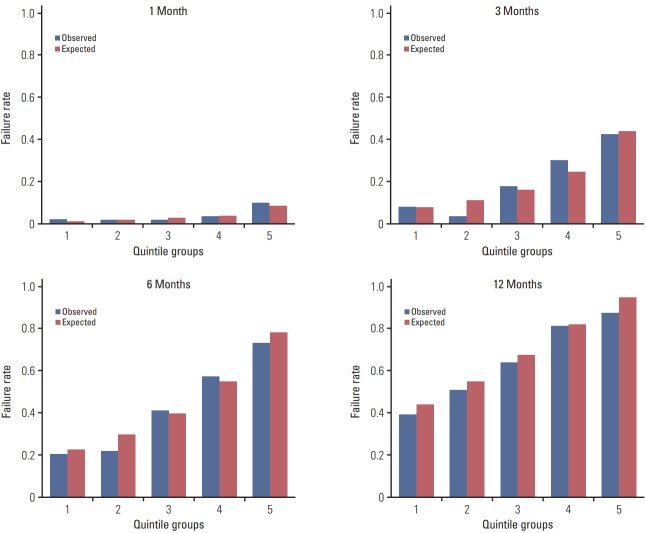
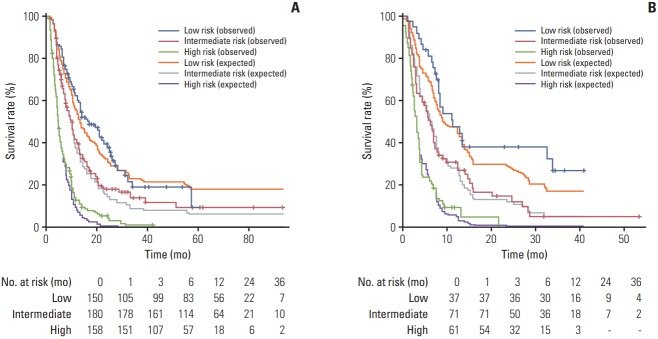
그림 출처: PubMed Central 공개 논문 (PMC5912123)
Conflict of interest statement
Conflict of interest relevant to this article was not reported.
그 밖의 정보
- 출판 형태
- Journal Article
- 저널
- Cancer research and treatment · eISSN 2005-9256
- 전자 출판
- 2017-05-15
- MeSH
- Adult · Aged · Aged, 80 and over · Antineoplastic Agents / pharmacology / therapeutic use · Carcinoma, Hepatocellular / classification / drug therapy / pathology · Cohort Studies · Female · Humans · Liver Neoplasms / classification / drug therapy / pathology · Male · Middle Aged · Niacinamide / analogs & derivatives / pharmacology / therapeutic use · Phenylurea Compounds / pharmacology / therapeutic use · Sorafenib
- Substances
- Antineoplastic Agents · Phenylurea Compounds · Niacinamide · Sorafenib
- 참고문헌
- 30편