Crizotinib in Combination with Everolimus Synergistically Inhibits Proliferation of Anaplastic Lymphoma Kinase‒Positive Anaplastic Large Cell Lymphoma.
Cancer Research Institute, Seoul National University, Seoul, Korea.
Department of Internal Medicine, Seoul National University Bundang Hospital, Seongnam, Korea.
Department of Internal Medicine, Seoul National University Hospital, Seoul, Korea.
Biomedical Research Institute, Seoul National University Hospital, Seoul, Korea.
Abstract
PURPOSE Anaplastic large cell lymphoma (ALCL) is a rare aggresive non-Hodgkin lymphoma, of which over 50% of cases have an aberrant nucleophosmin (NPM)‒anaplastic lymphoma kinase (ALK) fusion protein. Both mechanistic target of rapamycin (mTOR) inhibitor everolimus and ALK inhibitor crizotinib have shown promising antitumor activity in ALK-positive cancer cell lines. However, their combined effect has not yet been investigated.
MATERIALS AND METHODS We evaluated the anti-proliferative effects of everolimus and/or crizotinib in ALK-positive ALCL cell lines, Karpas 299 and SU-DHL-1, and lung adenocarcinoma cell line, NCI-H2228.
RESULTS We found that individually, both everolimus and crizotinib potently inhibited cell growth in a dose-dependent manner in both Karpas 299 and SU-DHL-1 cells. A combination of these agents synergistically inhibited proliferation in the two cell lines. Crizotinib down-regulated aberrant AKT and ERK phosphorylation induced by everolimus. Combination treatment also significantly increased G0/G1 cell-cycle arrest, DNA damage, and apoptosis compared with everolimus or crizotinib alone in ALK-positive ALCL cells. In the Karpas 299 xenograft model, the combination treatment exerted a stronger antitumor effect than monotherapies, without significant change in body weight. The synergistic effect of everolimus and crizotinib was also reproduced in the ALK-positive lung adenocarcinoma cell line NCI-H2228. The combination treatment abrogated phosphoinositide 3-kinase/AKT and mTOR signaling pathways with little effect on the Ras/ERK pathway in NCI-H2228 cells.
CONCLUSION Crizotinib combinedwith everolimus synergistically inhibits proliferation of ALK-positive ALCL cells. Our results suggest that this novel combination is worthy of further clinical development in patients with ALK-positive ALCL.
Keywords
Anaplastic large cell lymphomaAnaplastic lymphoma kinaseCrizotinibEverolimusTOR serine-threonine kinases
Figures
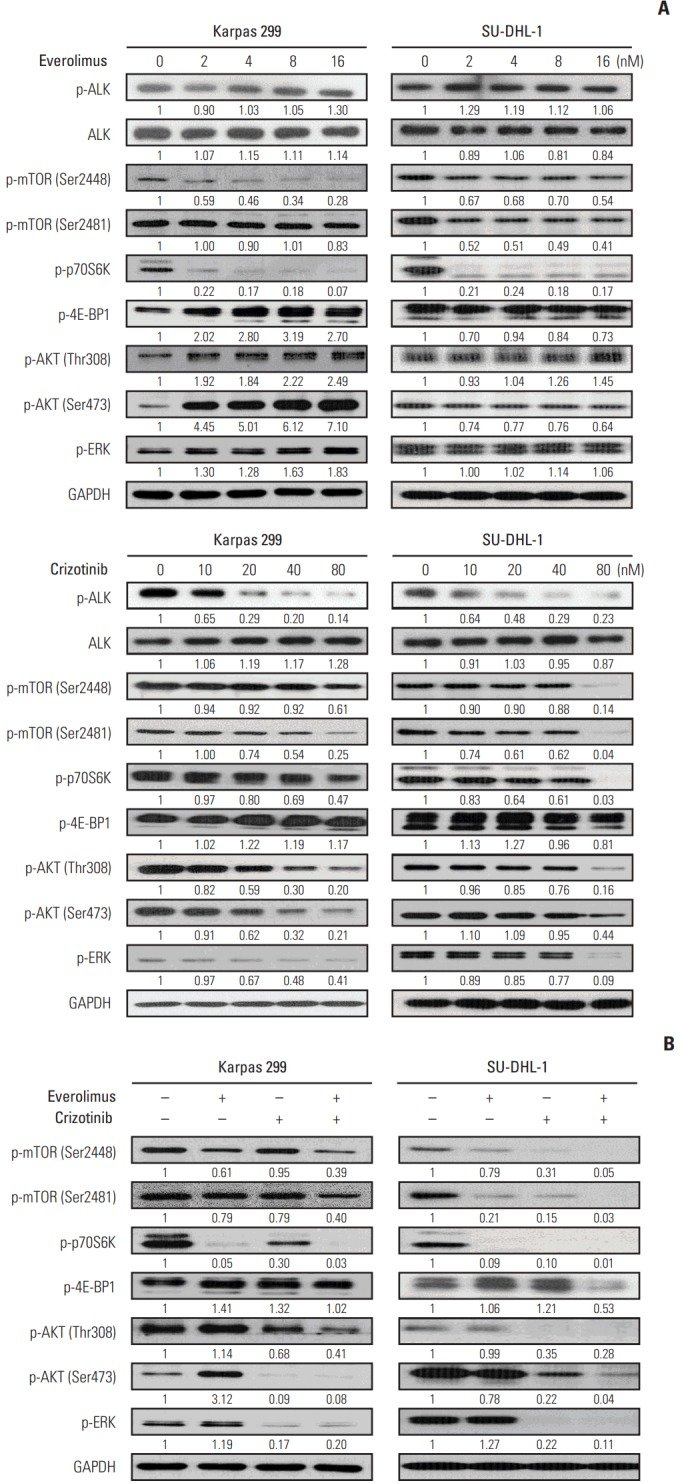
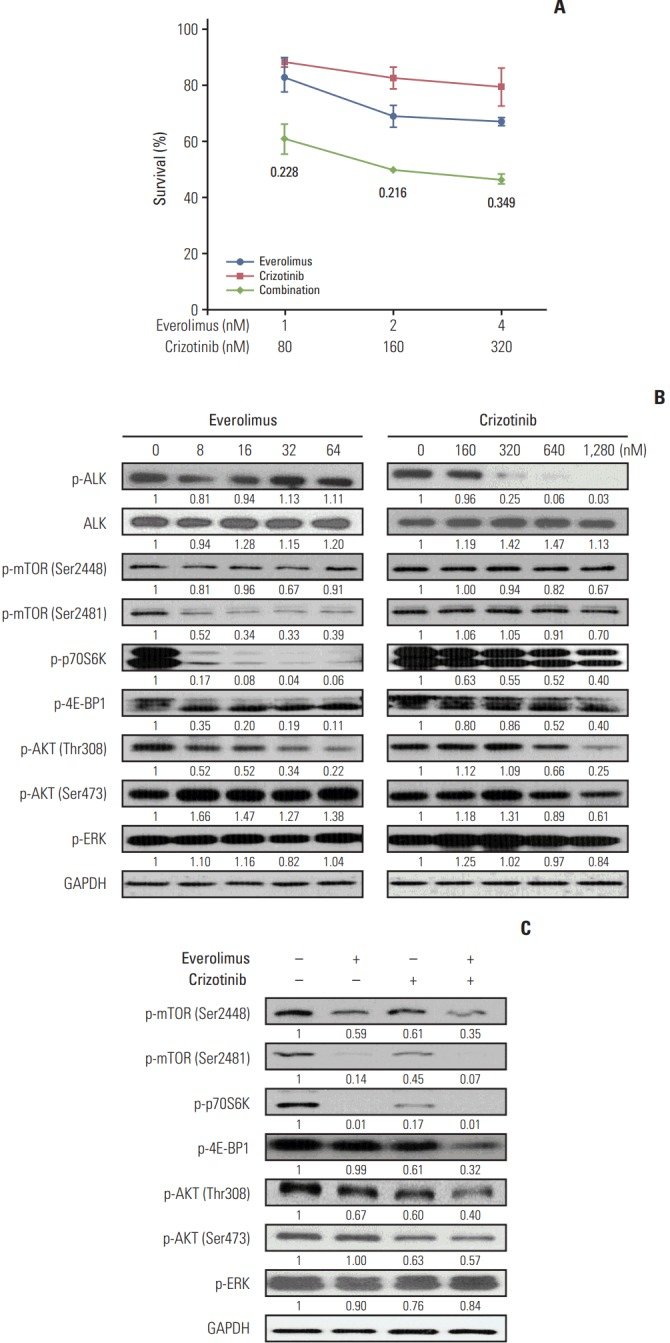
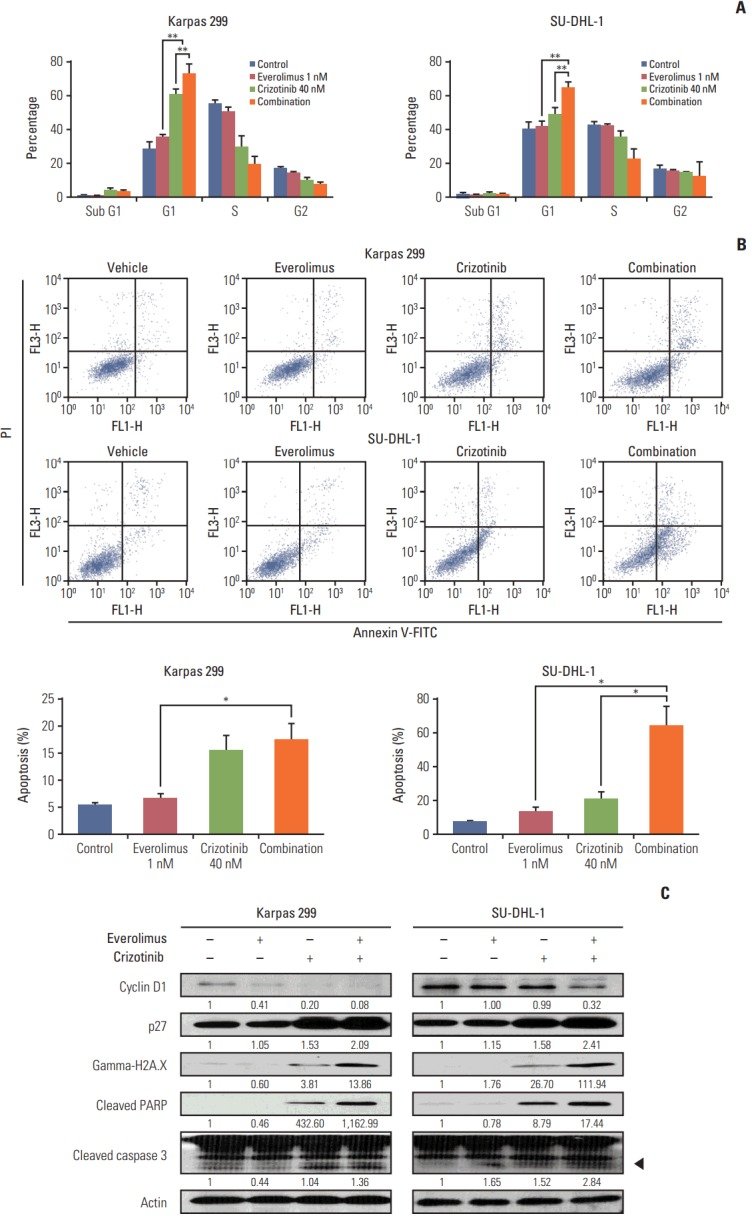
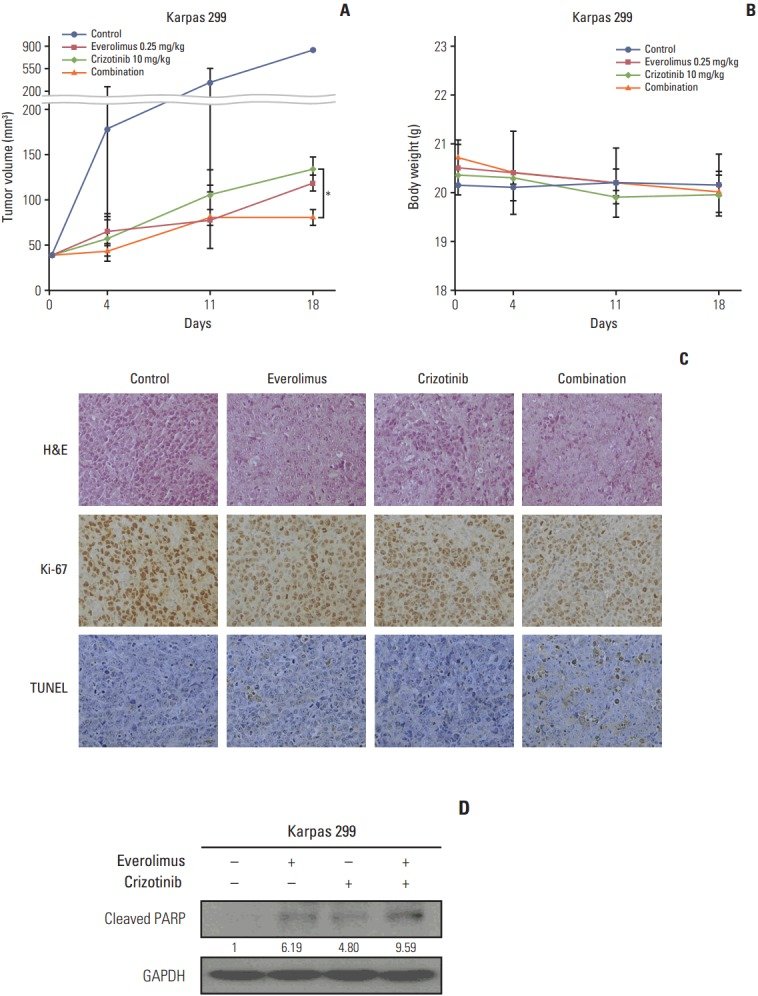
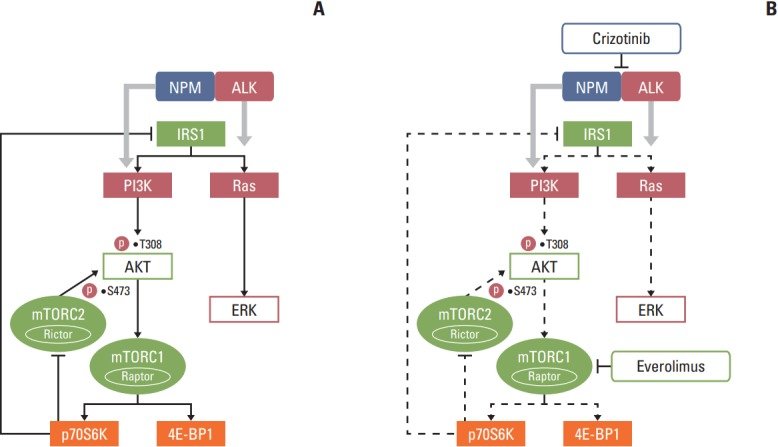
Fig. 1.The cytotoxic effect of everolimus and/or crizotinib on anaplastic lymphoma kinase‒positive anaplastic large cell lymphoma cells. (A) Karpas 299 and SU-DHL-1 cells were treated with increasing concentrations of everolimus or crizotinib for 72 hours. Both everolimus and crizotinib potently inhibited growth in a dose-dependent manner in the two cell lines. (B) Karpas 299 and SU-DHL-1 cells were then incubated with everolimus and/or crizotinib at a fixed ratio of 1:40 for 72 hours. Combination index (CI) values were indicated in the graphs. In all combinations, the CI values are less than 1, indicating synergistic cytotoxic effects of the combination treatment.Fig. 2.The effect of everolimus and/or crizotinib on signaling pathways in anaplastic lymphoma kinase (ALK)‒positive anaplastic large cell lymphoma cells. (A) Karpas 299 and SU-DHL-1 cells were treated with 0-16 nM of everolimus or with 0-80 nM of crizotinib for 24 hours. (B) Karpas 299 and SU-DHL-1 cells were treated with 2 nM everolimus and/or 80 nM crizotinib for 24 hours. The combination treatment more potently inhibited phosphoinositide 3-kinase/AKT, Ras/ERK, and mechanistic target of rapamycin (mTOR) signaling pathways compared with everolimus or crizotinib alone.Fig. 3.Synergistic cytotoxicity of everolimus and crizotinib combination and its effects on signaling pathways in the anaplastic lymphoma kinase (ALK)‒positive lung adenocarcinoma cell line, NCI-H2228. (A) NCI-H2228 cells were treated with everolimus and crizotinib at a fixed ratio of 1:80 for 72 hours. Combination index (CI) values calculated are indicated in the graphs. In all combinations, the CI values were less than 1, indicating synergistic cytotoxic effects of this combination treatment in ALK-positive lung adenocarcinoma cells. (B) To evaluate the effect of everolimus and crizotinib on signaling pathways, NCI-H2228 cells were treated with 0-64 nM of everolimus or with 0-1,280 nM of crizotinib for 24 hours. (C) NCI-H2228 cells were treated with 16 nM everolimus and/or 1,280 nM crizotinib for 24 hours. The combination treatment abrogated phosphorylation of molecules in phosphoinositide 3-kinase/AKT and mechanistic target of rapamycin (mTOR) signaling pathways, while its effects on the Ras/ERK signaling pathway was not apparent.Fig. 4.Cell-cycle arrest and apoptosis induced by everolimus and/or crizotinib in anaplastic lymphoma kinase‒positive anaplastic large cell lymphoma cells. Karpas 299 and SU-DHL-1 cells were treated with 1 nM everolimus and/or 40 nM crizotinib for 72 hours. (A) Cell-cycle distribution was assessed by flow cytometry. The cells were gated to sub-G1, G0/G1, S, and G2 phases according to their DNA contents. The combination of crizotinib and everolimus markedly increased the G0/G1 fraction compared with crizotinib or everolimus alone. **p < 0.01. (B) The cells were stained using Annexin V‒FITC and propidium iodide (PI) for apoptosis analysis by flow cytometry. Annexin V‒positive cells were defined as apoptotic. The data were obtained from three independent experiments. *p < 0.05. (C) Western blot analysis demonstrated that the combination treatment decreased cyclin D1 expression and increased p27 and gamma-H2A.X expression and poly(ADP-ribose) polymerase (PARP) and caspase 3 cleavages.Fig. 5.Effects of everolimus and crizotinib combination on Karpas 299 murine xenografts. Karpas 299 cells were inoculated subcutaneously into mice (n=2 per group). After 3 to 4 weeks, the tumors reached 40 mm3 . Mice were treated with control, everolimus, crizotinib, or combination of both. (A) Tumor volume was monitored weekly from the start of treatment. (B) Body weight after drug administration was monitored weekly. (C) Representative H&E, Ki-67, and terminal deoxynucleotidyl transferase–mediated dUTP nick end (TUNEL) staining in excised tumor of control and everolimus and/or crizotinib treatment group. (D) Western blot analysis revealed that the combination treatment increased poly(ADP-ribose) polymerase (PARP) cleavages in tumor xenograft.Fig. 6.Schematic diagram of signaling pathways in anaplastic lymphoma kinase (ALK)‒positive anaplastic large cell lymphoma (ALCL) cells. (A) Phosphoinositide 3-kinase (PI3K)/AKT and Ras/ERK pathways were activated by the nucleophosmin (NPM)-ALK fusion protein in ALK-positive ALCL cells. (B) Combination treatment of crizotinib and everolimus abrogated the AKT and ERK phosphorylation caused by everolimus.
그림 출처: PubMed Central 공개 논문 (PMC5912135)
Conflict of interest statement
Conflict of interest relevant to this article was not reported.
그 밖의 정보
출판 형태
Journal Article
저널
Cancer research and treatment · eISSN 2005-9256
전자 출판
2017-06-19
MeSH
Anaplastic Lymphoma Kinase · Animals · Crizotinib · Drug Synergism · Everolimus / pharmacology / therapeutic use · Humans · Immunohistochemistry · Lymphoma, Large-Cell, Anaplastic / drug therapy / pathology · Mice · Protein Kinase Inhibitors / pharmacology / therapeutic use · Pyrazoles / pharmacology / therapeutic use · Pyridines / pharmacology / therapeutic use · Receptor Protein-Tyrosine Kinases / drug effects