
Exp Mol Med. 2018;50(7):1-7.
Assessment of genetic factor and depression interactions for asthma symptom severity in cohorts of childhood and elderly asthmatics.
제1저자 박흥우 · 교신저자 박흥우
소속 (8)
- Department of Medicine, Channing Division of Network of Medicine, Brigham and Womens Hospital, Harvard Medical School, Boston, MA, USA. guinea71@snu.ac.kr.
- Department of Internal Medicine, Seoul National University College of Medicine, Seoul, Republic of Korea. guinea71@snu.ac.kr.
- Department of Internal Medicine, Seoul National University College of Medicine, Seoul, Republic of Korea.
- Department of Medicine, Channing Division of Network of Medicine, Brigham and Womens Hospital, Harvard Medical School, Boston, MA, USA.
- Arizona Respiratory Center, University of Arizona, Tucson, AZ, USA.
- Department of Public Health Sciences, Pennsylvania State University College of Medicine, Hershey, PA, USA.
- National Jewish Health, Denver, CO, USA.
- Department of Medicine, Division of Pulmonary and Critical Care Medicine, Brigham and Women's Hospital, Boston, MA, USA.
Abstract
It is well known that depression is associated with asthma symptoms. We assessed the combined effects of genetic factors and depression on asthma symptom severity using Bayesian network (BN) analysis. The common 100 top-ranked single-nucleotide polymorphisms (SNPs) were obtained from two genome-wide association studies of symptom severity in two childhood asthmatics trials (CAMP (Childhood Asthma Management Program) and CARE (Childhood Asthma Research and Education)). Using SNPs plus five discretized variables (depression, anxiety, age, sex, and race), we performed BN analysis in 529 CAMP subjects. We identified two nodes (depression and rs4672619 mapping to ERBB4 (Erb-B2 receptor tyrosine kinase 4)) that were within the Markov neighborhood of the symptom node in the network and then evaluated the interactive effects of depressive status and rs4672619 genotypes on asthma symptom severity. In childhood asthmatics with homozygous reference alleles, severe depression was related to less severe symptoms. However, in childhood asthmatics with heterozygous alleles and homozygous variant alleles, depression and symptom severity showed a positive correlation (interaction permutation P value = 0.019). We then tried to evaluate whether the interactive effects that we found were sustained in another independent cohort of elderly asthmatics. Contrary to the findings from childhood asthmatics, elderly asthmatics with homozygous reference alleles showed a positive correlation between depression and symptom severity, and elderly asthmatics with heterozygous alleles and homozygous variant alleles showed a negative correlation (interaction permutation P value = 0.003). In conclusion, we have identified a novel SNP, rs4672619, that shows interactive effects with depression on asthma symptom severity in childhood and elderly asthmatics in opposite directions.
Figures
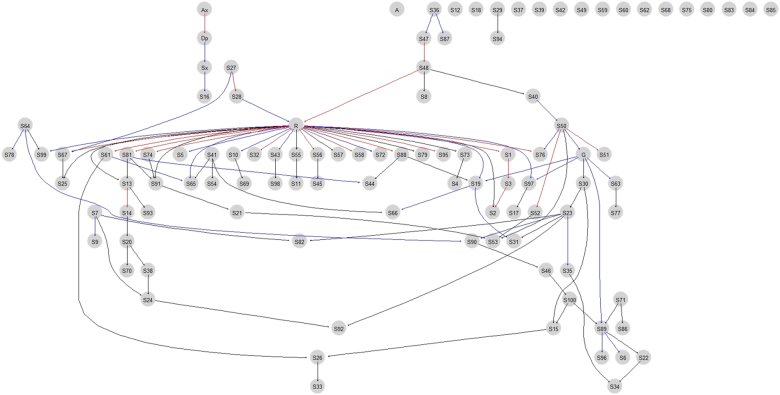
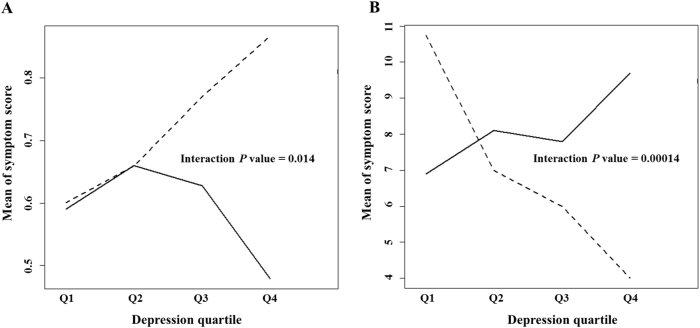
그림 출처: PubMed Central 공개 논문 (PMC6031659)
Conflict of interest statement
The authors declare that they have no conflict of interest.
그 밖의 정보
- 출판 형태
- Journal Article, Research Support, N.I.H., Extramural, Research Support, Non-U.S. Gov't
- 저널
- Experimental & molecular medicine · eISSN 2092-6413
- 전자 출판
- 2018-07-04
- MeSH
- Aged · Asthma / epidemiology / genetics · Child · Depression / epidemiology / genetics · Female · Homozygote · Humans · Male · Polymorphism, Single Nucleotide* · Receptor, ErbB-4 / genetics
- Substances
- ERBB4 protein, human · Receptor, ErbB-4
- 연구비
- NHLBI NIH HHS U01 HL065899 · NINR NIH HHS R01 NR013391 · NIH HHS R01 NR013391 and U01 HL065899 · NIEHS NIH HHS P30 ES006694 · NHLBI NIH HHS R01 HL139634 · NHLBI NIH HHS R01 HL127332 · NHLBI NIH HHS U10 HL064313
- 참고문헌
- 58편