
Cancer Res Treat. 2018;50(3):670-680.
Comparison of Native Escherichia coli L-Asparaginase versus Pegylated Asparaginase, in Combination with Ifosfamide, Methotrexate, Etoposide, and Prednisolone, in Extranodal NK/T-Cell Lymphoma, Nasal Type.
제1저자 옥찬영 · 교신저자 김태민
소속 (5)
- Department of Pharmacy, Seoul National University Hospital, Seoul, Korea.
- Department of Internal Medicine, Seoul National University Hospital, Seoul, Korea.
- Seoul National University Cancer Research Institute, Seoul, Korea.
- College of Pharmacy and Institute of Pharmaceutical Science and Technology, Hanyang University, Guri, Korea.
- Department of Radiation Oncology, Seoul National University Hospital, Seoul, Korea.
Abstract
PURPOSE The aim of this study was to compare asparaginase-related toxicities in two asparaginase preparations, namely native Escherichia coli L-asparaginase (L-ASP) and pegylated asparaginase (PEG-ASP) in combination with ifosfamide, methotrexate, etoposide, and prednisolone (IMEP) in natural killer (NK)/T-cell lymphoma (NTCL).
MATERIALS AND METHODS A total of 41 NTCL patients who received IMEP plus native E. coli L-ASP or PEG-ASP at Seoul National University Hospital were included in this study between January 2013 and March 2016. IMEP/ASP treatment consisted of ifosfamide, methotrexate, etoposide, plus native E. coli L-ASP (6,000 IU/m2 on days 1, 3, 5, 7, 9, and 11) or PEG-ASP (2,500 IU/m2 on day 1) every 3 weeks. ASP-related toxicities, toxicity patterns, length of hospital stay, and clinical outcomes were compared between the different treatment groups.
RESULTS The frequency of ASP-related toxicities was similar between the IMEP plus native E. coli L-ASP group and the PEG-ASP group apart from hypofibrinogenemia (native E. coli L-ASP vs. PEG-ASP group, 86.4% vs. 36.8%; p=0.001). Although post-treatment transaminase and albumin levels were significantly high and low, respectively, hepatotoxicity gradients before and after treatment did not differ significantly between the groups. Since PEG-ASP was given at an outpatient clinic in some patients, length of hospital stay was significantly shorter in the IMEP plus PEG-ASP group (median, 4.0 vs. 6.0 days; p=0.002). A favorable tendency of clinical outcomes was observed in NTCL patients treated with IMEP plus PEG-ASP (complete remission rate, 73.7% vs. 45.5%; p=0.067).
CONCLUSION IMEP plus PEG-ASP showed similar ASP-related toxicities, shorter length of hospital stay, and a trend towards improved clinical outcomes compared with IMEP plus native E. coli L-ASP in NTCL.
Keywords
Length of stayNative Escherichia coli L-asparaginasePegylated asparaginaseToxicityNK/T-cell lymphoma
Figures

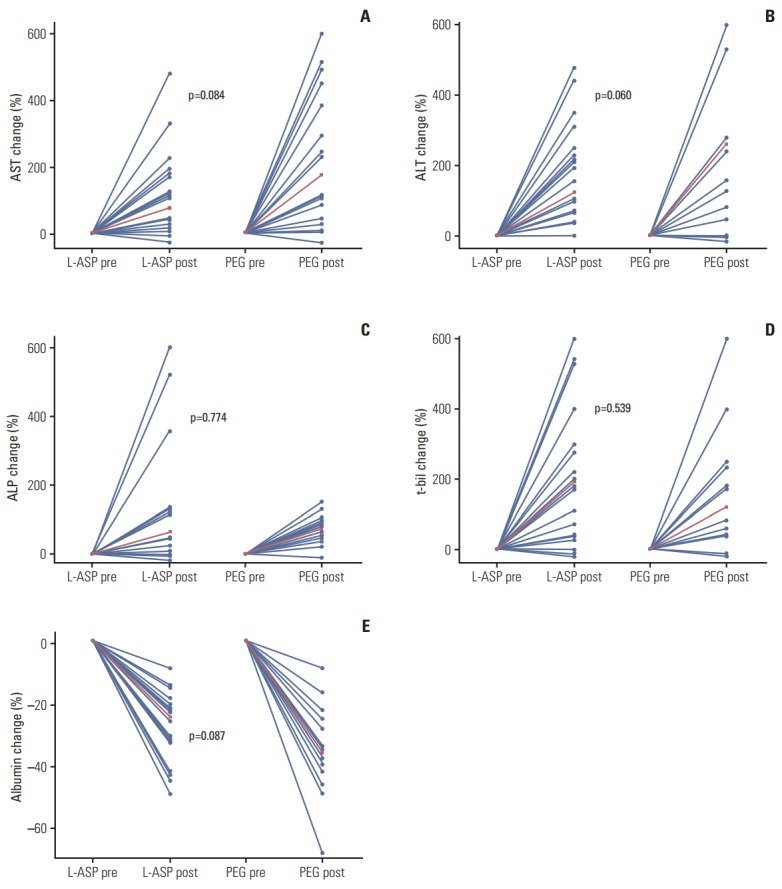
그림 출처: PubMed Central 공개 논문 (PMC6056977)
Conflict of interest statement
Conflict of interest relevant to this article was not reported.
그 밖의 정보
- 출판 형태
- Comparative Study, Journal Article
- 저널
- Cancer research and treatment · eISSN 2005-9256
- 전자 출판
- 2017-07-03
- MeSH
- Aged · Antineoplastic Combined Chemotherapy Protocols / administration & dosage / therapeutic use · Asparaginase / administration & dosage / adverse effects · Escherichia coli / enzymology · Etoposide / administration & dosage / therapeutic use · Female · Humans · Ifosfamide / administration & dosage / therapeutic use · Length of Stay · Lymphoma, Extranodal NK-T-Cell / drug therapy · Male · Methotrexate / administration & dosage / therapeutic use · Middle Aged · Polyethylene Glycols / administration & dosage / adverse effects · Prednisolone / administration & dosage / therapeutic use · Treatment Outcome
- Substances
- Polyethylene Glycols · Etoposide · pegaspargase · Prednisolone · Asparaginase · Ifosfamide · Methotrexate
- 참고문헌
- 29편