
Exp Mol Med. 2017;49(7):e356.
Findings of a 1303 Korean whole-exome sequencing study.
제1저자 곽수헌, 채지수 · 교신저자 박경수, 김종일
소속 (10)
- Department of Internal Medicine, Seoul National University Hospital, Seoul, Korea.
- Department of Biochemistry and Molecular Biology, Seoul National University College of Medicine, Seoul, Korea.
- Department of Biomedical Sciences, Seoul National University College of Medicine, Seoul, Korea.
- Biomedical Research Institute, Seoul National University Hospital, Seoul, Korea.
- Department of Pediatrics, Seoul National University College of Medicine, Seoul, Korea.
- Green Cross Genome, Yongin, Korea.
- Korean Hemophilia Foundation, Seoul, Korea.
- Cancer Research Institute, Seoul National University College of Medicine, Seoul, Korea.
- Department of Internal Medicine, Seoul National University College of Medicine, Seoul, Korea.
- Department of Molecular Medicine and Biopharmaceutical Sciences, Graduate School of Convergence Science and Technology, Seoul National University, Seoul, Korea.
Abstract
Ethnically specific data on genetic variation are crucial for understanding human biology and for clinical interpretation of variant pathogenicity. We analyzed data obtained by deep sequencing 1303 Korean whole exomes; the data were generated by three independent whole exome sequencing projects (named the KOEX study). The primary focus of this study was to comprehensively analyze the variant statistics, investigate secondary findings that may have clinical actionability, and identify loci that should be cautiously interpreted for pathogenicity. A total of 495 729 unique variants were identified at exonic regions, including 169 380 nonsynonymous variants and 4356 frameshift insertion/deletions. Among these, 76 607 were novel coding variants. On average, each individual had 7136 nonsynonymous single-nucleotide variants and 74 frameshift insertion/deletions. We classified 13 pathogenic and 13 likely pathogenic variants in 56 genes that may have clinical actionability according to the guidelines of the American College of Medical Genetics and Genomics, and the Association for Molecular Pathology. The carrier frequency of these 26 variants was 2.46% (95% confidence interval 1.73-3.46). To identify loci that require cautious interpretation in clinical sequencing, we identified 18 genes that are prone to sequencing errors, and 671 genes that are highly polymorphic and carry excess nonsynonymous variants. The catalog of identified variants, its annotation and frequency information are publicly available (http://koex.snu.ac.kr). These findings should be useful resources for investigating ethnically specific characteristics in human health and disease.
Figures
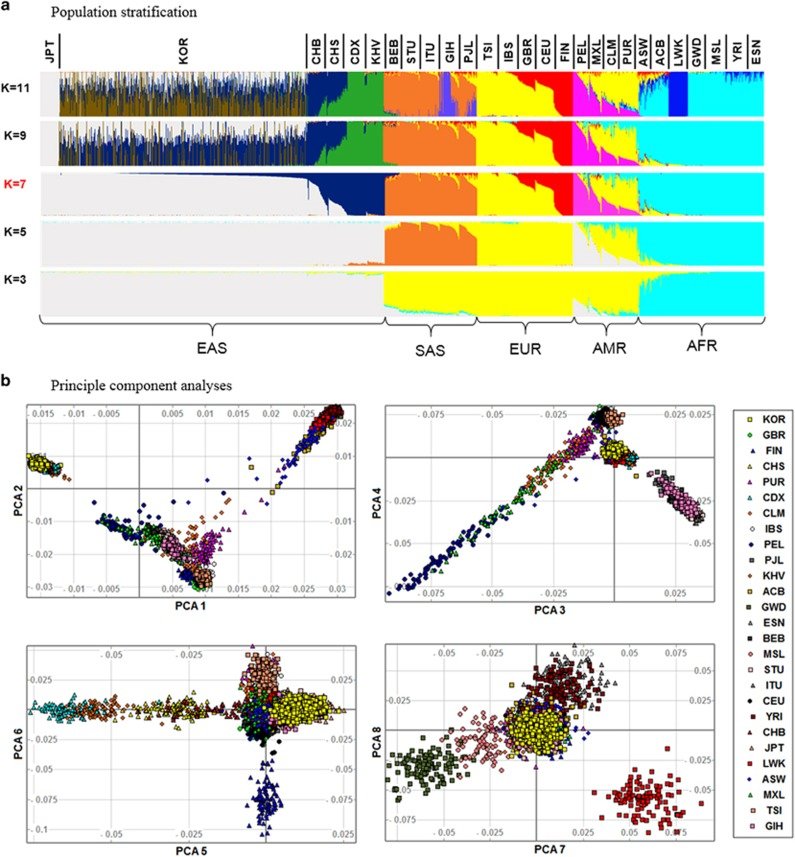
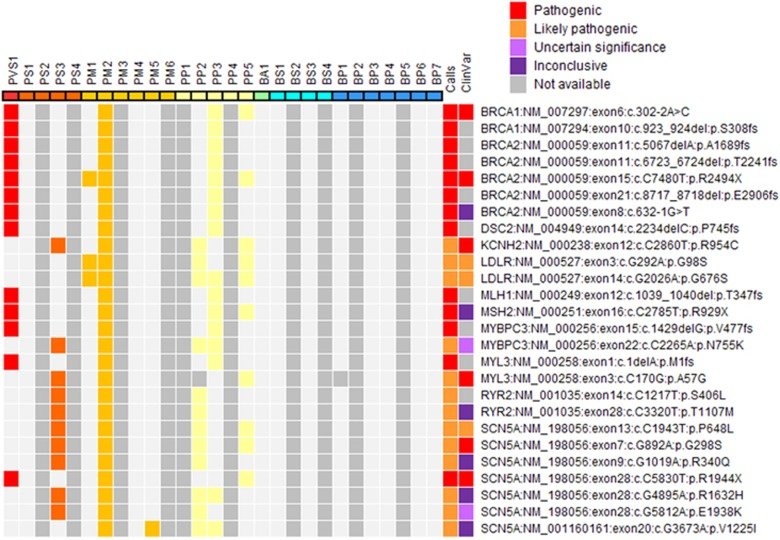
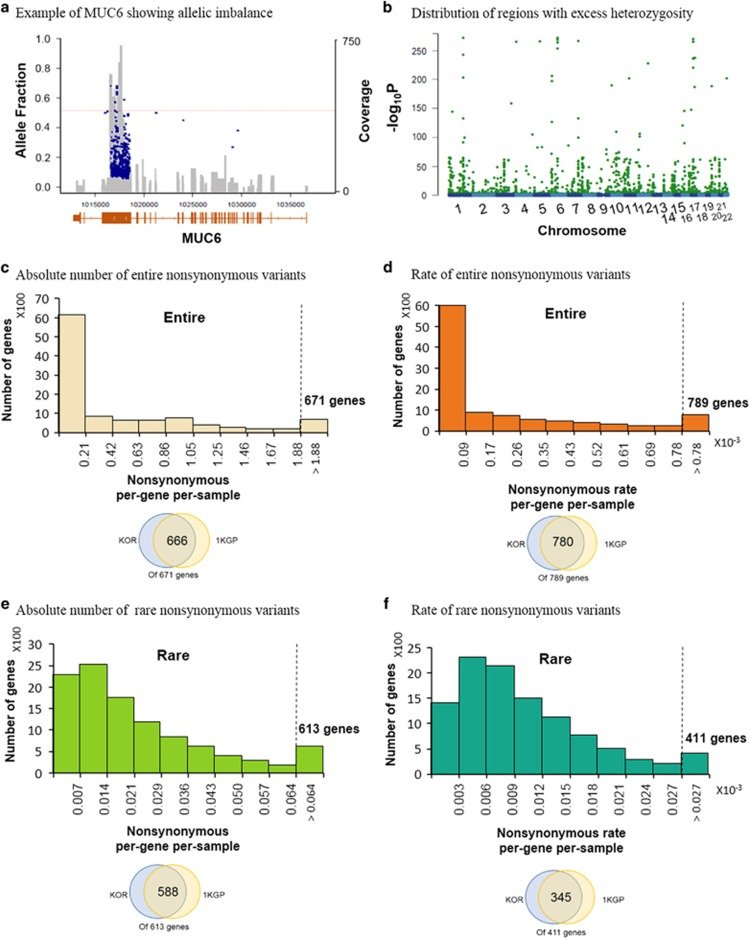
그림 출처: PubMed Central 공개 논문 (PMC5565953)
Conflict of interest statement
The authors declare no conflict of interest.
그 밖의 정보
- 출판 형태
- Journal Article
- 저널
- Experimental & molecular medicine · eISSN 2092-6413
- 전자 출판
- 2017-07-14
- MeSH
- Asian People / genetics · Data Interpretation, Statistical · Exome / genetics · Female · Frameshift Mutation · Genetic Loci · Genetic Variation* · High-Throughput Nucleotide Sequencing · Humans · Male · Polymorphism, Single Nucleotide · Republic of Korea · Exome Sequencing*
- 참고문헌
- 31편