
Cancer Res Treat. 2017;49(4):1153-1163.
Bilateral Salpingo-oophorectomy Compared to Gonadotropin-Releasing Hormone Agonists in Premenopausal Hormone Receptor-Positive Metastatic Breast Cancer Patients Treated with Aromatase Inhibitors.
제1저자 서경진 · 교신저자 김지현
소속 (8)
- Department of Internal Medicine, Seoul National University Bundang Hospital, Seoul National University College of Medicine, Seongnam, Korea.
- Department of Internal Medicine, Seoul National University Hospital, Seoul National University College of Medicine, Seoul, Korea.
- Cancer Research Institute, Seoul National University College of Medicine, Seoul, Korea.
- Department of Surgery and Seoul National University Bundang Hospital, Seoul National University College of Medicine, Seongnam, Korea.
- Department of 5Obstetrics and Gynecology, Seoul National University Bundang Hospital, Seoul National University College of Medicine, Seongnam, Korea.
- Department of Obstetrics and Gynecology, Seoul National University Bundang Hospital, Seoul National University College of Medicine, Seongnam, Korea.
- Department of Surgery and Seoul National University Hospital, Seoul National University College of Medicine, Seoul, Korea.
- Department of Obstetrics and Gynecology, Seoul National University Hospital, Seoul National University College of Medicine, Seoul, Korea.
Abstract
PURPOSE Although combining aromatase inhibitors (AI) with gonadotropin-releasing hormone agonists (GnRHa) is becoming more common, it is still not clear if GnRHa is as effective as bilateral salpingo-oophorectomy (BSO).
MATERIALS AND METHODS We retrospectively analyzed data of 66 premenopausal patients with hormone receptor- positive, human epidermal growth factor receptor 2-negative recurrent and metastatic breast cancer who had been treated with AIs in combination with GnRHa or BSO between 2002 and 2015.
RESULTS The median patient age was 44 years. Overall, 24 (36%) received BSO and 42 (64%) received GnRHa. The clinical benefit rate was higher in the BSO group than in the GnRHa group (88% vs. 69%, p=0.092). Median progression-free survival (PFS) was longer in the BSO group, although statistical significance was not reached (17.2 months vs. 13.3 months, p=0.245). When propensity score matching was performed, the median PFS was 17.2 months for the BSO group and 8.2 months for the GnRHa group (p=0.137). Multivariate analyses revealed that the luminal B subtype (hazard ratio, 1.67; 95% confidence interval [CI], 1.08 to 2.60; p=0.022) and later-line treatment (≥ third line vs. first line; hazard ratio, 3.24; 95% CI, 1.59 to 6.59; p=0.001) were independent predictive factors for a shorter PFS. Incomplete ovarian suppression was observed in a subset of GnRHa-treated patients whose disease showed progression, with E2 levels higher than 21 pg/mL.
CONCLUSION Both BSO and GnRHa were found to be effective in our AI-treated premenopausal metastatic breast cancer patient cohort. However, further studies in larger populations are needed to determine if BSO is superior to GnRHa.
Keywords
Aromatase inhibitorsBreast neoplasmsGonadotropin-releasing hormoneOvariectomyPremenopause
Figures
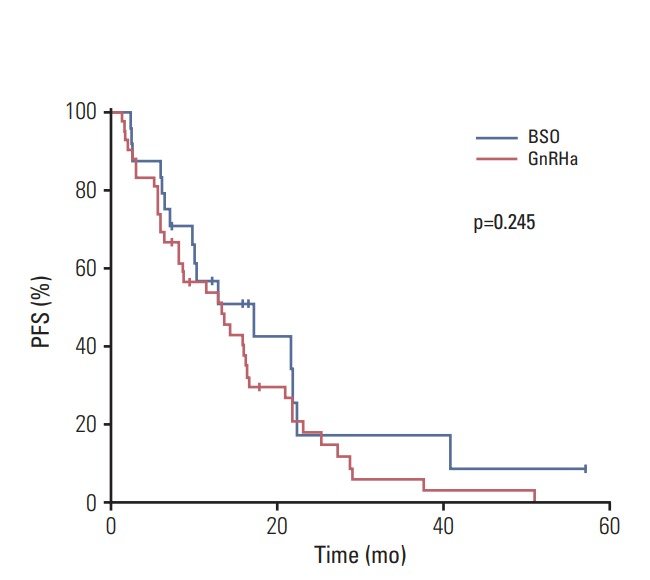
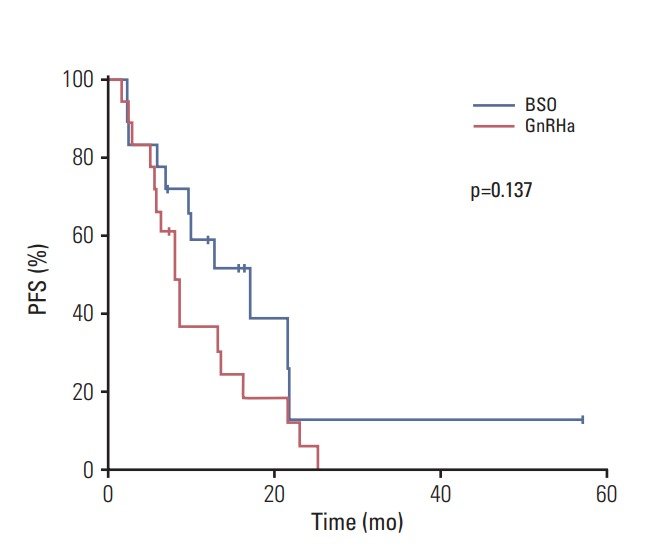
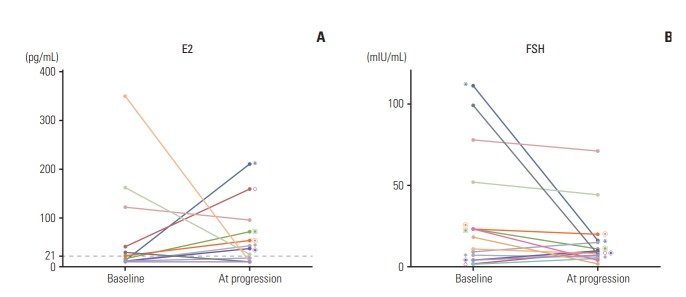
그림 출처: PubMed Central 공개 논문 (PMC5654164)
Conflict of interest statement
T.Y. Kim has received a speaker honorarium from Roche. S.A. Im received a research fund from AstraZeneca, and has uncompensated advisory roles for Novartis, Spectrum and Hanmi. None of the other authors have any potential conflicts of interest.
그 밖의 정보
- 출판 형태
- Journal Article
- 저널
- Cancer research and treatment · eISSN 2005-9256
- 전자 출판
- 2017-02-27
- MeSH
- Adult · Antineoplastic Agents, Hormonal / administration & dosage / adverse effects / therapeutic use · Aromatase Inhibitors / administration & dosage / adverse effects / therapeutic use · Breast Neoplasms / metabolism / mortality / pathology / therapy · Combined Modality Therapy / adverse effects / methods · Female · Follow-Up Studies · Gonadotropin-Releasing Hormone / agonists · Humans · Kaplan-Meier Estimate · Middle Aged · Premenopause* · Propensity Score · Receptors, Estrogen / metabolism · Receptors, Progesterone / metabolism · Retrospective Studies · Salpingo-oophorectomy* / adverse effects / methods · Treatment Outcome · Young Adult
- Substances
- Antineoplastic Agents, Hormonal · Aromatase Inhibitors · Receptors, Estrogen · Receptors, Progesterone · Gonadotropin-Releasing Hormone
- 참고문헌
- 30편