
Cancer Res Treat. 2017;49(1):129-140.
Post-bevacizumab Clinical Outcomes and the Impact of Early Discontinuation of Bevacizumab in Patients with Recurrent Malignant Glioma.
제1저자 차용준, 김유정 · 교신저자 이세훈
소속 (9)
- Department of Internal Medicine, Seoul National University Hospital, Seoul, Korea.
- Department of Internal Medicine, Seoul National University Bundang Hospital, Seongnam, Korea.
- Division of Hematology/Oncology, Department of Medicine, Samsung Medical Center, Sungkyunkwan University School of Medicine, Seoul, Korea.
- Department of Radiology, Seoul National University Hospital, Seoul, Korea.
- Department of Neurosurgery, Seoul National University Hospital, Seoul, Korea.
- Department of Radiation Oncology, Seoul National University Hospital, Seoul, Korea.
- Department of Radiology, Seoul National University Bundang Hospital, Seongnam, Korea.
- Department of Neurosurgery, Seoul National University Bundang Hospital, Seongnam, Korea.
- Department of Radiation Oncology, Seoul National University Bundang Hospital, Seongnam, Korea.
Abstract
PURPOSE Bevacizumab±irinotecan is effective for treatment of recurrent malignant gliomas. However, the optimal duration of treatment has not been established.
MATERIALS AND METHODS Ninety-four consecutive patients with recurrent malignant glioma who were treated with bevacizumab at our institutions were identified. Patients who continued bevacizumab until tumor progression were enrolled in a late discontinuation (LD) group, while those who stopped bevacizumab before tumor progression were enrolled in an early discontinuation (ED) group. Landmark analyses were performed at weeks 9, 18, and 26 for comparison of patient survival between the two groups.
RESULTS Among 89 assessable patients, 62 (69.7%) and 27 (30.3%) patients were categorized as the LD and ED groups, respectively. According to landmark analysis, survival times from weeks 9, 18, and 26 were not significantly different between the two groups in the overall population. However, the LD group showed a trend toward increased survival compared to the ED group among responders. In the ED group, the median time from discontinuation to disease progression was 11.4 weeks, and none of the patients showed a definite rebound phenomenon. Similar median survival times after disease progression were observed between groups (14.4 weeks vs. 15.7 weeks, p=0.251). Of 83 patients, 38 (45.8%) received further therapy at progression, and those who received further therapy showed longer survival in both the LD and ED groups.
CONCLUSION In recurrent malignant glioma, duration of bevacizumab was not associated with survival time in the overall population. However, ED of bevacizumab in responding patients might be associated with decreased survival.
Keywords
BevacizumabGlioblastomaGliomaHigh-grade glioma
Figures
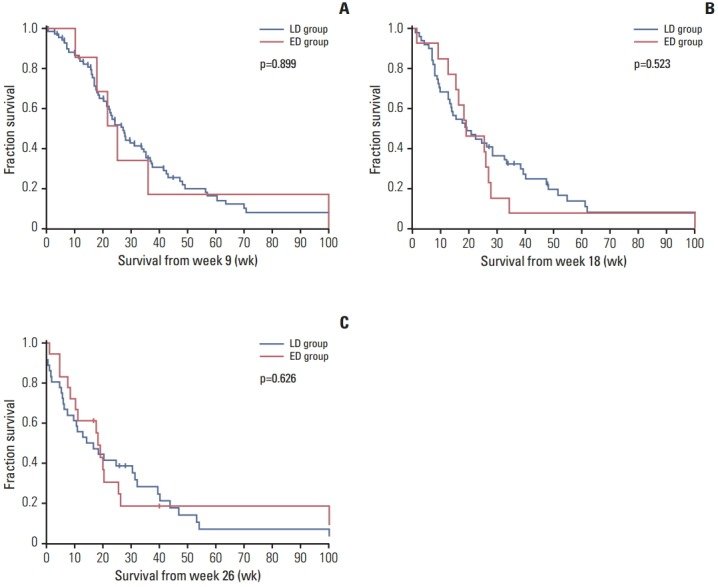
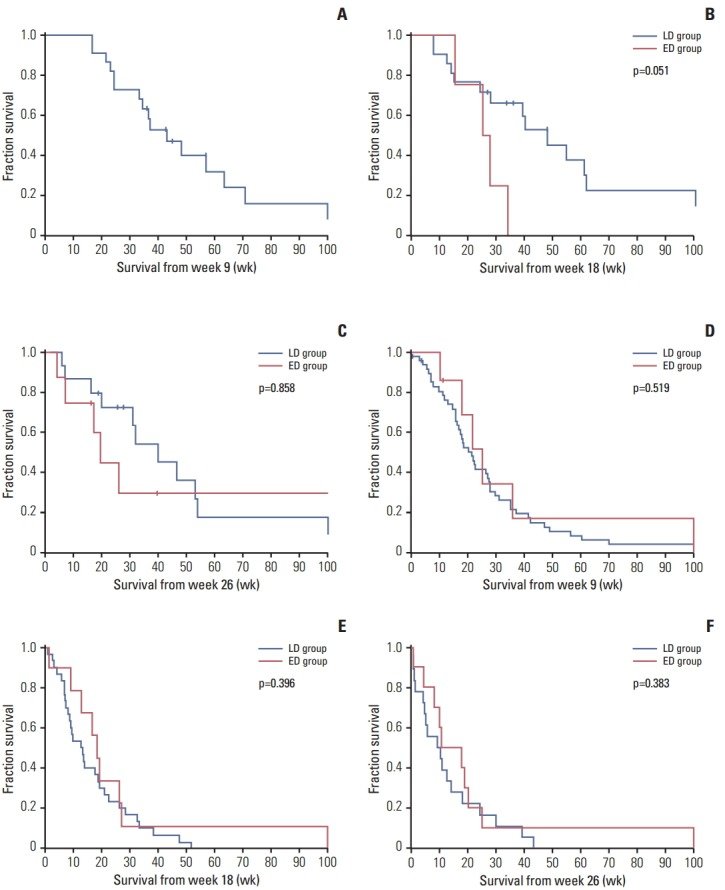
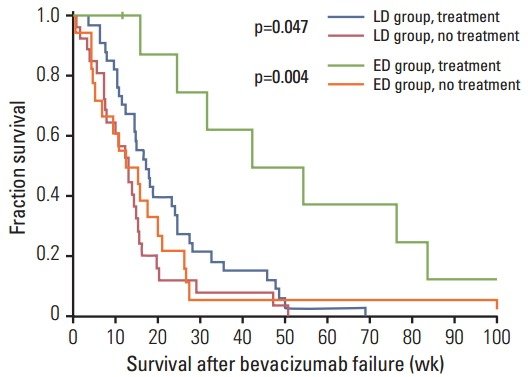
그림 출처: PubMed Central 공개 논문 (PMC5266387)
Conflict of interest statement
relevant to this article was not reported.
그 밖의 정보
- 출판 형태
- Journal Article
- 저널
- Cancer research and treatment · eISSN 2005-9256
- 전자 출판
- 2016-05-18
- MeSH
- Adult · Aged · Angiogenesis Inhibitors / administration & dosage / adverse effects / therapeutic use · Antineoplastic Agents, Immunological / administration & dosage / adverse effects / therapeutic use · Antineoplastic Combined Chemotherapy Protocols / therapeutic use · Bevacizumab / administration & dosage / adverse effects / therapeutic use · Camptothecin / administration & dosage / analogs & derivatives · Combined Modality Therapy · Female · Follow-Up Studies · Glioma / diagnostic imaging / drug therapy / mortality / pathology · Humans · Irinotecan · Kaplan-Meier Estimate · Magnetic Resonance Imaging / methods · Male · Middle Aged · Neoplasm Grading · Neoplasm Recurrence, Local · Time Factors · Treatment Outcome · Young Adult
- Substances
- Angiogenesis Inhibitors · Antineoplastic Agents, Immunological · Bevacizumab · Irinotecan · Camptothecin
- 참고문헌
- 25편