
Cancer Res Treat. 2016;48(1):88-97.
Gefitinib-Induced Interstitial Lung Disease in Korean Lung Cancer Patients.
제1저자 범승훈 · 교신저자 김동완
소속 (2)
- Department of Internal Medicine, Seoul National University Hospital, Seoul, Korea.
- Department of Internal Medicine, Seoul National University Hospital, Seoul, Korea ; Cancer Research Institute, Seoul National University College of Medicine, Seoul, Korea.
Abstract
PURPOSE Interstitial lung disease (ILD) is a serious adverse effect of gefitinib. We examined the incidence and clinical characteristics of drug-induced ILD in Korean non-small cell lung carcinoma patients treated with gefitinib.
MATERIALS AND METHODS A retrospective cohort study was performed in non-small cell lung cancer (NSCLC) patients who started gefitinib treatment at Seoul National University Hospital from January 2002 through December 2011. Patients who developed new abnormal radiologic findings with respiratory symptoms after gefitinib treatment were defined as having possible adverse pulmonary reactions. The patients' medical records were reviewed independently by investigators to identify the causes of pulmonary toxicities.
RESULTS Among the 1,114 patients evaluated, 128 patients (11.5%) developed pulmonary adverse reactions after taking gefitinib. An infectious complication occurred in 98 patients (8.8%) and 15 patients (1.3%) developed ILD. Nine of the 15 patients (60.0%) with gefitinib-induced ILD experienced a fatal clinical course that met either the Common Terminology Criteria for Adverse Events grade 4 (n=3) or grade 5 (n=6). In the multivariate analysis, a lower serum albumin level (≤ 3.0 g/dL) at baseline was significantly associated with the development of gefitinib-induced ILD (odds ratio, 3.91; 95% confidence interval, 1.20 to 12.71).
CONCLUSION The incidence of gefitinib-induced ILD in Korean NSCLC patients was similar to that reported worldwide, but lower than values reported for Japanese population. ILD was usually a life-threatening adverse effect of gefitinib, and the development of ILD was significantly associated with a lower baseline serum albumin level.
Keywords
Drug-related side effects and adverse reactionsGefitinibInterstitial lung diseasesLung injuryLung neoplasms
Figures
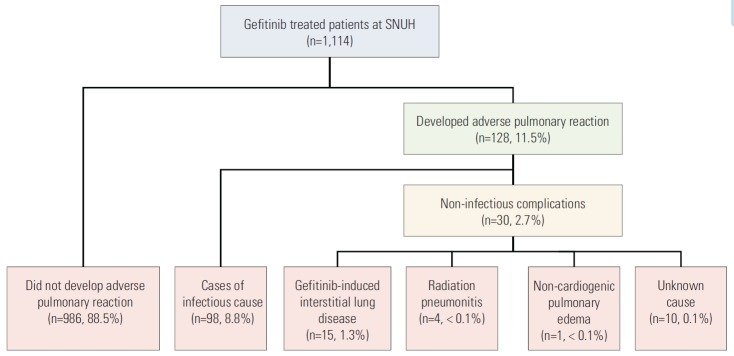
그림 출처: PubMed Central 공개 논문 (PMC4720097)
Conflict of interest statement
Conflict of interest relevant to this article was not reported.
그 밖의 정보
- 출판 형태
- Journal Article
- 저널
- Cancer research and treatment · eISSN 2005-9256
- 전자 출판
- 2015-03-03
- MeSH
- Antineoplastic Agents / adverse effects / therapeutic use · Carcinoma, Non-Small-Cell Lung / drug therapy · Gefitinib · Humans · Lung Diseases, Interstitial / chemically induced · Lung Neoplasms / drug therapy · Quinazolines / adverse effects / therapeutic use · Retrospective Studies · Seoul
- Substances
- Antineoplastic Agents · Quinazolines · Gefitinib
- 참고문헌
- 25편