
EClinicalMedicine. 2026;91:103698.
Abbreviated dual antiplatelet therapy after percutaneous coronary intervention with ultrathin-strut drug-eluting stents in South Korea: 3-year outcomes of the multicentre, randomised HOST-IDEA trial.
제1저자 한정규, 황도연 · 교신저자 김효수, 이남호
소속 (14)
- Cardiovascular Center, Seoul National University Hospital, Seoul, Republic of Korea.
- Department of Internal Medicine, College of Medicine, Seoul National University, Seoul, Republic of Korea.
- Department of Internal Medicine, Keimyung University Dongsan Hospital, Daegu, Republic of Korea.
- Division of Cardiology, Department of Internal Medicine, Kyung Hee University Hospital, Seoul, Republic of Korea.
- Department of Cardiology, Cardiovascular Center, Seoul Medical Center, Seoul, Republic of Korea.
- Department of Internal Medicine, Daejeon Eulji Medical Center, Eulji University School of Medicine, Daejeon, Republic of Korea.
- Division of Cardiology, Department of Internal Medicine, Gachon University Gil Hospital, Incheon, Republic of Korea.
- Division of Cardiology, Department of Internal Medicine, Boramae Medical Center, Seoul National University College of Medicine, Seoul, Republic of Korea.
- Department of Cardiology, Seoul Hospital, Ewha Womans University College of Medicine, Seoul, Republic of Korea.
- Department of Internal Medicine, Dong-A University College of Medicine, Busan, Republic of Korea.
- Division of Cardiology, Department of Internal Medicine, Soonchunhyang University Cheonan Hospital, Cheonan, Republic of Korea.
- Cardiovascular Center, Guro Hospital Korea University, Seoul, Republic of Korea.
- Department of Internal Medicine, Hallym University Kangnam Sacred Heart Hospital, Seoul, Republic of Korea.
- Seoul National University Hospital, Republic of Korea.
Abstract
BACKGROUND The HOST-IDEA trial demonstrated non-inferiority of 3-to-6-month dual antiplatelet therapy (DAPT) to 12-month DAPT for net adverse clinical event (NACE) at 1 year in patients undergoing percutaneous coronary intervention (PCI) with third-generation drug-eluting stents (DES). We evaluated the long-term outcomes of abbreviated antiplatelet therapy following PCI with third-generation DES.
METHODS In the open-label, adjudicator-blinded, multicentre, randomised HOST-IDEA trial, 2013 patients from 37 hospitals in South Korea were randomly allocated to 3-to-6-month (n = 1002) or 12-month (n = 1011) DAPT between January 2016 and May 2021. The primary outcome was NACE at 3 years, comprising cardiac death, target vessel myocardial infarction (TVMI), clinically driven target lesion revascularisation (CD-TLR), stent thrombosis, and major bleeding (Bleeding Academic Research Consortium type 3 or 5). Major secondary outcomes were target lesion failure (TLF)-comprising cardiac death, TVMI, and CD-TLR-and major bleeding at 3 years. To evaluate the efficacy and safety of >1-year DAPT, patients event-free at 1 year were classified into >1-year and ≤1-year DAPT groups and matched using a propensity score. These 3-year clinical outcomes were prespecified in the published protocol as mandatory clinical follow-up. HOST-IDEA is registered with ClinicalTrials.gov, NCT02601157.
FINDINGS At 3 years, clinical follow-up was completed in 955 patients (95.3%) and 966 patients (95.5%) in the 3-to-6-month and 12-month DAPT groups, respectively. The median follow-up duration was 1095 days (IQR 1095-1095). The primary outcome occurred in 7.7% and 8.2% of patients in the 3-to-6-month and 12-month DAPT groups, respectively (HR 0.94; 95% CI 0.69-1.29; P = 0.71). The risks of TLF (HR 0.92; 95% CI 0.62-1.36; P = 0.66) and major bleeding (HR 0.96; 95% CI 0.59-1.56; P = 0.88) were comparable between the two groups. Among patients who were event-free at 1 year, 583 remained on DAPT, while 1259 switched to single antiplatelet therapy within the 1 year. In the matched cohort, there was some evidence of a higher risk of TLF in the >1-year DAPT group (HR 2.56; 95% CI 0.99-6.60; P = 0.05), whereas major bleeding risk was significantly higher with >1-year DAPT (HR 4.44; 95% CI 1.26-15.57; P = 0.02).
INTERPRETATION 3-to-6-month and 12-month DAPT showed comparable 3-year clinical outcomes in patients undergoing PCI with third-generation DES. However, extending DAPT beyond 1 year was associated with increased major bleeding without additional ischemic benefits. Further studies are warranted to validate these findings and identify patient subsets who may benefit from extended DAPT.
FUNDING Biotronik Korea (Seongnam si, Gyeonggi-do, South Korea) and B. Braun Korea (Seoul, South Korea).
© 2025 The Authors.
Keywords
Dual antiplatelet therapyLong-termOutcomePercutaneous coronary intervention
Figures
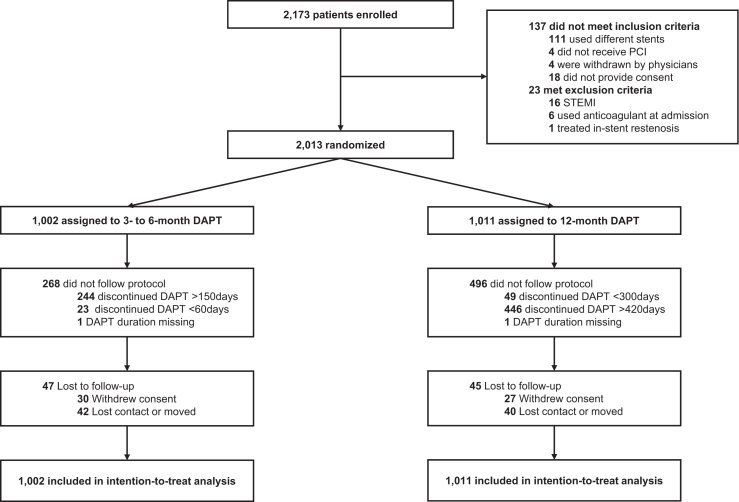
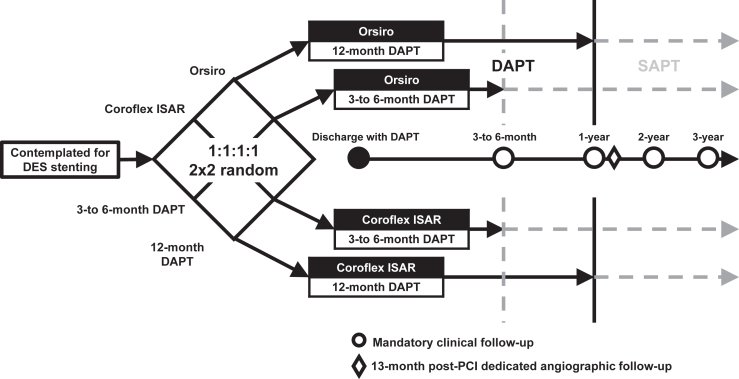
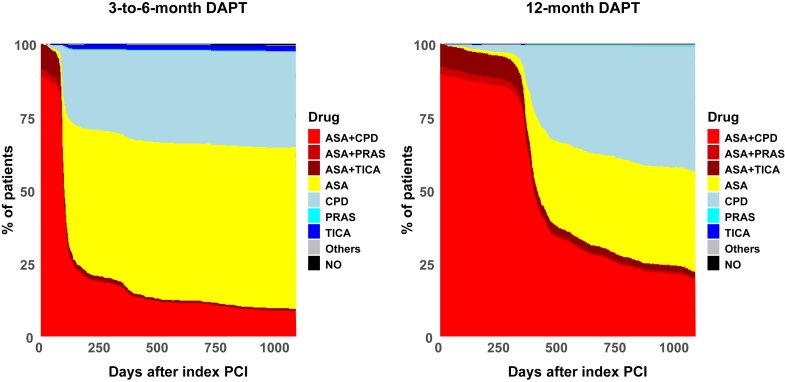
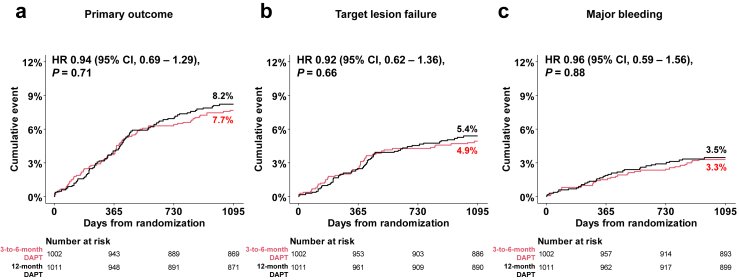
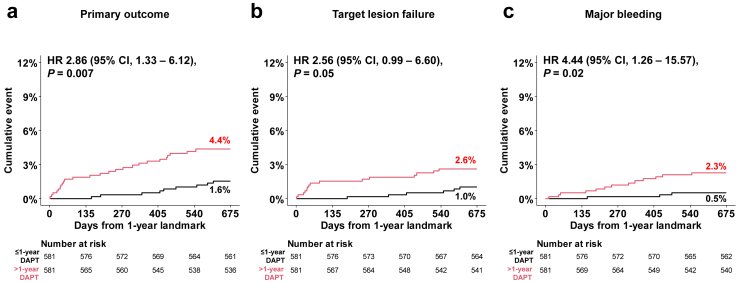
그림 출처: PubMed Central 공개 논문 (PMC12774699)
Conflict of interest statement
JK Han reports the grants from ChongKunDang and HanMi, outside of the submitted work. KW Park reports the speaker's fees from Daiichi Sankyo, AstraZeneca, Sanofi, Bristol-Myers Squibb, Bayer, and Pfizer, outside of the submitted work. HS Kim reports the grants or speaker fees from Daiichi Sankyo, Boston Scientific, Terumo, Biotronik, Dio, Medtronic, Abbott Vascular, Edwards Life Science, Amgen, and Behringer Ingelheim, outside of the submitted work. All other authors declare no competing interests.
그 밖의 정보
- 출판 형태
- Journal Article
- 저널
- EClinicalMedicine · eISSN 2589-5370
- 전자 출판
- 2025-12-18
- 데이터
- ClinicalTrials.gov: NCT02601157
- 참고문헌
- 39편