
PLoS One. 2014;9(8):e105532.
Effect of dialysis initiation timing on clinical outcomes: a propensity-matched analysis of a prospective cohort study in Korea.
제1저자 이정환 · 교신저자 이정표
소속 (9)
- Department of Internal Medicine, Hallym University Hangang Sacred Heart Hospital, Seoul, Korea; Clinical Research Center for End Stage Renal Disease (CRC for ESRD), Daegu, Korea.
- Department of Internal Medicine, Seoul National University Boramae Medical Center, Seoul, Korea.
- Department of Internal Medicine, Chung-Ang University Medical Center, Seoul, Korea.
- Clinical Research Center for End Stage Renal Disease (CRC for ESRD), Daegu, Korea; Department of Internal Medicine, Kyungpook National University School of Medicine, Daegu, Korea.
- Clinical Research Center for End Stage Renal Disease (CRC for ESRD), Daegu, Korea; Department of Internal Medicine, Yonsei University College of Medicine, Seoul, Korea.
- Clinical Research Center for End Stage Renal Disease (CRC for ESRD), Daegu, Korea; Department of Internal Medicine, The Catholic University of Korea College of Medicine, Seoul, Korea.
- Clinical Research Center for End Stage Renal Disease (CRC for ESRD), Daegu, Korea; Department of Internal Medicine, Chonnam National University Medical School, Gwangju, Korea.
- Clinical Research Center for End Stage Renal Disease (CRC for ESRD), Daegu, Korea; Department of Internal Medicine, Seoul National University Boramae Medical Center, Seoul, Korea.
- Clinical Research Center for End Stage Renal Disease (CRC for ESRD), Daegu, Korea; Department of Internal Medicine, Seoul National University Hospital, Seoul National University College of Medicine, Seoul, Korea.
Abstract
BACKGROUND Controversy persists regarding the appropriate initiation timing of renal replacement therapy for patients with end-stage renal disease. We evaluated the effect of dialysis initiation timing on clinical outcomes. Initiation times were classified according to glomerular filtration rate (GFR).
METHODS We enrolled a total of 1691 adult patients who started dialysis between August 2008 and March 2013 in a multi-center, prospective cohort study at the Clinical Research Center for End Stage Renal Disease in the Republic of Korea. The patients were classified into the early-start group or the late-start group according to the mean estimated GFR value, which was 7.37 ml/min/1.73 m2. The primary outcome was patient survival, and the secondary outcomes were hospitalization, cardiovascular events, vascular access complications, change of dialysis modality, and peritonitis. The two groups were compared before and after matching with propensity scores.
RESULTS Before propensity score matching, the early-start group had a poor survival rate (P<0.001). Hospitalization, cardiovascular events, vascular access complications, changes in dialysis modality, and peritonitis were not different between the groups. A total of 854 patients (427 in each group) were selected by propensity score matching. After matching, neither patient survival nor any of the other outcomes differed between groups.
CONCLUSIONS There was no clinical benefit after adjustment by propensity scores comparing early versus late initiation of dialysis.
Figures

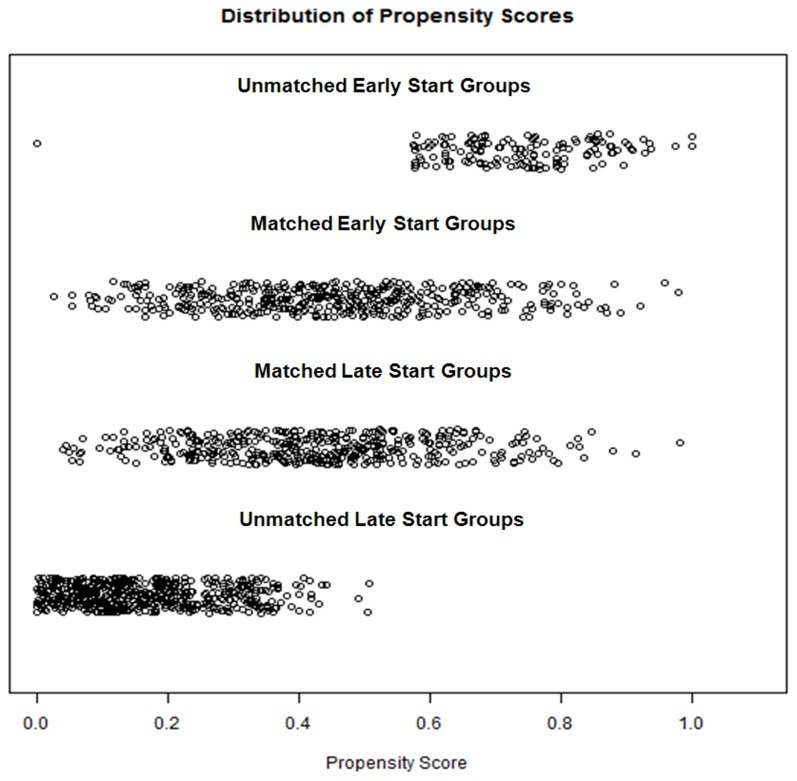
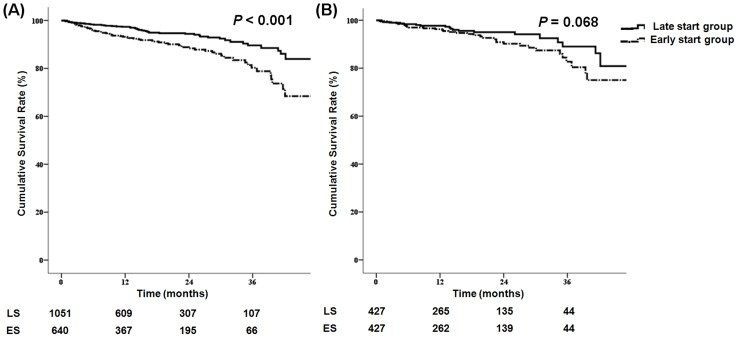
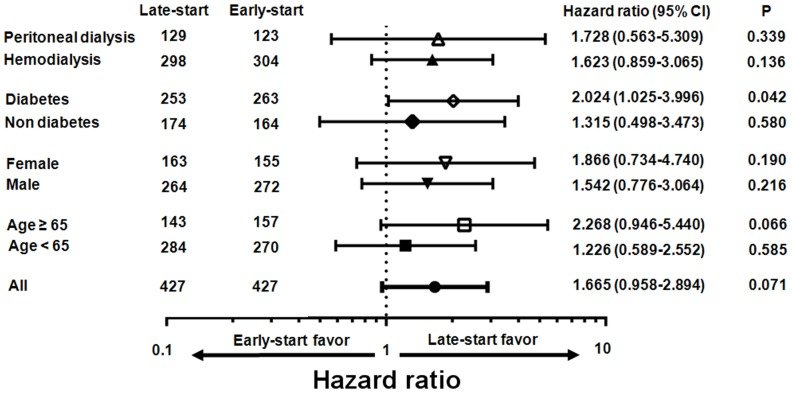
그림 출처: PubMed Central 공개 논문 (PMC4138196)
Conflict of interest statement
Competing Interests:The authors have declared that no competing interests exist.
그 밖의 정보
- 출판 형태
- Journal Article, Multicenter Study, Research Support, Non-U.S. Gov't
- 저널
- PloS one · eISSN 1932-6203
- 전자 출판
- 2014-08-19
- MeSH
- Cardiovascular Diseases / physiopathology · Female · Glomerular Filtration Rate / physiology · Hospitalization · Humans · Kidney Failure, Chronic / therapy · Male · Middle Aged · Peritonitis / physiopathology · Propensity Score · Prospective Studies · Renal Dialysis / methods · Renal Replacement Therapy / methods · Republic of Korea · Survival Rate · Time Factors
- 참고문헌
- 63편