
Epidemiol Health. 2021;43:e2021077.
Epidemiology and treatment status of hepatitis C virus infection among people who have ever injected drugs in Korea: a prospective multicenter cohort study from 2007 to 2019 in comparison with non-PWID.
제1저자 김경아, 최광현 · 교신저자 정숙향
소속 (7)
- Department of Internal Medicine, Inje University Ilsan Paik Hospital, Goyang, Korea.
- Department of Internal Medicine, Seoul National University Bundang Hospital, Seoul National University College of Medicine, Seongnam, Korea.
- Department of Internal Medicine, Soonchunhyang University Bucheon Hospital, Bucheon, Korea.
- Department of Internal Medicine, Inje University Busan Paik Hospital, Busan, Korea.
- Department of Internal Medicine, Jeonbuk National University Hospital, Jeonju, Korea.
- Department of Internal Medicine, Chonnam National University Hwasun Hospital, Hwasun, Korea.
- Department of Cancer Control and Policy, Graduate School of Cancer Science and Policy, National Cancer Center, Goyang, Korea.
Abstract
OBJECTIVES Injection drug use is a major risk factor for hepatitis C virus (HCV) infection; however, limited data on this topic are available in Korea. Thus, this study aimed to investigate the epidemiological and clinical characteristics, treatment uptake, and outcomes of HCV infection among people who inject drugs (PWID).
METHODS We used the data from the Korea HCV cohort, which prospectively enrolled patients with HCV infection between 2007 and 2019. Clinical data and results of a questionnaire survey on lifetime risk factors for HCV infection were analyzed according to a self-reported history of injection drug use (PWID vs. non-PWID group).
RESULTS Among the 2,468 patients, 166 (6.7%) were in the PWID group, which contained younger patients (50.6±8.2 vs. 58.2±13.1 years) and a higher proportion of male (81.9 vs. 48.8%) than the non-PWID group. The distribution of PWID showed significant regional variations. Exposure to other risk factors for HCV infection was different between the groups. The proportion of patients with genotype non-2 infection was higher in the PWID group. Treatment uptake was higher in the PWID group in the interferon era; however, it was comparable between the groups in the direct-acting antiviral era. The rate of sustained virological response did not significantly differ between the groups.
CONCLUSIONS As of 2019, PWID constituted a minority of HCV-infected people in Korea. The epidemiological characteristics, but not treatment uptake and outcomes, were different between the PWID and non-PWID groups. Therefore, active HCV screening and treatment should be offered to PWID in Korea.
Keywords
Drug usersEpidemiologyHepatitis CTreatment uptake
Figures
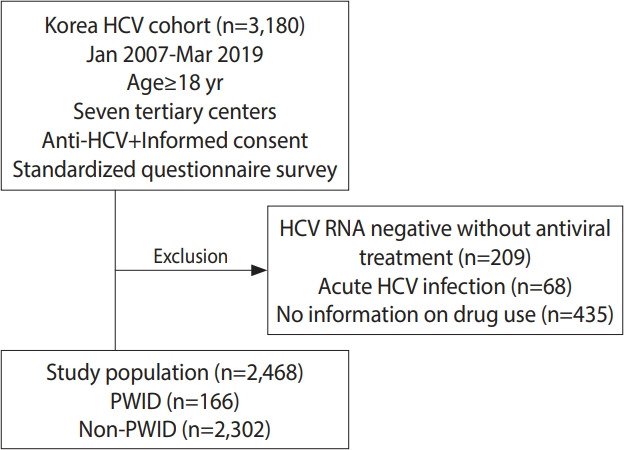
그림 출처: PubMed Central 공개 논문 (PMC8666681)
Conflict of interest statement
The authors have no conflicts of interest to declare for this study.
그 밖의 정보
- 출판 형태
- Journal Article, Multicenter Study
- 저널
- Epidemiology and health · eISSN 2092-7193
- 전자 출판
- 2021-10-06
- MeSH
- Antiviral Agents / therapeutic use · Cohort Studies · Hepacivirus · Hepatitis C* / epidemiology · Hepatitis C, Chronic* / drug therapy · Humans · Male · Pharmaceutical Preparations* · Prospective Studies · Substance Abuse, Intravenous* / drug therapy / epidemiology
- Substances
- Antiviral Agents · Pharmaceutical Preparations
- 연구비
- Korea Disease Control and Prevention Agency 4800-4859-304
- 참고문헌
- 25편