
Kidney Res Clin Pract. 2021;40(2):282-293.
Causal effect of alcohol use on the risk of end-stage kidney disease and related comorbidities: a Mendelian randomization study.
제1저자 박세훈 · 교신저자 김동기
소속 (9)
- Department of Biomedical Sciences, Seoul National University College of Medicine, Seoul, Republic of Korea.
- Department of Internal Medicine, Korean Armed Forces Capital Hospital, Seongnam, Republic of Korea.
- Division of Nephrology, Department of Internal Medicine, Uijeongbu Eulji University Medical Center, Seongnam, Republic of Korea.
- Department of Internal Medicine, Keimyung University School of Medicine, Daegu, Republic of Korea.
- Department of Internal Medicine, Seoul National University Hospital, Seoul, Republic of Korea.
- Transdisciplinary Department of Medicine and Advanced Technology, Seoul National University Hospital, Seoul, Republic of Korea.
- Kidney Research Institute, Seoul National University, Seoul, Republic of Korea.
- Department of Internal Medicine, Seoul National University College of Medicine, Seoul, Republic of Korea.
- Department of Internal Medicine, SMG-SNU Boramae Medical Center, Seoul, Republic of Korea.
Abstract
BACKGROUND An inverse observational association between alcohol use and the risk of chronic kidney disease (CKD) or end-stage kidney disease (ESKD) has been reported. The causal effect of alcohol use on the risk of ESKD warrants additional investigation.
METHODS The study was an observational cohort study investigating the UK Biobank and performed Mendelian randomization (MR) analysis. Amounts of alcohol use were collected using a touchscreen questionnaire. In the observational analysis, 212,133 participants without prevalent ESKD were studied, and the association between alcohol use and the risk of prevalent CKD or incident ESKD was investigated. The genetic analysis included 337,138 participants of white British ancestry. For one-sample MR, an analysis based on a polygenic risk score (PRS) was conducted with genetically predicted alcohol intake. The MR analysis investigated ESKD outcome and related comorbidities.
RESULTS Lower alcohol use was observationally associated with a higher risk of prevalent CKD or incident ESKD. However, the genetic risk of CKD was significantly associated with lower alcohol use, suggesting reverse causation. A higher PRS for alcohol use was significantly associated with a higher risk of ESKD (per units of one phenotypical alcohol drink; adjusted odds ratio of 1.16 [95% confidence interval, 1.02-1.31]) and related comorbidities, including hypertension, diabetes mellitus, obesity, and central obesity.
CONCLUSION The inverse observational association between alcohol use and the risk of CKD or ESKD may have been affected by reverse causation. Our study supports a causal effect of alcohol use on a higher risk of ESKD and related predisposing comorbidities.
Keywords
AlcoholChronic kidney diseaseEnd-stage kidney diseaseLife styleMendelian randomization
Figures
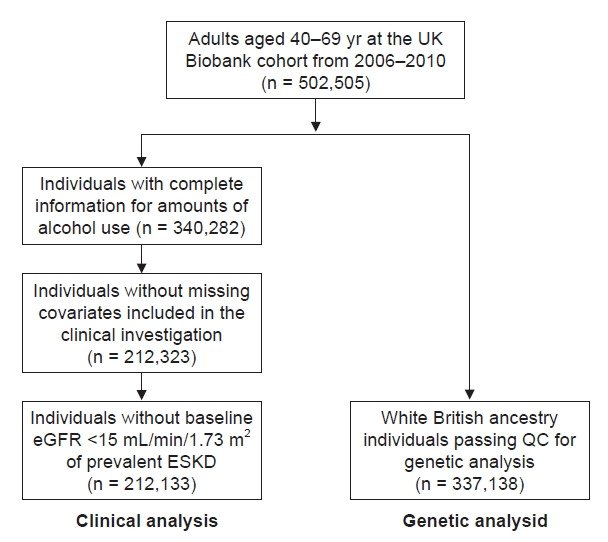
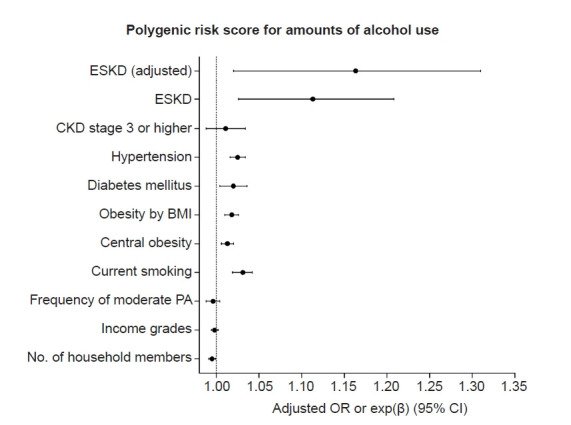
그림 출처: PubMed Central 공개 논문 (PMC8237113)
Conflict of interest statement
Conflict of interest. All authors have no conflicts of interest to declare.
그 밖의 정보
- 출판 형태
- Journal Article
- 저널
- Kidney research and clinical practice · ISSN 2211-9132
- 전자 출판
- 2021-04-20
- 연구비
- Medical Research Council MC_PC_17228 · Medical Research Council MC_QA137853 · Ministry of Trade, Industry and Energy · Industrial Strategic Technology Development Program 10077474
- 참고문헌
- 31편