
J Korean Med Sci. 2024;39(2):e5.
A Multicenter Analysis of Clinical Features and Long-Term Outcomes of POEMS Syndrome in Korea.
제1저자 국혜원 · 교신저자 김진석, 윤성수
소속 (9)
- Division of Hematology, Department of Internal Medicine, Severance Hospital, Yonsei University College of Medicine, Seoul, Korea.
- Department of Hematology, Seoul St. Mary's Hospital, College of Medicine, The Catholic University of Korea, Seoul, Korea.
- Department of Oncology, Asan Medical Center, University of Ulsan College of Medicine, Seoul, Korea.
- Department of Medicine, Samsung Medical Center, Sungkyunkwan University School of Medicine, Seoul, Korea.
- Department of Internal Medicine, Seoul National University Bundang Hospital, Seoul National University College of Medicine, Seongnam, Korea.
- Department of Internal Medicine, Korea University Anam Hospital, Korea University College of Medicine, Seoul, Korea.
- Department of Internal Medicine, Gachon University Gil Medical Center, Gachon University College of Medicine, Incheon, Korea.
- Department of Internal Medicine, Seoul National University Hospital, Seoul National University College of Medicine, Seoul, Korea. ssysmc@snu.ac.kr.
- Division of Hematology, Department of Internal Medicine, Severance Hospital, Yonsei University College of Medicine, Seoul, Korea. hemakim@yuhs.ac.
Abstract
BACKGROUND POEMS syndrome is a rare form of plasma cell dyscrasia characterized by polyneuropathy, organomegaly, endocrinopathy, monoclonal proteins, and skin changes. Owing to its low incidence, there are few reports regarding this syndrome. This multicenter study included 84 patients diagnosed with POEMS syndrome in South Korea.
METHODS We retrospectively evaluated 84 patients diagnosed with POEMS syndrome at 8 hospitals in South Korea between January 2000 and October 2022. The clinical characteristics and treatment outcomes were analyzed.
RESULTS The median patient age was 53 years (range, 26-77 years), and 63.1% of the patients were male. All patients had peripheral neuropathy, and 81 (96.4%) had monoclonal plasma cell proliferation. Plasma vascular endothelial growth factor levels were available for 32 patients with a median of 821 pg/mL (range, 26-12,900 pg/mL). Other common features included skin changes (54.2%), volume overload (71.4%), and organomegaly (72.6%). Of the 84 patients, 75 received initial treatment (local radiotherapy, 6 [8.0%]; chemotherapy, 17 [22.7%]; both chemotherapy and local radiotherapy, 9 [12.0%]), upfront autologous stem cell transplantation (ASCT), 43 (57.3%; with induction chemotherapy, n = 12, 16.0%; without induction chemotherapy, n = 31, 41.3%). The median follow-up duration was 40.7 months. The 5-year overall survival (OS) was 78%, and the 5-year progression-free survival (PFS) was 55%. Patients who underwent upfront ASCT and were diagnosed after 2014 had a longer OS and PFS.
CONCLUSION The demographics of Korean patients with POEMS syndrome were similar to those reported previously. Because of the introduction of new treatment agents and the reduced rate of transplant-related mortality related to ASCT, the treatment outcomes of Korean patients with POEMS syndrome have improved in recent years.
© 2024 The Korean Academy of Medical Sciences.
Keywords
Autologous Stem Cell TransplantationLong-Term OutcomePOEMS Syndrome
Figures
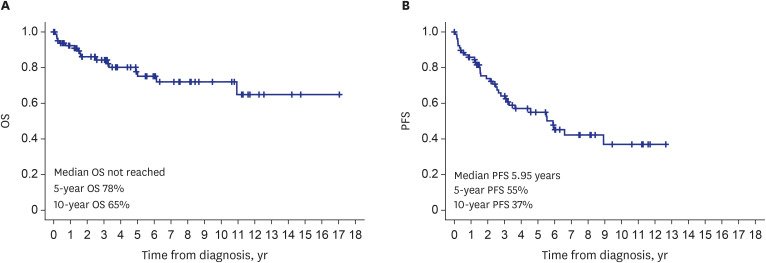
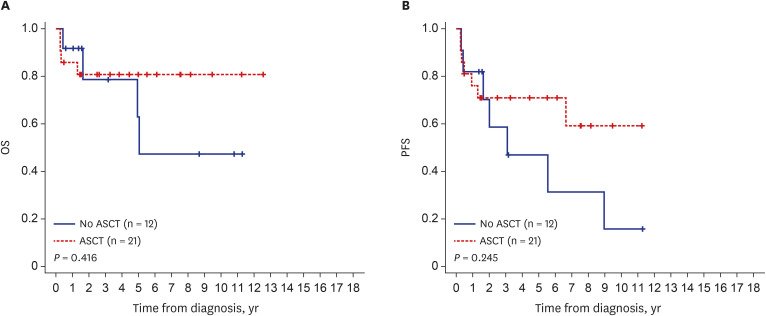
그림 출처: PubMed Central 공개 논문 (PMC10789530)
Conflict of interest statement
The authors have no potential conflicts of interest to disclose.
그 밖의 정보
- 출판 형태
- Multicenter Study, Journal Article
- 저널
- Journal of Korean medical science · eISSN 1598-6357
- 전자 출판
- 2024-01-15
- MeSH
- Humans · Male · Adult · Middle Aged · Aged · Female · POEMS Syndrome* / therapy / drug therapy · Hematopoietic Stem Cell Transplantation* · Vascular Endothelial Growth Factor A · Retrospective Studies · Transplantation, Autologous · Republic of Korea / epidemiology
- Substances
- Vascular Endothelial Growth Factor A
- 참고문헌
- 26편