
Endocrinol Metab (Seoul). 2024;39(2):206-221.
Glucagon-Like Peptide-1 Based Therapies: A New Horizon in Obesity Management.
제1저자 손장원 · 교신저자 임수
소속 (2)
- Department of Internal Medicine, Bucheon St. Mary's Hospital, College of Medicine, The Catholic University of Korea, Bucheon, Korea.
- Department of Internal Medicine, Seoul National University Bundang Hospital, Seoul National University College of Medicine, Seongnam, Korea.
Abstract
Obesity is a significant risk factor for health issues like type 2 diabetes and cardiovascular disease. It often proves resistant to traditional lifestyle interventions, prompting a need for more precise therapeutic strategies. This has led to a focus on signaling pathways and neuroendocrine mechanisms to develop targeted obesity treatments. Recent developments in obesity management have been revolutionized by introducing novel glucagon-like peptide-1 (GLP-1) based drugs, such as semaglutide and tirzepatide. These drugs are part of an emerging class of nutrient-stimulated hormone-based therapeutics, acting as incretin mimetics to target G-protein-coupled receptors like GLP-1, glucose-dependent insulinotropic polypeptide (GIP), and glucagon. These receptors are vital in regulating body fat and energy balance. The development of multiagonists, including GLP-1-glucagon and GIP-GLP-1-glucagon receptor agonists, especially with the potential for glucagon receptor activation, marks a significant advancement in the field. This review covers the development and clinical efficacy of various GLP-1-based therapeutics, exploring the challenges and future directions in obesity management.
Keywords
GlucagonGlucagon-like peptide-1 receptor agonistsGlucose-dependent insulinotropic polypeptideMultiagonistObesity
Figures

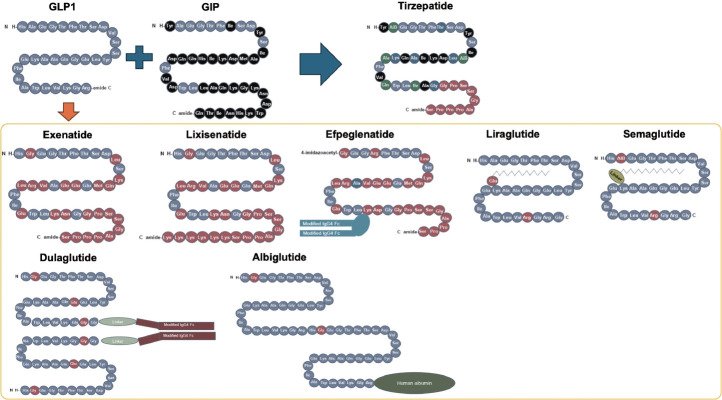

그림 출처: PubMed Central 공개 논문 (PMC11066441)
Conflict of interest statement
CONFLICTS OF INTEREST . No potential conflict of interest relevant to this article was reported.
그 밖의 정보
- 출판 형태
- Journal Article, Review, Research Support, Non-U.S. Gov't
- 저널
- Endocrinology and metabolism (Seoul, Korea) · eISSN 2093-5978
- 전자 출판
- 2024-04-16
- MeSH
- Humans · Obesity* / drug therapy · Glucagon-Like Peptide 1* / therapeutic use / metabolism · Glucagon-Like Peptides / therapeutic use · Obesity Management / methods · Animals · Anti-Obesity Agents / therapeutic use · Glucagon-Like Peptide-1 Receptor Agonists · Semaglutide
- Substances
- Glucagon-Like Peptide 1 · Glucagon-Like Peptides · Anti-Obesity Agents · Glucagon-Like Peptide-1 Receptor Agonists · Semaglutide
- 참고문헌
- 114편