
J Korean Med Sci. 2024;39(12):e115.
Prevalence, Incidence, and Treatment Pattern of Wilson's Disease Using National Health Insurance Data From 2010-2020, Korea.
제1저자 장은선, 최화영 · 교신저자 정숙향
소속 (5)
- Department of Internal Medicine, Seoul National University College of Medicine, Seoul National University Bundang Hospital, Seongnam, Korea.
- Department of Cancer Control and Population Health, Graduate School of Cancer Science and Policy, National Cancer Center, Goyang, Korea.
- Center for Liver and Pancreatobiliary Cancer, Division of Gastroenterology, National Cancer Center, Goyang, Korea.
- Department of Internal Medicine, Inje University Ilsan Paik Hospital, Goyang, Korea.
- Department of Internal Medicine, Seoul National University College of Medicine, Seoul National University Bundang Hospital, Seongnam, Korea. jsh@snubh.org.
Abstract
BACKGROUND Wilson's disease (WD) is an autosomal recessive disorder in which copper (Cu) accumulates in organs, particularly in the liver and central nervous system. This study aimed to investigate the prevalence, incidence, and treatment patterns of WD patients in Korea.
METHODS National Health Insurance System (NHIS) claims data from 2010 to 2020 were analyzed. patients with WD as a primary or additional diagnosis at least once were identified using the International Classification of Diseases (ICD)-10 disease code E83.0 and a record for a registration program for rare intractable diseases in Korea.
RESULTS The average age- and sex-adjusted prevalence and incidence of WD between 2010 and 2020 were 3.06/100,000 and 0.11/100,000, respectively. The mean age of the patients with newly diagnosed WD was 21.0 ± 15.9 years. Among the 622 WD incident cases during the study period, 19.3% of the patients had liver cirrhosis and 9.2% had received liver transplantation. Psychological and neurological diseases were present in 40.7% and 48.1% of the patients, respectively. Regarding the diagnosis of WD, liver biopsy was performed in only 51.6% of new cases. D-penicillamine, trientine, or zinc were prescribed in 81.5% of the incident cases, and the treatment uptake rates decreased with increasing age.
CONCLUSION The prevalence of WD in Korea is 3.06/100,000 and approximately 1,800 patients use medical services annually. A significant proportion of patients are diagnosed at the cirrhotic stage and not treated with Cu-chelating therapeutics, suggesting the need for early diagnosis and adequate treatment to improve prognosis.
© 2024 The Korean Academy of Medical Sciences.
Keywords
EpidemiologyPenicillamineTrientineWilson's DiseaseZinc
Figures
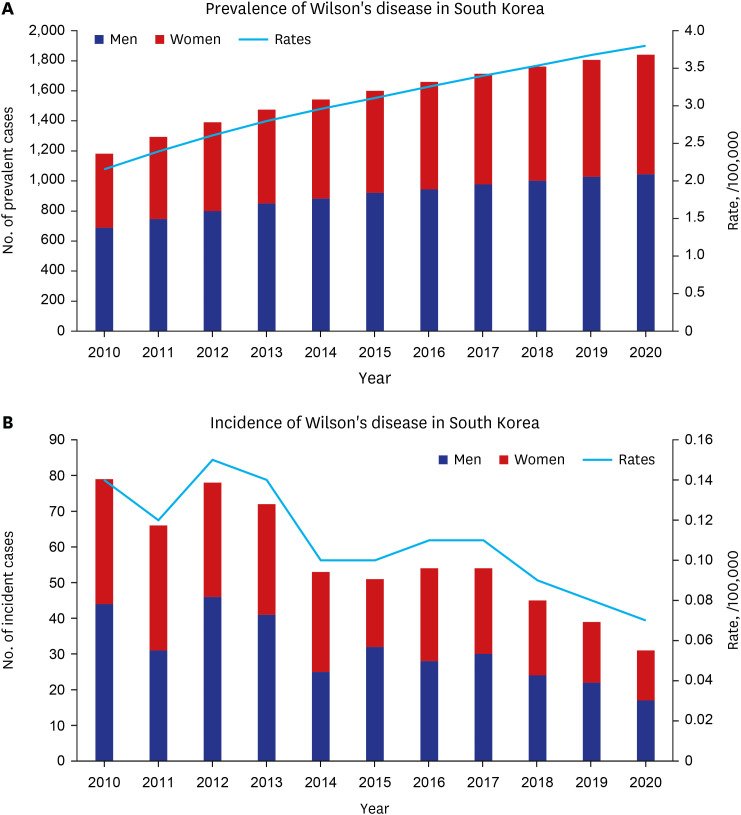
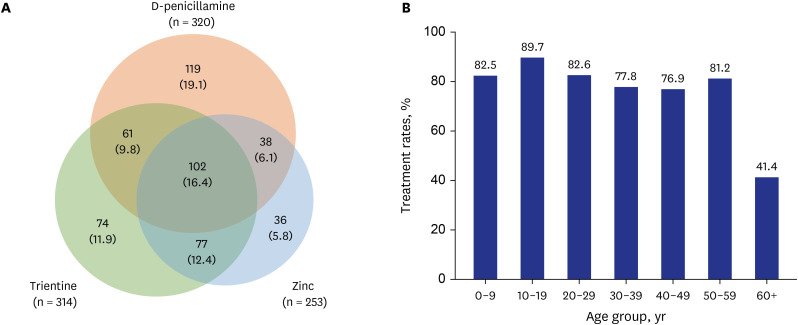
그림 출처: PubMed Central 공개 논문 (PMC10985507)
Conflict of interest statement
The authors have no potential conflicts of interest to disclose.
그 밖의 정보
- 출판 형태
- Journal Article
- 저널
- Journal of Korean medical science · eISSN 1598-6357
- 전자 출판
- 2024-04-01
- MeSH
- Humans · Child, Preschool · Child · Adolescent · Young Adult · Adult · Hepatolenticular Degeneration* / diagnosis / epidemiology / therapy · Prevalence · Incidence · Chelating Agents / therapeutic use · Republic of Korea / epidemiology
- Substances
- Chelating Agents
- 연구비
- Korean Association for the Study of the Liver
- 참고문헌
- 24편