
J Korean Med Sci. 2023;38(38):e296.
Factors Associated With the Development and Severity of Polycystic Liver in Patients With Autosomal Dominant Polycystic Kidney Disease.
제1저자 김예림, 박혜인조 · 교신저자 오윤규
소속 (9)
- Department of Internal Medicine, Keimyung University School of Medicine, Daegu, Korea.
- Department of Internal Medicine, Hallym University College of Medicine, Seoul, Korea.
- Department of Internal Medicine, Seoul National University College of Medicine, Seoul, Korea.
- Department of Internal Medicine, National Medical Center, Seoul, Korea.
- Department of Internal Medicine, Kangbuk Samsung Hospital, Sungkyunkwan University School of Medicine, Seoul, Korea.
- Department of Internal Medicine, Inje University College of Medicine, Busan Paik Hospital, Busan, Korea.
- Department of Internal Medicine, Chonnam National University Medical School, Gwangju, Korea.
- Department of Biomedical Sciences, Korea University College of Medicine, Seoul, Korea.
- Department of Internal Medicine, Seoul Metropolitan Government-Seoul National University Boramae Medical Center, Seoul, Korea. yoonkyuoh@gmail.com.
Abstract
BACKGROUND Factors related to the development and severity of polycystic liver disease (PLD) have not been well established. We aimed to evaluate the genetic and epidemiologic risk factors of PLD in patients with autosomal dominant polycystic kidney disease (ADPKD).
METHODS Adult patients with inherited cystic kidney disease were enrolled from May 2019 to May 2021. Demographic, clinical, and laboratory data were collected at the initial study visit. The severity of PLD was graded based on the height-adjusted total liver volume: < 1,000 mL/m (Gr1), 1,000-1,800 mL/m (Gr2), and > 1,800 mL/m (Gr3). Targeted exome sequencing was done by a gene panel including 89 ciliopathy-related genes. We searched out the relative factors to the presence and the severity of PLD using logistic regression analysis.
RESULTS Of 602 patients with typical ADPKD, 461 (76.6%) patients had PLD. The patients with PLD showed female predominance and a higher frequency of other ADPKD-related complications. The genetic variants with truncating mutation of PKD1 (PKD1-protein-truncating [PT]) or PKD2 commonly affected the development and severity of PLD. An older age, female sex, and higher kidney volume with Mayo classification 1C-1E was significantly associated with the development of PLD, but not with the severity of PLD. On the other hand, higher body mass index, lower hemoglobin, and higher alkaline phosphatase (ALP) were the significant risk factors of severe PLD (≥ Gr2).
CONCLUSION Hepatic involvement in ADPKD could be related to kidney manifestations and genetic variants including PKD1-PT or PKD2. Monitoring hemoglobin and ALP and evaluating the genetic variants might help predict severe PLD.
TRIAL REGISTRATION Clinical Research Information Service Identifier: KCT0005580.
© 2023 The Korean Academy of Medical Sciences.
Keywords
Autosomal DominantGenotypePolycystic KidneyPolycystic Liver DiseaseRisk Factors
Figures
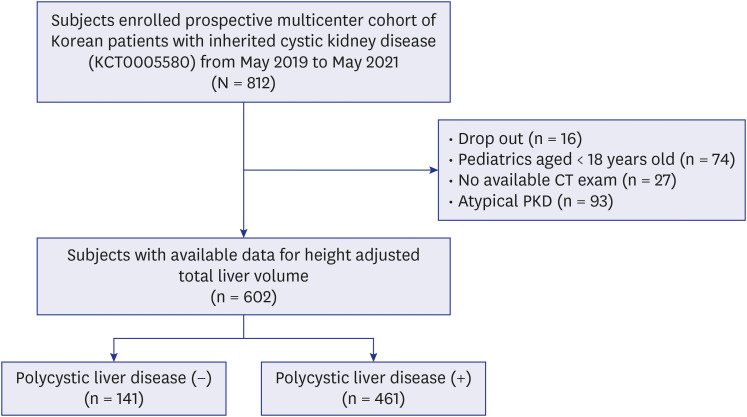
그림 출처: PubMed Central 공개 논문 (PMC10519778)
Conflict of interest statement
The authors have no potential conflicts of interest to disclose.
그 밖의 정보
- 출판 형태
- Journal Article
- 저널
- Journal of Korean medical science · eISSN 1598-6357
- 전자 출판
- 2023-09-25
- MeSH
- Adult · Humans · Female · Male · Polycystic Kidney, Autosomal Dominant* / complications / diagnosis / genetics · Liver · Kidney · Body Mass Index · Laboratories
- 연구비
- Korea Disease Control and Prevention Agency 2019-ER-7304-00 · Korea Disease Control and Prevention Agency 2019-ER-7304-01 · Korea Disease Control and Prevention Agency 2019-ER-7304-02
- 참고문헌
- 43편