
J Korean Med Sci. 2023;38(25):e189.
Antibiotic Prescription in Patients With Coronavirus Disease 2019: Analysis of National Health Insurance System Data in the Republic of Korea.
제1저자 최윤상, 강민선 · 교신저자 김홍빈
소속 (6)
- Division of Infectious Diseases, Department of Internal Medicine, Seoul National University Bundang Hospital, Seongnam, Korea.
- Department of Internal Medicine, Seoul National University College of Medicine, Seoul, Korea.
- Artificial Intelligence and Big-Data Convergence Centre, Gil Medical Centre, Gachon University College of Medicine, Incheon, Korea.
- Department of Preventive Medicine, Gachon University College of Medicine, Incheon, Korea.
- Division of Infectious Diseases, Department of Internal Medicine, Soonchunhyang University Seoul Hospital, Soonchunhyang University College of Medicine, Seoul, Korea.
- Department of Internal Medicine, Seoul National University College of Medicine, Seoul, Korea. hbkimmd@snu.ac.kr.
Abstract
BACKGROUND Although coronavirus disease 2019 (COVID-19) is a viral infection, antibiotics are often prescribed due to concerns about accompanying bacterial infection. Therefore, we aimed to analyze the number of patients with COVID-19 who received antibiotic prescriptions, as well as factors that influenced antibiotics prescription, using the National Health Insurance System database.
METHODS We retrospectively reviewed claims data for adults aged ≥ 19 years hospitalized for COVID-19 from December 1, 2019 to December 31, 2020. According to the National Institutes of Health guidelines for severity classification, we calculated the proportion of patients who received antibiotics and the number of days of therapy per 1,000 patient-days. Factors contributing to antibiotic use were determined using linear regression analysis. In addition, antibiotic prescription data for patients with influenza hospitalized from 2018 to 2021 were compared with those for patients with COVID-19, using an integrated database from Korea Disease Control and Prevention Agency-COVID19-National Health Insurance Service cohort (K-COV-N cohort), which was partially adjusted and obtained from October 2020 to December 2021.
RESULTS Of the 55,228 patients, 46.6% were males, 55.9% were aged ≥ 50 years, and most patients (88.7%) had no underlying diseases. The majority (84.3%; n = 46,576) were classified as having mild-to-moderate illness, with 11.2% (n = 6,168) and 4.5% (n = 2,484) having severe and critical illness, respectively. Antibiotics were prescribed to 27.3% (n = 15,081) of the total study population, and to 73.8%, 87.6%, and 17.9% of patients with severe, critical, and mild-to-moderate illness, respectively. Fluoroquinolones were the most commonly prescribed antibiotics (15.1%; n = 8,348), followed by third-generation cephalosporins (10.4%; n = 5,729) and beta-lactam/beta-lactamase inhibitors (6.9%; n = 3,822). Older age, COVID-19 severity, and underlying medical conditions contributed significantly to antibiotic prescription requirement. The antibiotic use rate was higher in the influenza group (57.1%) than in the total COVID-19 patient group (21.2%), and higher in severe-to-critical COVID-19 cases (66.6%) than in influenza cases.
CONCLUSION Although most patients with COVID-19 had mild to moderate illness, more than a quarter were prescribed antibiotics. Judicious use of antibiotics is necessary for patients with COVID-19, considering the severity of disease and risk of bacterial co-infection.
© 2023 The Korean Academy of Medical Sciences.
Keywords
AntibioticsCoronavirus Disease 2019National Health Insurance
Figures

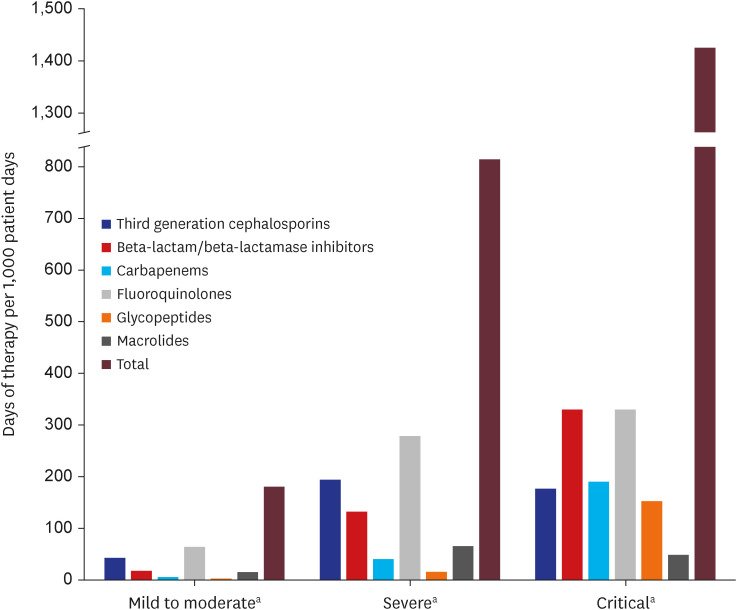
그림 출처: PubMed Central 공개 논문 (PMC10293658)
Conflict of interest statement
The authors have no potential conflicts of interest to disclose.
그 밖의 정보
- 출판 형태
- Journal Article
- 저널
- Journal of Korean medical science · eISSN 1598-6357
- 전자 출판
- 2023-06-26
- MeSH
- Adult · Male · Humans · Female · Anti-Bacterial Agents / therapeutic use · COVID-19* · Influenza, Human* / drug therapy · Retrospective Studies · Bacterial Infections* / drug therapy · Drug Prescriptions · Republic of Korea / epidemiology · National Health Programs
- Substances
- Anti-Bacterial Agents
- 연구비
- National Research Foundation of Korea NRF-2021M3A9H5079533 · National Research Foundation of Korea 2022M3A9H5037485
- 참고문헌
- 39편