
J Korean Med Sci. 2023;38(24):e186.
Predictive Value of Electromechanical Window for Risk of Fatal Ventricular Arrhythmia.
제1저자 이태민 · 교신저자 오세일
소속 (2)
- Department of Internal Medicine, Seoul National University Hospital, Seoul, Korea.
- Department of Internal Medicine, Seoul National University Hospital, Seoul, Korea. seil@snu.ac.kr.
Abstract
BACKGROUND As an indicator of electro-mechanical coupling, electromechanical window (EMW) can be used to predict fatal ventricular arrhythmias. We investigated the additive effect of EMW on the prediction of fatal ventricular arrhythmias in high-risk patients.
METHODS We included patients who had implantable cardioverter-defibrillator (ICD) implanted for primary or secondary prevention. The event group was defined as those who received an appropriate ICD therapy. We acquired echocardiograms at ICD implantation and follow-up. The EMW was calculated as the difference between the interval from QRS onset to aortic valve closure and QT interval from the electrocardiogram embedded in the continuous wave doppler image. We evaluated the predictive value of EMW for predicting fatal ventricular arrhythmia.
RESULTS Of 245 patients (67.2 ± 12.8 years, 63.7% men), the event group was 20.0%. EMW at baseline (EMW-Baseline) and follow-up (EMW-FU) was significantly different between event and control groups. After adjustment, both EMW-Baseline (odds ratio [OR]adjust 1.02 [1.01-1.03], P = 0.004) and EMW-FU (ORadjust 1.06 [1.04-1.07], P < 0.001) remained as significant predictors for fatal arrhythmic events. Adding EMW-Baseline significantly improved the discriminating ability of the multivariable model including clinical variables (area under the curve [AUC] 0.77 [0.70-0.84] vs. AUC 0.72 [0.64-0.80], P = 0.004), while a univariable model using EMW-FU alone showed the best performance among models (AUC 0.87 [0.81-0.94], P = 0.060 against model with clinical variables; P = 0.030 against model with clinical variables and EMW-Baseline).
CONCLUSION The EMW could effectively predict severe ventricular arrhythmia in ICD implanted patients. This finding supports the importance of incorporating the electro-mechanical coupling index into the clinical practice for predicting future fatal arrhythmia events.
© 2023 The Korean Academy of Medical Sciences.
Keywords
EchocardiographyElectromechanical WindowImplantable Cardioverter-DefibrillatorSudden Cardiac DeathVentricular Arrhythmia
Figures
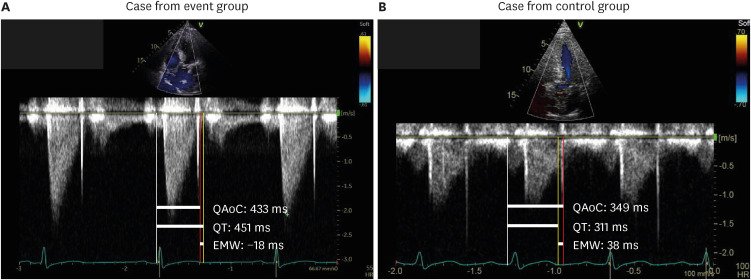
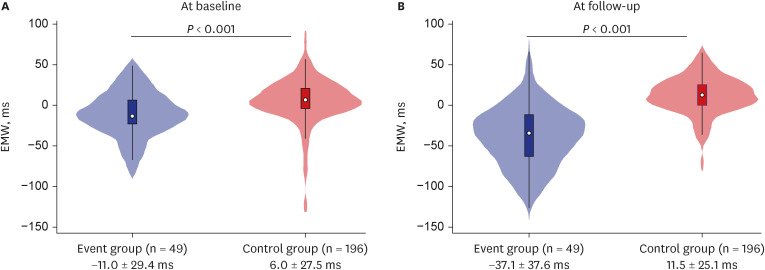
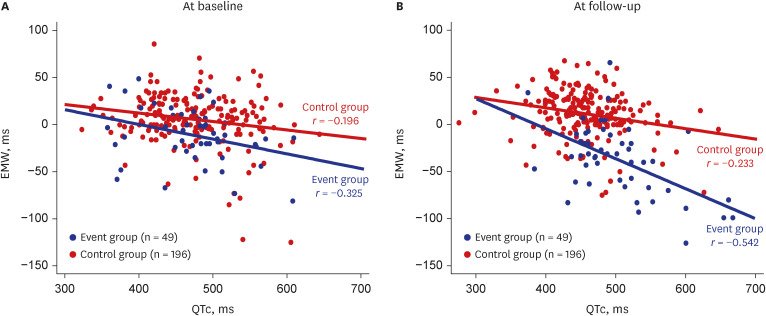
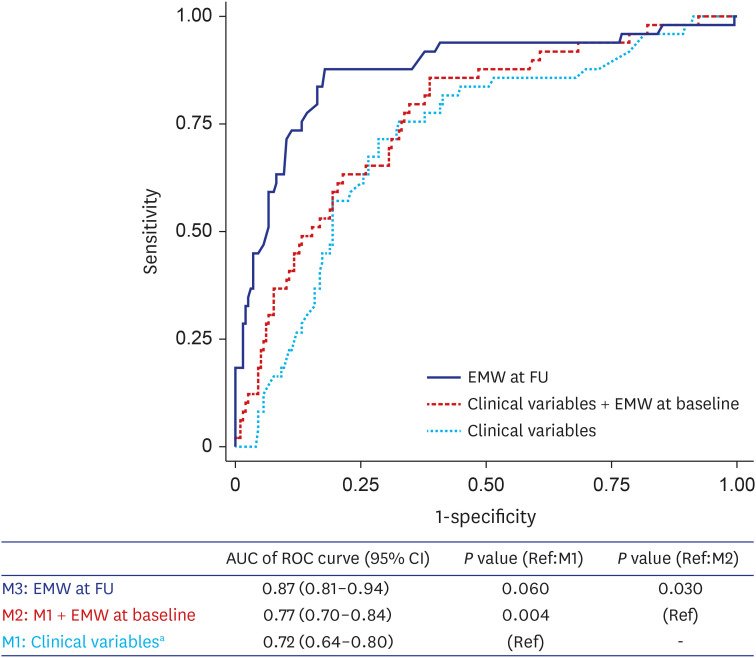
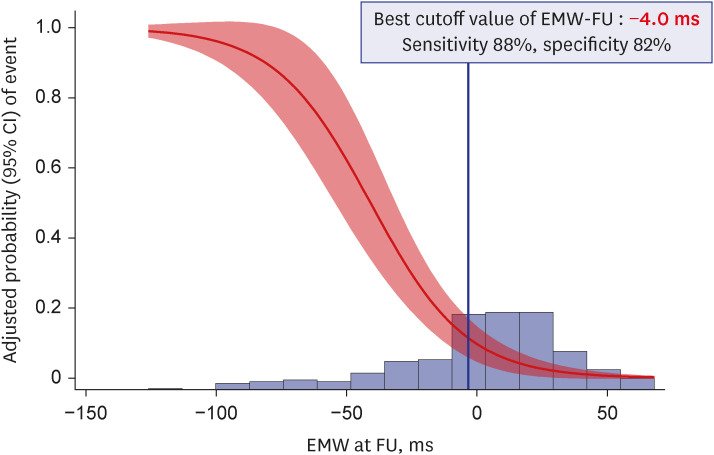
그림 출처: PubMed Central 공개 논문 (PMC10279514)
Conflict of interest statement
The authors have no potential conflicts of interest to disclose.
그 밖의 정보
- 출판 형태
- Journal Article
- 저널
- Journal of Korean medical science · eISSN 1598-6357
- 전자 출판
- 2023-06-19
- MeSH
- Male · Humans · Female · Arrhythmias, Cardiac* / diagnosis · Electrocardiography · Echocardiography · Defibrillators, Implantable* · Death, Sudden, Cardiac / etiology / prevention & control · Risk Factors
- 참고문헌
- 22편