
J Korean Med Sci. 2023;38(16):e129.
Anti-Alpha-Toxin Antibody Responses and Clinical Outcomes of Staphylococcus aureus Bacteremia.
제1저자 김낙현 · 교신저자 박완범, 김홍빈
소속 (4)
- Department of Internal Medicine, Seoul National University Bundang Hospital, Seoul National University College of Medicine, Seongnam, Korea.
- Department of Laboratory Medicine, Seoul National University Bundang Hospital, Seoul National University College of Medicine, Seongnam, Korea.
- Department of Internal Medicine, Seoul National University Hospital, Seoul National University College of Medicine, Seoul, Korea. wbpark1@snu.ac.kr.
- Department of Internal Medicine, Seoul National University Bundang Hospital, Seoul National University College of Medicine, Seongnam, Korea. hbkimmd@snu.ac.kr.
Abstract
BACKGROUND Alpha-toxin (AT), a major virulence factor of Staphylococcus aureus, is an important immunotherapeutic target to prevent or treat invasive S. aureus infections. Previous studies have suggested that anti-AT antibodies (Abs) may have a protective role against S. aureus bacteremia (SAB), but their function remains unclear. Therefore, we aimed to investigate the association between serum anti-AT Ab levels and clinical outcomes of SAB.
METHODS Patients from a prospective SAB cohort at a tertiary-care medical center (n = 51) were enrolled in the study from July 2016 to January 2019. Patients without symptoms or signs of infection were enrolled as controls (n = 100). Blood samples were collected before the onset of SAB and at 2- and 4-weeks post-bacteremia. Anti-AT immunoglobin G (IgG) levels were measured using an enzyme-linked immunosorbent assay. All clinical S. aureus isolates were tested for the presence of hla using polymerase chain reaction.
RESULTS Anti-AT IgG levels in patients with SAB before the onset of bacteremia did not differ significantly from those in non-infectious controls. Pre-bacteremic anti-AT IgG levels tended to be lower in patients with worse clinical outcomes (7-day mortality, persistent bacteremia, metastatic infection, septic shock), although the differences were not statistically significant. Patients who needed intensive care unit care had significantly lower anti-AT IgG levels at 2 weeks post-bacteremia (P = 0.020).
CONCLUSION The study findings suggest that lower anti-AT Ab responses before and during SAB, reflective of immune dysfunction, are associated with more severe clinical presentations of infection.
© 2023 The Korean Academy of Medical Sciences.
Keywords
Alpha-ToxinAnti-Alpha-Toxin AntibodyAntibody ResponseBacteremiaStaphylococcus aureus
Figures
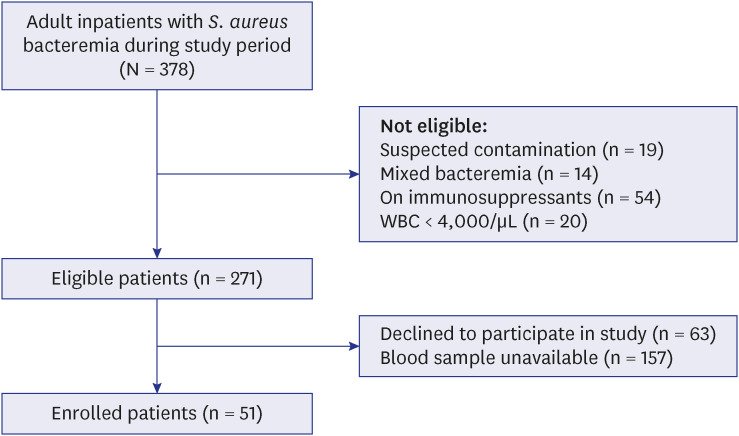
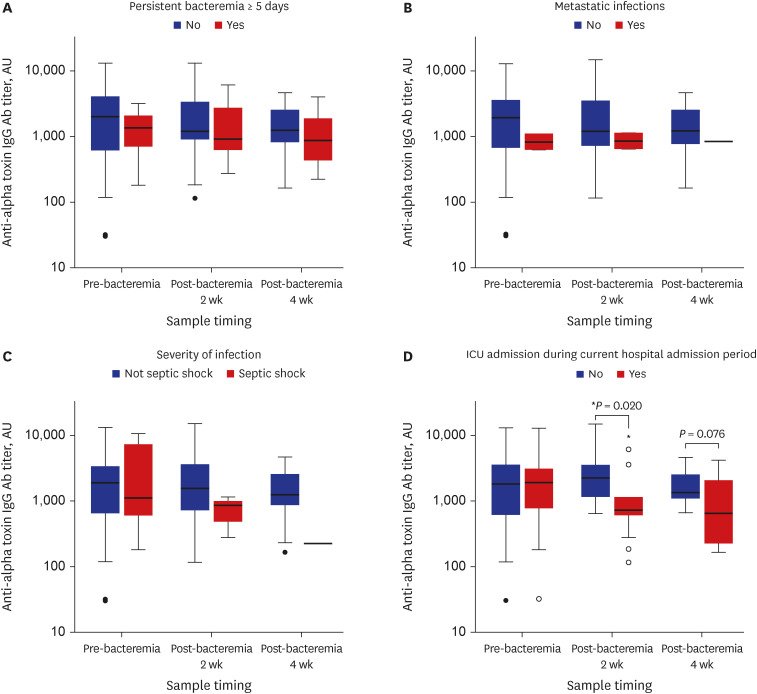
그림 출처: PubMed Central 공개 논문 (PMC10125797)
Conflict of interest statement
The authors have no potential conflicts of interest to disclose.
그 밖의 정보
- 출판 형태
- Journal Article
- 저널
- Journal of Korean medical science · eISSN 1598-6357
- 전자 출판
- 2023-04-24
- MeSH
- Humans · Staphylococcus aureus · Prospective Studies · Antibody Formation · Bacteremia* / drug therapy · Staphylococcal Infections* / drug therapy · Immunoglobulin G · Anti-Bacterial Agents / therapeutic use
- Substances
- Immunoglobulin G · Anti-Bacterial Agents
- 연구비
- Seoul National University Bundang Hospital 13-2015-0006
- 참고문헌
- 40편