Cardiovascular Center and Department of Internal Medicine, Seoul National University College of Medicine, Seoul National University Bundang Hospital, Seongnam, Republic of Korea.
Department of Internal Medicine, Seoul National University College of Medicine, Seoul National University Hospital, Seoul, Republic of Korea.
Department of Cardiology in Internal Medicine, Chungnam National University Hospital, Chungnam National University College of Medicine, Daejeon, Republic of Korea.
Abstract
AIMS Some patients with apparent heart failure (HF) have an ejection fraction (EF) ≥ 50% and elevated levels of natriuretic peptides (NPs), but no significant diastolic dysfunction. Among these, some may have HF, others may not. Myocardial strain is an excellent prognostic factor.
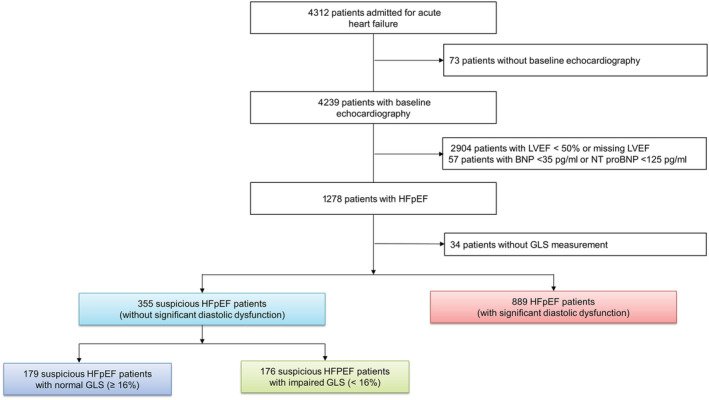
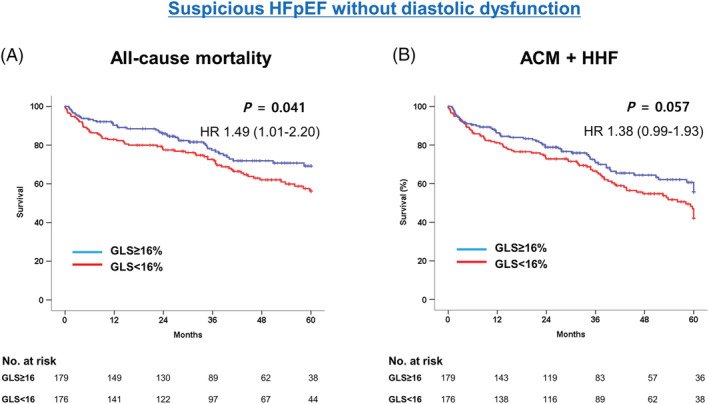
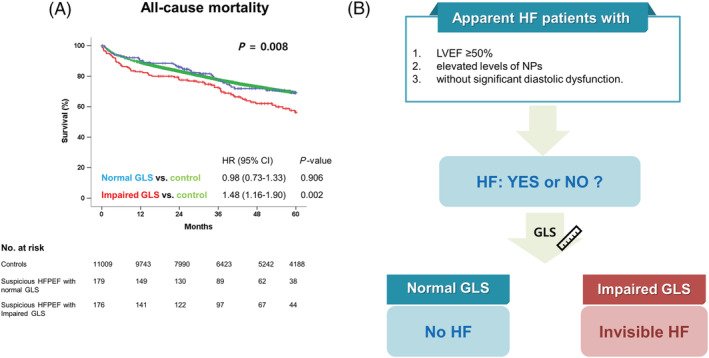
METHODS AND RESULTS Among 4312 consecutive patients with acute HF from three tertiary hospitals, we included 355 patients with EF of ≥50% and elevated levels of NPs, without significant diastolic dysfunction. Patients were classified as having impaired global longitudinal strain (GLS < 16%) or normal GLS (GLS ≥ 16%). The primary endpoint was 5 year all-cause mortality. The mean age was 70.3 years and 49% were female. Overall, 107 patients (30.1%) died at 5 years. As per the definition, 176 (49.6%) patients had impaired GLS and 179 (50.4%) had normal GLS. Patients with normal GLS had lower 5 year all-cause mortality than those with impaired GLS (P < 0.001). When comparing with the 11 365 age-matched and sex-matched controls, patients with normal GLS had the same long-term survival as the controls (P = 0.834), whereas those with impaired GLS had 48% increased risk of all-cause mortality (hazard ratio, 1.48; 95% confidence interval, 1.17-1.89).
CONCLUSIONS Among patients with apparent HF and preserved EF but without diastolic dysfunction, those with impaired GLS may be considered to have HF.
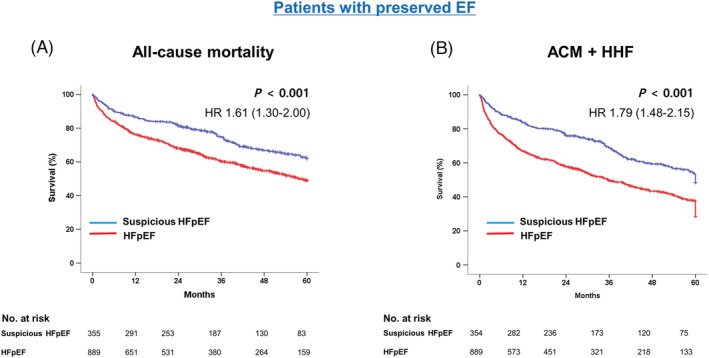
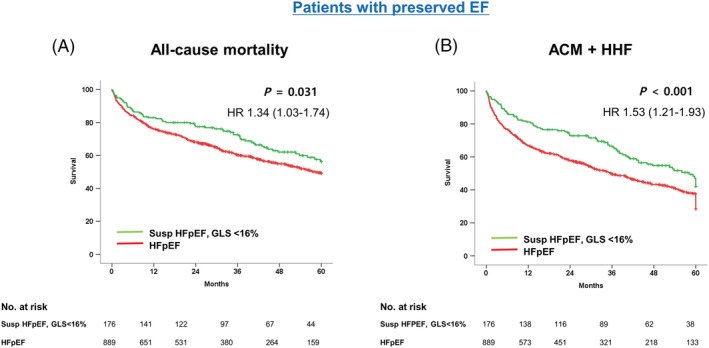
Figure 1Study population. BNP, B‐type natriuretic peptide; HFpEF, heart failure with preserved ejection fraction; LVEF, left ventricular ejection fraction; NT‐pro‐BNP, N‐terminal pro‐B‐type natriuretic peptide.Figure 2Kaplan–Meier estimates of 5 year all‐cause mortality and hospitalization for heart failure in patients with preserved EF. Among patients with preserved EF, HFpEF patients with significant diastolic dysfunction had higher all‐cause mortality (A) and higher the composite of all‐cause mortality or hospitalization for heart failure (B) than the suspicious HFpEF patients without significant diastolic dysfunction. ACM, all‐cause mortality; GLS, global longitudinal strain; HFpEF, heart failure with preserved ejection fraction; HHF, hospitalization for heart failure; HR, hazard ratio; CI, confidence interval.Figure 3Kaplan–Meier estimates of 5 year all‐cause mortality and hospitalization for heart failure in patients with suspicious HFpEF without diastolic dysfunction. Among suspicious HFpEF without diastolic dysfunction, those with impaired GLS had higher all‐cause mortality (A) and higher the composite of all‐cause mortality or hospitalization for heart failure (B). ACM, all‐cause mortality; GLS, global longitudinal strain; HFpEF, heart failure with preserved ejection fraction; HHF, hospitalization for heart failure; HR, hazard ratio; CI, confidence interval.Figure 4Kaplan–Meier estimates of 5 year all‐cause mortality and hospitalization for heart failure in patients with HFpEF and suspicious HFPEF with impaired GLS. The mean GLS was 14.7 ± 4.7% for HFpEF and 12.5 ± 2.7 for suspicious HFpEF with impaired GLS. Suspicious HFpEF patients with impaired GLS had lower all‐cause mortality (A) and lower the composite of all‐cause mortality or hospitalization for heart failure (B). ACM, all‐cause mortality; GLS, global longitudinal strain; HFpEF, heart failure with preserved ejection fraction; HHF, hospitalization for heart failure; HR, hazard ratio; CI, confidence interval.Figure 5When stratifying these patients according to global longitudinal strain (GLS) and comparing them to age and sex‐matched population, suspicious HFpEF patients with impaired GLS had a worse prognosis, whereas those with normal GLS had similar outcomes as the controls (A). Patients with LVEF ≥50% and elevated levels of NPs, without significant diastolic dysfunction would have been classified as not having HF per contemporary definition of HFpEF. Because HF is a disease with worse prognosis, only those with impaired GLS are true, invisible HF patients. Therefore, myocardial strain may be used to identify invisible HF patients (B). GLS, global longitudinal strain; LVEF, left ventricular ejection fraction; HR, hazard ratio; CI, confidence interval.