
J Korean Med Sci. 2023;38(1):e4.
Rapid FEV1/FVC Decline Is Related With Incidence of Obstructive Lung Disease and Mortality in General Population.
제1저자 최광용 · 교신저자 이현우
소속 (2)
- Division of Pulmonary and Critical Care Medicine, Department of Internal Medicine, Seoul National University College of Medicine, Seoul Metropolitan Government-Seoul National University Boramae Medical Center, Seoul, Korea.
- Division of Pulmonary and Critical Care Medicine, Department of Internal Medicine, Seoul National University College of Medicine, Seoul Metropolitan Government-Seoul National University Boramae Medical Center, Seoul, Korea. athrunzara86@snu.ac.kr.
Abstract
BACKGROUND Forced expiratory volume in 1 second (FEV1)/forced vital capacity (FVC) naturally decreases with age; however, an excessive decline may be related with increased morbidity and mortality. This study aimed to evaluate the FEV1/FVC decline rate in the Korean general population and to identify whether rapid FEV1/FVC decline is a risk factor for obstructive lung disease (OLD) and all-cause and respiratory mortality.
METHODS We evaluated individuals aged 40-69 years who underwent baseline and biannual follow-up spirometric assessments for up to 18 years, excluding those with airflow limitations at baseline. Based on the quartiles of the annual FEV1/FVC decline rate, the most negative FEV1/FVC change (1st quartile of annual FEV1/FVC decline rate) was classified as rapid FEV1/FVC decline. We investigated the risk of progression to OLD and all-cause and respiratory mortality in individuals with rapid FEV1/FVC decline.
RESULTS The annual FEV1/FVC decline rate in the eligible 7,768 patients was 0.32 percentage point/year. The incidence rate of OLD was significantly higher in patients with rapid FEV1/FVC decline than in those with non-rapid FEV1/FVC decline (adjusted incidence rate, 2.119; 95% confidence interval [CI], 1.932-2.324). Rapid FEV1/FVC decline was an independent risk factor for all-cause mortality (adjusted hazard [HR], 1.374; 95% CI, 1.105-1.709) and respiratory mortality (adjusted HR, 1.353; 95% CI, 1.089-1.680).
CONCLUSION The annual FEV1/FVC decline rate was 0.32%p in the general population in Korea. The incidence rate of OLD and the hazards of all-cause and respiratory mortality were increased in rapid FEV1/FVC decliners.
© 2023 The Korean Academy of Medical Sciences.
Keywords
Cohort StudiesForced Expiratory VolumeForced Vital CapacityMortalityRespiratory Function TestsRisk Factors
Figures
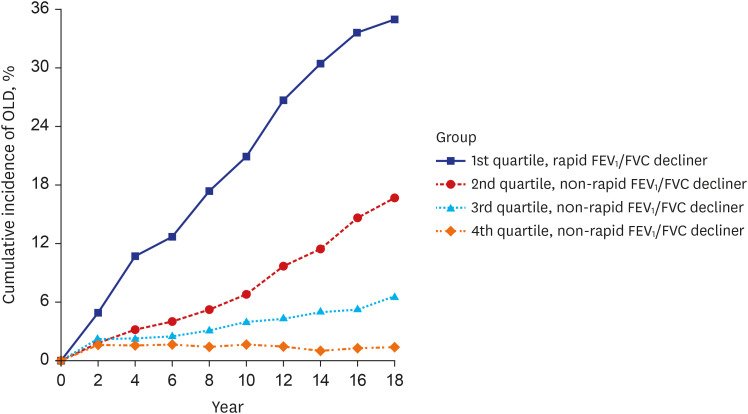
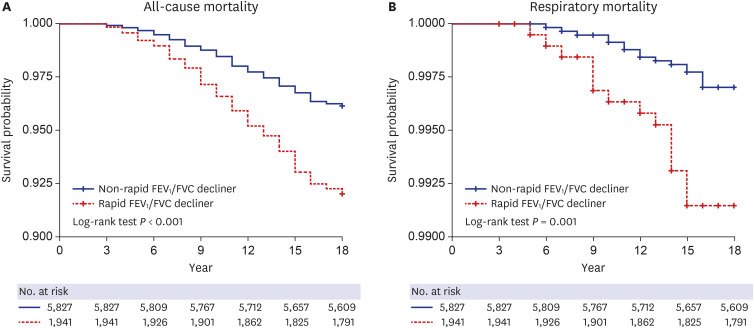
그림 출처: PubMed Central 공개 논문 (PMC9807769)
Conflict of interest statement
The authors have no potential conflicts of interest to disclose.
그 밖의 정보
- 출판 형태
- Journal Article
- 저널
- Journal of Korean medical science · eISSN 1598-6357
- 전자 출판
- 2023-01-02
- MeSH
- Humans · Incidence · Lung* · Vital Capacity · Lung Diseases, Obstructive* · Forced Expiratory Volume · Spirometry
- 참고문헌
- 49편