
Pediatr Allergy Immunol. 2026;37(5):e70374.
MicroRNA clustering in pediatric asthma reveals differential corticosteroid responsiveness.
제1저자 양민석 · 교신저자 Kelan Tantisira
소속 (7)
- Division of Pediatric Respiratory Medicine, Department of Pediatrics, University of California san Diego, La Jolla, California, USA.
- Department of Internal Medicine, Seoul National University College of Medicine, Seoul, Korea.
- Department of Neurology, Yale School of Medicine, Yale University, New Haven, Connecticut, USA.
- Computational Health Informatics Program, Boston Children's Hospital, Boston, Massachusetts, USA.
- Molecular Physiology and Biophysics, Vanderbilt University, Nashville, Tennessee, USA.
- Channing Division of Network Medicine, Brigham and Women's Hospital, Boston, Massachusetts, USA.
- Division of Respiratory Medicine, Rady Children's Hospital, San Diego, California, USA.
Abstract
BACKGROUND Asthma is a heterogeneous disease with variable treatment responses. miRNAs play a critical role in asthma pathogenesis and may serve as biomarkers for distinct asthma endotypes. We tried to identify possible molecular asthma clusters based on miRNA expression profiles in pediatric patients from the Childhood Asthma Management Program (CAMP) cohort.
METHODS We performed miRNA profiling and k-means clustering on 462 CAMP participants. Differential miRNA expression and pathway enrichment analyses were conducted to characterize cluster-associated molecular features. Clinical characteristics and budesonide-related changes in lung function were compared across clusters, including analyses stratified by peripheral blood eosinophil counts.
RESULTS Three possible molecular clusters were identified, each with distinct miRNA expression patterns and enriched biological pathways. All clusters showed enrichment in IL-4/IL-13 signaling and PIP3/AKT pathways. Cluster 1 was characterized by Toll-like receptor-related signaling pathways, Cluster 2 by FOXO-mediated transcription pathways, and Cluster 3 by pathways associated with SCF-KIT signaling. Baseline demographic and clinical characteristics were largely similar across clusters. However, patterns of budesonide-related lung function change differed. Clusters 1 and 3 showed more favorable lung function profiles after budesonide treatment than Cluster 2. In Cluster 1, eosinophilic participants had a higher proportion of moderate asthma, whereas those without eosinophilia were more often classified as having mild asthma. In Cluster 3, eosinophilic participants had greater baseline airway hyperresponsiveness and lower baseline FEV1/FVC but showed greater improvement in FEV1/FVC after budesonide.
CONCLUSION miRNA profiling identified possible molecular asthma clusters with different clinical, physiologic, and treatment-related patterns.
© 2026 The Author(s). Pediatric Allergy and Immunology published by European Academy of Allergy and Clinical Immunology and John Wiley & Sons Ltd.
Keywords
asthmacluster analysismicroRNA
Figures
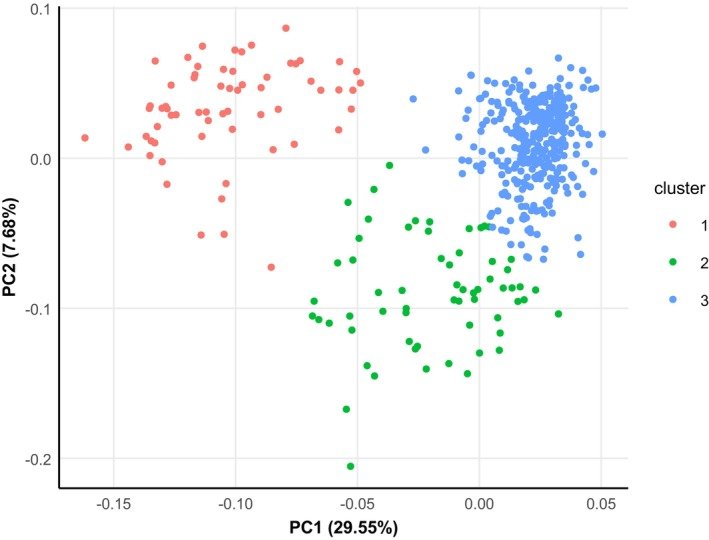

그림 출처: PubMed Central 공개 논문 (PMC13172431)
Conflict of interest statement
All authors declared that none have a conflict of interest related to this article.
그 밖의 정보
- 출판 형태
- Journal Article
- 저널
- Pediatric allergy and immunology : official publication of the European Society of Pediatric Allergy and Immunology · eISSN 1399-3038
- MeSH
- Humans · MicroRNAs* / genetics · Asthma* / drug therapy / genetics / diagnosis · Female · Child · Male · Budesonide* / therapeutic use · Cluster Analysis · Gene Expression Profiling · Adrenal Cortex Hormones* / therapeutic use · Adolescent · Clustering Algorithms · Signal Transduction · Eosinophils / immunology · Child, Preschool · Treatment Outcome · Biomarkers
- Substances
- MicroRNAs · Budesonide · Adrenal Cortex Hormones · Biomarkers
- 연구비
- NHLBI NIH HHS R01 HL127332 · NHLBI NIH HHS R01 HL161362 · NHLBI NIH HHS R01 HL162570 · NIH HHS
- 참고문헌
- 30편