
PLoS One. 2014;9(4):e93633.
Serum bilirubin affects graft outcomes through UDP-glucuronosyltransferase sequence variation in kidney transplantation.
제1저자 이정표 · 교신저자 임춘수
소속 (5)
- Department of Internal Medicine, Seoul National University Boramae Medical Center, Seoul, Korea.
- Department of Internal Medicine, Chung-Ang University Hospital, Seoul, Korea.
- Department of Internal Medicine, Seoul National University College of Medicine, Seoul, Korea; Kidney Research Institute, Seoul National University College of Medicine, Seoul, Korea.
- Department of Internal Medicine, Seoul National University College of Medicine, Seoul, Korea.
- Department of Surgery, Seoul National University College of Medicine, Seoul, Korea.
Abstract
BACKGROUND Oxidative stress is a major mediator of adverse outcome after kidney transplantation. Bilirubin is produced by heme oxygenase-1 (HO-1), catalyzed by UDP-glucuronosyltransferase (UGT1A1), and has potential as an antioxidant. In this study, we investigated the effects of HO-1 and UGT1A1 sequence variations on kidney allograft outcomes.
METHODS Clinical data were collected from 429 Korean recipients who underwent kidney transplantation from 1990-2008. Genotyping for UGT1A1*28 and HO-1 (A-413T) was performed. Acute rejection and graft survival were monitored as end-points.
RESULTS Serum levels of total bilirubin were significantly increased after transplantation (0.41 ± 0.19 mg/dL to 0.80 ± 0.33 mg/dL, P<0.001). Post-transplant 1-year bilirubin level was higher in 6/7 or 7/7 carriers compared with 6/6 homozygotes in terms of the UGT1A1*28 polymorphism (6/6 vs. 6/7 vs. 7/7: 0.71 ± 0.27 vs. 1.06 ± 0.36 vs. 1.10 ± 0.45 mg/dL, P<0.001). According to an additive model of genotype analysis, the 7-allele genotype had a protective effect on the development of acute rejection compared with the 6-allele (odds ratio 0.43, 95% CI 0.25-0.73, P for trend = 0.006). Multivariate Cox regression analysis revealed that individuals carrying the 7-allele had a decreased risk of graft loss, by a factor of 0.36 (95% CI 0.15-0.85, P = 0.019). The HO-1 (A-413T) polymorphism had no effect on serum bilirubin levels or graft outcomes.
CONCLUSIONS The UGT1A1*28 polymorphism is associated with changes in serum bilirubin and with graft outcome after kidney transplantation.
Figures
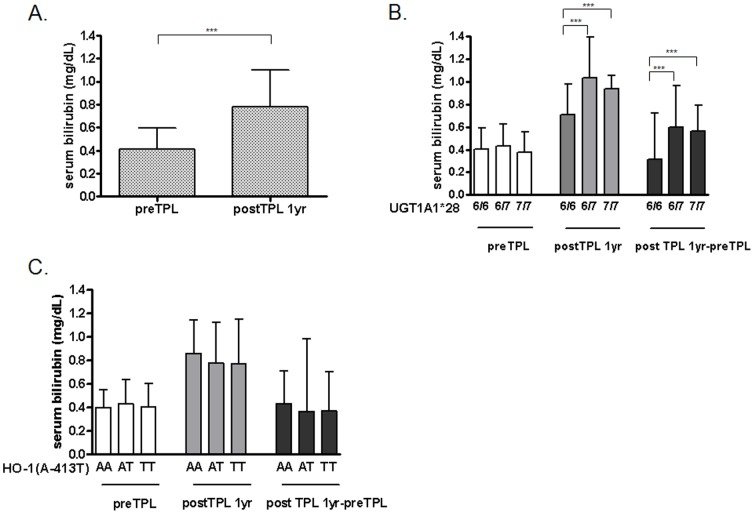
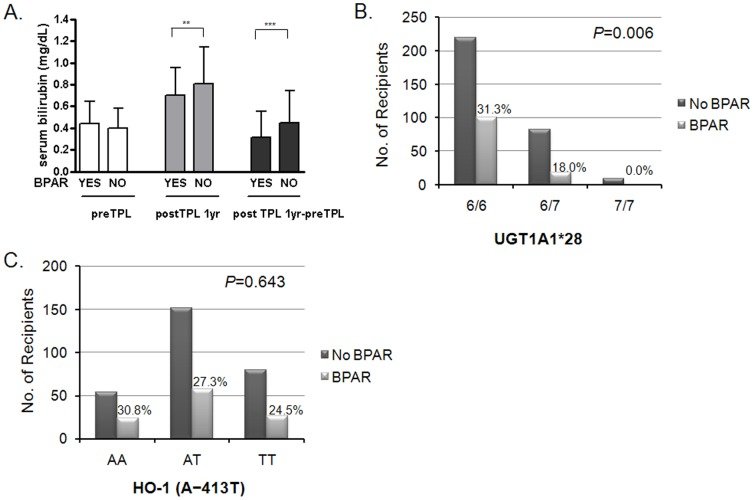
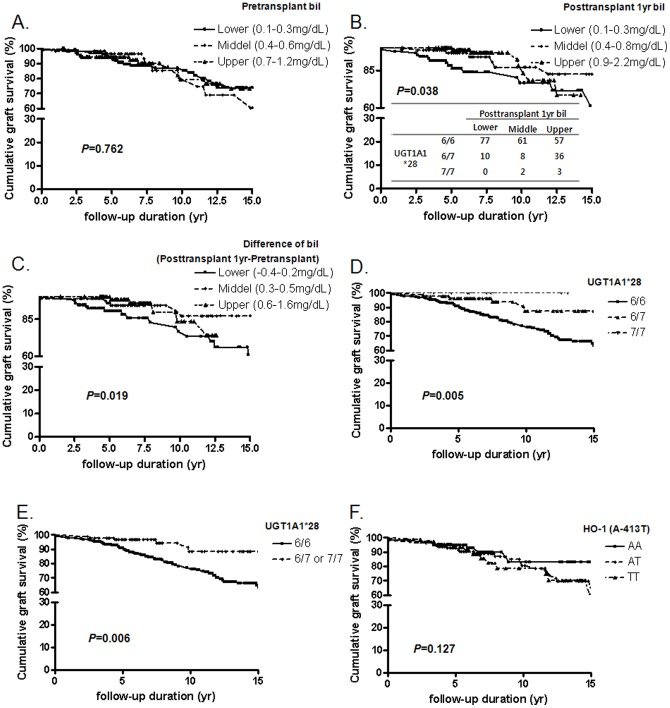
그림 출처: PubMed Central 공개 논문 (PMC3972238)
Conflict of interest statement
Competing Interests:The authors have declared that no competing interests exist.
그 밖의 정보
- 출판 형태
- Journal Article, Research Support, Non-U.S. Gov't
- 저널
- PloS one · eISSN 1932-6203
- 전자 출판
- 2014-04-01
- MeSH
- Adult · Antioxidants / metabolism · Bilirubin / blood · Female · Genetic Association Studies · Genotype · Glucuronosyltransferase / genetics · Graft Rejection / genetics / pathology · Heme Oxygenase-1 / genetics · Humans · Kidney Transplantation / adverse effects · Male · Middle Aged · Oxidative Stress / genetics · Polymorphism, Single Nucleotide · UGT1A1 Enzyme
- Substances
- Antioxidants · Bilirubin · Glucuronosyltransferase · Heme Oxygenase-1 · UGT1A1 Enzyme
- 참고문헌
- 42편