
J Korean Med Sci. 2022;37(34):e262.
Comprehensive Rehabilitation in Severely Ill Inpatients With COVID-19: A Cohort Study in a Tertiary Hospital.
제1저자 우현성 · 교신저자 송경호, 범재원
소속 (4)
- Department of Rehabilitation Medicine, Seoul National University College of Medicine, Seoul National University Bundang Hospital, Seongnam, Korea.
- Department of Internal Medicine, Seoul National University College of Medicine, Seoul National University Bundang Hospital, Seongnam, Korea.
- Department of Internal Medicine, Seoul National University College of Medicine, Seoul National University Bundang Hospital, Seongnam, Korea. khsongmd@gmail.com.
- Department of Rehabilitation Medicine, Seoul National University College of Medicine, Seoul National University Bundang Hospital, Seongnam, Korea. powe5@snubh.org.
Abstract
BACKGROUND This study aimed to investigate the effects of comprehensive rehabilitation management on functional recovery and examine the correlation between clinical parameters and improvements in functional outcomes in severe-to-critical inpatients with coronavirus disease 2019 (COVID-19) in a tertiary hospital.
METHODS Post-acute COVID-19 patients who had a World Health Organization (WHO) ordinal scale of 5-7, underwent intensive care, and received comprehensive rehabilitation management, including exercise programs, nutritional support, dysphagia evaluation, and psychological care were included. The appendicular skeletal muscle mass index (SMI), Medical Research Council sum score, handgrip strength, number of repetitions in the 1-minute sit-to-stand test, gait speed, Berg Balance Scale (BBS), and Functional Ambulation Classification (FAC) were evaluated at hospital stay, discharge, and 1-month follow-up. The correlation between the rehabilitation dose and improvement in each outcome measure was analyzed.
RESULTS Overall, 37 patients were enrolled, of whom 59.5% and 32.4% had a score of 6 and 7 on the WHO ordinal scale, respectively. Lengths of stay in the intensive care unit and hospital were 33.6 ± 23.9 and 63.8 ± 36.5 days. Outcome measures revealed significant improvements at discharge and 1-month follow-up. The SMI was significantly increased at the 1-month follow-up (6.13 [5.24-7.76]) compared with that during the hospital stay (5.80 [5.39-7.05]). We identified dose-response associations between the rehabilitation dose and FAC (ρ = 0.46) and BBS (ρ = 0.50) scores. Patients with older age, longer hospitalization, longer stay at the intensive care unit, longer duration of mechanical ventilation, tracheostomy, a more depressive mood, and poorer nutritional status revealed poorer improvement in gait speed at the 1-month follow-up.
CONCLUSION Comprehensive rehabilitation management effectively improved muscle mass, muscle strength, and physical performance in severe-to-critical COVID-19 patients. Dose-response relationship of rehabilitation and functional improvement emphasizes the importance of intensive post-acute inpatient rehabilitation in COVID-19 survivors.
TRIAL REGISTRATION ClinicalTrials.gov Identifier: NCT05104411.
© 2022 The Korean Academy of Medical Sciences.
Keywords
Coronavirus Disease 2019 (COVID-19)Critical IllnessOutcome AssessmentRecovery of FunctionRehabilitation
Figures
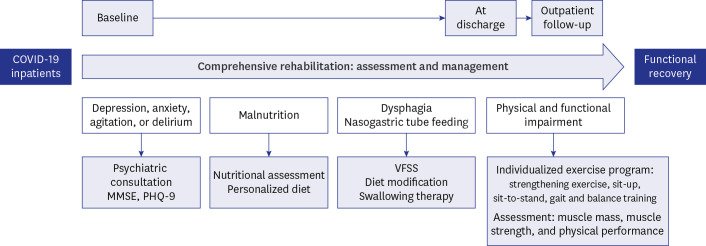
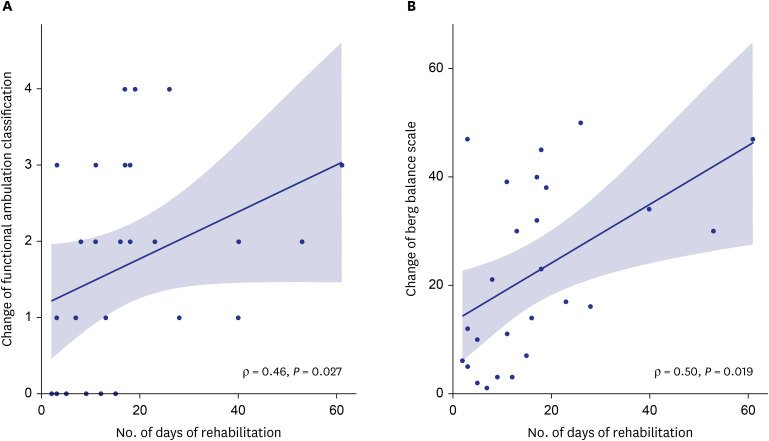
그림 출처: PubMed Central 공개 논문 (PMC9424699)
Conflict of interest statement
The authors have no potential conflicts of interest to disclose.
그 밖의 정보
- 출판 형태
- Journal Article
- 저널
- Journal of Korean medical science · eISSN 1598-6357
- 전자 출판
- 2022-08-29
- MeSH
- COVID-19* · Cohort Studies · Hand Strength · Humans · Inpatients · Intensive Care Units · Tertiary Care Centers
- 데이터
- ClinicalTrials.gov: NCT05104411
- 참고문헌
- 55편