
J Korean Med Sci. 2022;37(32):e252.
Breakthrough COVID-19 Infection During the Delta Variant Dominant Period: Individualized Care Based on Vaccination Status Is Needed.
제1저자 이찬미 · 교신저자 박상원
소속 (4)
- Department of Internal Medicine, Seoul National University College of Medicine, Seoul, Korea.
- Department of Internal Medicine, Seoul Metropolitan Government-Seoul National University Boramae Medical Center, Seoul, Korea.
- Division of Infectious Diseases, Department of Internal Medicine, Seoul National University Bundang Hospital, Seongnam, Korea.
- Department of Internal Medicine, Seoul Metropolitan Government-Seoul National University Boramae Medical Center, Seoul, Korea. hswon1@snu.ac.kr.
Abstract
BACKGROUND The clinical features of coronavirus disease 2019 (COVID-19) patients in the COVID-19 vaccination era need to be clarified because breakthrough infection after vaccination is not uncommon.
METHODS We retrospectively analyzed hospitalized COVID-19 patients during a delta variant-dominant period 6 months after the national COVID-19 vaccination rollout. The clinical characteristics and risk factors for severe progression were assessed and subclassified according to vaccination status.
RESULTS A total of 438 COVID-19 patients were included; the numbers of patients in the unvaccinated, partially vaccinated and fully vaccinated groups were 188 (42.9%), 117 (26.7%) and 133 (30.4%), respectively. The vaccinated group was older, less symptomatic and had a higher Charlson comorbidity index at presentation. The proportions of patients who experienced severe progression in the unvaccinated and fully vaccinated groups were 20.3% (31/153) and 10.8% (13/120), respectively. Older age, diabetes mellitus, solid cancer, elevated levels of lactate dehydrogenase and chest X-ray abnormalities were associated with severe progression, and the vaccination at least once was the only protective factor for severe progression. Chest X-ray abnormalities at presentation were the only predictor for severe progression among fully vaccinated patients.
CONCLUSION In the hospitalized setting, vaccinated and unvaccinated COVID-19 patients showed different clinical features and risk of oxygen demand despite a relatively high proportion of patients in the two groups. Vaccination needs to be assessed as an initial checkpoint, and chest X-ray may be helpful for predicting severe progression in vaccinated patients.
© 2022 The Korean Academy of Medical Sciences.
Keywords
Breakthrough InfectionCOVID-19Oxygen TherapySARS-CoV-2Severe Progression
Figures
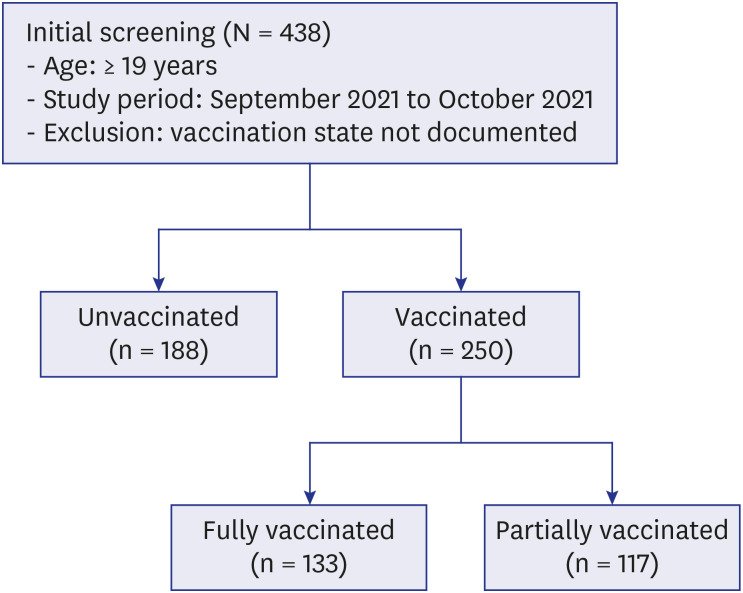
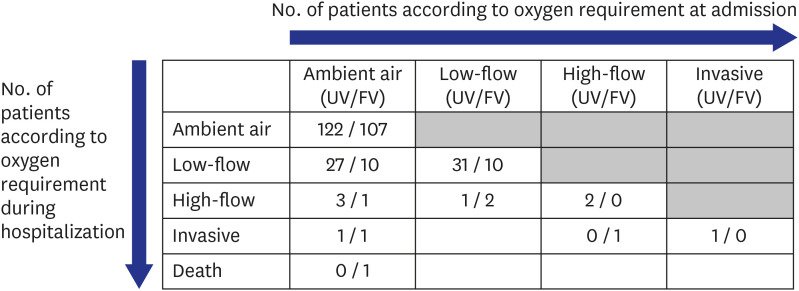
그림 출처: PubMed Central 공개 논문 (PMC9424692)
Conflict of interest statement
The authors have no potential conflicts of interest to disclose.
그 밖의 정보
- 출판 형태
- Journal Article
- 저널
- Journal of Korean medical science · eISSN 1598-6357
- 전자 출판
- 2022-08-15
- MeSH
- COVID-19* / epidemiology / prevention & control · COVID-19 Vaccines* · Humans · Retrospective Studies · SARS-CoV-2 · Vaccination · Breakthrough Infections
- Substances
- COVID-19 Vaccines
- 연구비
- Seoul Metropolitan Government Seoul National University Boramae Medical Center 04-2022-0007
- 참고문헌
- 19편