
J Korean Med Sci. 2022;37(29):e228.
Clinical Characteristics of COVID-19: Use of Steroids in Mostly Unvaccinated COVID-19 Patients Before the Omicron Variant.
제1저자 오상민 · 교신저자 함신영, 박상원
소속 (5)
- Department of Internal Medicine, Jeonbuk National University Medical School and Hospital, Jeonju, Korea.
- Department of Internal Medicine, Seoul Metropolitan Government-Seoul National University Boramae Medical Center, Seoul, Korea.
- Department of Internal Medicine, Veterans Health Service Medical Center, Seoul, Korea.
- Department of Internal Medicine, Korea Cancer Center Hospital, Seoul, Korea.
- Department of Internal Medicine, Seoul Metropolitan Government-Seoul National University Boramae Medical Center, Seoul, Korea. hswon1@snu.ac.kr.
Abstract
BACKGROUND Glucocorticoids are one of the current standard agents for moderate to severe coronavirus disease 2019 (COVID-19) treatment based on the RECOVERY trial. Data on the real clinical application of steroids for COVID-19 are scarce and will help guide the optimal use of steroids. We described the current prescription pattern of steroids for COVID-19 and investigated the factors related to specific practices.
METHODS All adults aged ≥ 19 years who were diagnosed with COVID-19 by real-time reverse transcription-polymerase chain reaction and admitted to one of 3 study hospitals from 8 December 2020 to 30 June 2021 were enrolled. Demographic and clinical data, including medications and oxygen therapy, were retrospectively collected from electronic medical records. The severity of comorbidities and COVID-19 were measured. The subjects were divided into steroid and nonsteroid groups, and the steroid group was then subdivided into standard and higher/longer groups.
RESULTS Among a total of 805 patients, 217 (27.0%) were treated with steroids. The steroid group showed a higher rate of oxygen therapy (81.1% vs. 2.7%), more concomitant use of remdesivir (77.4% vs. 1.4%) or antibiotics (79.3% vs. 4.3%), and a higher proportion of high risk according to National Early Warning Score-2 score (30.0% vs. 0.9%) or severe risk according to National Institute of Allergy and Infectious Disease Ordinal Scale score (81.1% vs. 2.7%) than the nonsteroid group. The mortality of the steroid group was 4.6%. In the steroid group, 82.5% received a standard or lower dose of steroids within ten days, and 17.5% (38/217) received a higher or longer dose of steroids. Multivariate analysis showed that initial lymphopenia (adjusted odds ratio [aOR], 0.94; 95% confidence interval [CI], 0.89-0.99) and high level of lactate dehydrogenase (LDH) (aOR, 1.00; 95% CI, 1.00-1.01) were independent risk factors for higher doses or longer steroid use.
CONCLUSION The dose and duration of steroids were in line with current guidelines in 82.5% of COVID-19 patients, but the outliers may need tailored therapy according to surrogate markers, such as initial lymphopenia or high level of LDH.
© 2022 The Korean Academy of Medical Sciences.
Keywords
COVID-19SARS-CoV-2Steroid
Figures
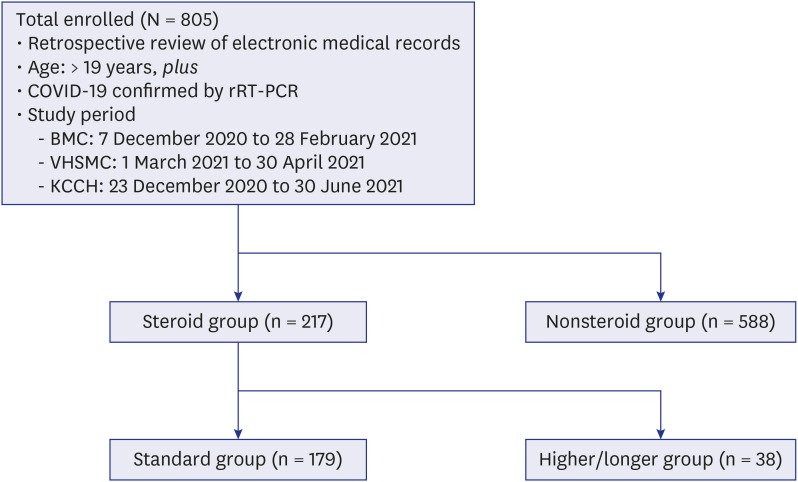
그림 출처: PubMed Central 공개 논문 (PMC9313976)
Comment · 정정
Conflict of interest statement
The authors have no potential conflicts of interest to disclose.
그 밖의 정보
- 출판 형태
- Journal Article
- 저널
- Journal of Korean medical science · eISSN 1598-6357
- 전자 출판
- 2022-07-25
- MeSH
- Adult · COVID-19* · Humans · Lymphopenia* · Oxygen · Retrospective Studies · SARS-CoV-2 · Steroids / therapeutic use
- Substances
- Steroids · Oxygen
- 참고문헌
- 16편