
Endocrinol Metab (Seoul). 2022;37(1):124-137.
Adrenal Morphology as an Indicator of Long-Term Disease Control in Adults with Classic 21-Hydroxylase Deficiency.
제1저자 김택민, 김정희 · 교신저자 김상윤
소속 (4)
- Department of Radiology, Seoul National University Hospital, Seoul National University College of Medicine, Seoul, Korea.
- Department of Internal Medicine, Seoul National University Hospital, Seoul National University College of Medicine, Seoul, Korea.
- Molecular Recognition Research Center, Korea Institute of Science and Technology, Seoul, Korea.
- Institute of Radiation Medicine and Kidney Research Institute, Seoul National University Medical Research Center, Seoul, Korea.
Abstract
BACKGROUND Monitoring adults with classical 21-hydroxylase deficiency (21OHD) is challenging due to variation in clinical and laboratory settings. Moreover, guidelines for adrenal imaging in 21OHD are not yet available. We evaluated the relationship between adrenal morphology and disease control status in classical 21OHD.
METHODS This retrospective, cross-sectional study included 90 adult 21OHD patients and 270 age- and sex-matched healthy controls. We assessed adrenal volume, width, and tumor presence using abdominal computed tomography and evaluated correlations of adrenal volume and width with hormonal status. We investigated the diagnostic performance of adrenal volume and width for identifying well-controlled status in 21OHD patients (17α-hydroxyprogesterone [17-OHP] <10 ng/mL).
RESULTS The adrenal morphology of 21OHD patients showed hypertrophy (45.6%), normal size (42.2%), and hypotrophy (12.2%). Adrenal tumors were detected in 12 patients (13.3%). The adrenal volume and width of 21OHD patients were significantly larger than those of controls (18.2±12.2 mL vs. 7.1±2.0 mL, 4.7±1.9 mm vs. 3.3±0.5 mm, P<0.001 for both). The 17-OHP and androstenedione levels were highest in patients with adrenal hypertrophy, followed by those with normal adrenal glands and adrenal hypotrophy (P<0.05 for both). Adrenal volume and width correlated positively with adrenocorticotropic hormone, 17-OHP, 11β-hydroxytestosterone, progesterone sulfate, and dehydroepiandrosterone sulfate in both sexes (r=0.33-0.95, P<0.05 for all). For identifying well-controlled patients, the optimal cut-off values of adrenal volume and width were 10.7 mL and 4 mm, respectively (area under the curve, 0.82-0.88; P<0.001 for both).
CONCLUSION Adrenal volume and width may be reliable quantitative parameters for monitoring patients with classical 21OHD.
Keywords
Adrenal cortexAdrenal hyperplasia, congenitalAdrenal volumeAndrogens
Figures

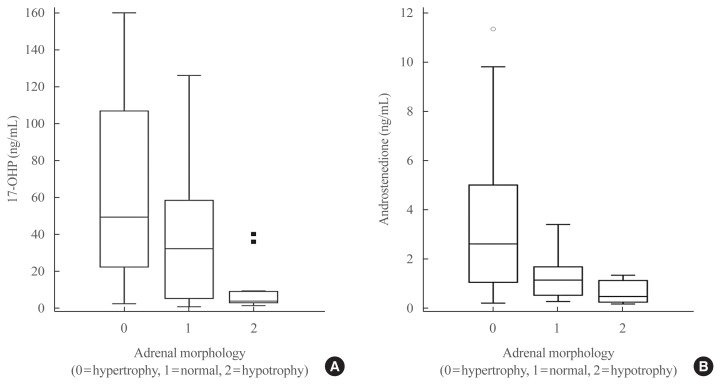
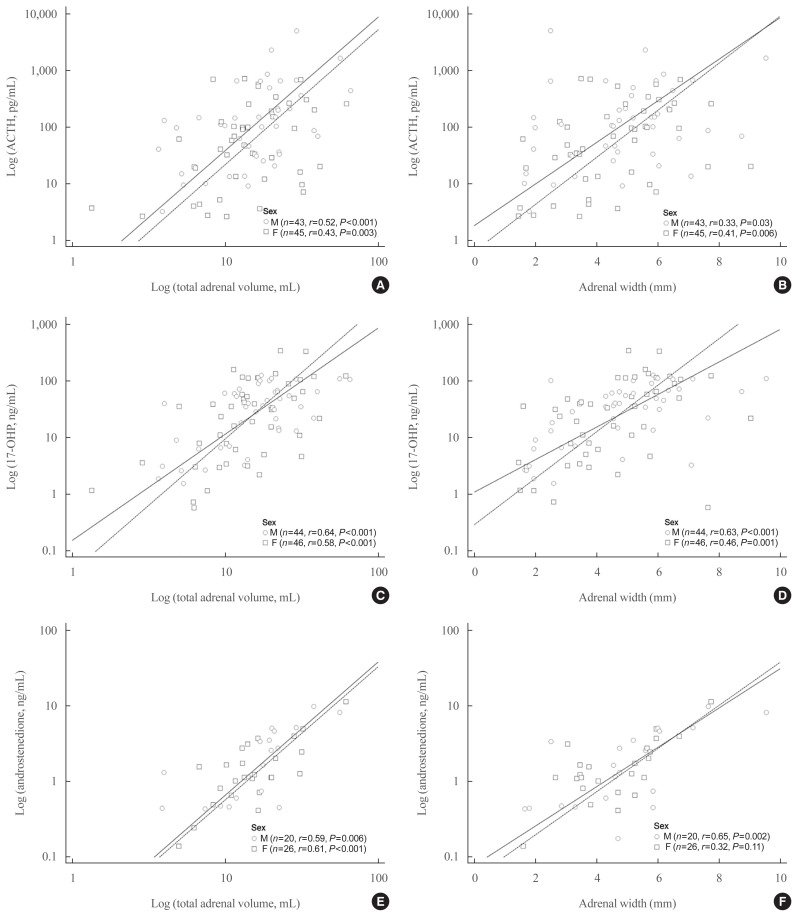

그림 출처: PubMed Central 공개 논문 (PMC8901969)
Conflict of interest statement
CONFLICTS OF INTEREST . No potential conflict of interest relevant to this article was reported.
그 밖의 정보
- 출판 형태
- Journal Article
- 저널
- Endocrinology and metabolism (Seoul, Korea) · eISSN 2093-5978
- 전자 출판
- 2022-02-08
- MeSH
- 17-alpha-Hydroxyprogesterone · Adrenal Hyperplasia, Congenital* / diagnosis · Adult · Cross-Sectional Studies · Female · Humans · Male · Retrospective Studies
- Substances
- 17-alpha-Hydroxyprogesterone
- 참고문헌
- 25편