
Endocrinol Metab (Seoul). 2021;36(3):574-581.
A Multicenter, Randomized, Controlled Trial for Assessing the Usefulness of Suppressing Thyroid Stimulating Hormone Target Levels after Thyroid Lobectomy in Low to Intermediate Risk Thyroid Cancer Patients (MASTER): A Study Protocol.
제1저자 이은경, 강예은 · 교신저자 박영주, 구본석
소속 (26)
- Center for Thyroid Cancer, National Cancer Center, Goyang, Korea.
- Department of Internal Medicine, Chungnam National University College of Medicine, Daejeon, Korea.
- Department of Internal Medicine, Seoul National University College of Medicine, Seoul, Korea.
- Department of Otorhinolaryngology-Head and Neck Surgery, Chungnam National University College of Medicine, Daejeon, Korea.
- Department of Surgery, Asan Medical Center, University of Ulsan College of Medicine, Seoul, Korea.
- Department of Internal Medicine, Chungbuk National University College of Medicine, Cheongju, Korea.
- Department of Otorhinolaryngology-Head and Neck Surgery, Chungnam National University Sejong Hospital, Sejong, Korea.
- Department of Internal Medicine, Dankook University College of Medicine, Cheonan, Korea.
- Department of Internal Medicine, Daegu Catholic University School of Medicine, Daegu, Korea.
- Department of Surgery, Ewha Womans University School of Medicine, Seoul, Korea.
- Department of Surgery, Gangnam Severance Hospital, Yonsei University College of Medicine, Seoul, Korea.
- Department of Internal Medicine, Konyang University Hospital, Daejeon, Korea.
- Department of Breast and Endocrine Surgery, Hallym University Sacred Heart Hospital, Anyang, Korea.
- Department of Surgery, Inje University Busan Paik Hospital, Busan, Korea.
- Department of Internal Medicine, Nowon Eulji Medical Center, Eulji University, Seoul, Korea.
- Department of Internal Medicine, Pusan National University Hospital, Busan, Korea.
- Division of Endocrinology & Metabolism, Department of Medicine, Thyroid Center, Samsung Medical Center, Sungkyunkwan University School of Medicine, Seoul, Korea.
- Department of Internal Medicine, Seoul Metropolitan Government Seoul National University Boramae Medical Center, Seoul, Korea.
- Department of Preventive Medicine, Seoul National University College of Medicine, Seoul, Korea.
- Cancer Research Institute, Seoul National University, Seoul, Korea.
- Convergence Graduate Program in Innovative Medical Science, Seoul National University College of Medicine, Seoul, Korea.
- Department of Otorhinolaryngology-Head and Neck Surgery, Seoul National University College of Medicine, Seoul, Korea.
- Department of Surgery, Seoul National University Bundang Hospital, Seongnam, Korea.
- Department of Surgery, Seoul St. Mary's Hospital, College of Medicine, The Catholic University of Korea, Seoul, Korea.
- Department of Internal Medicine, Daejeon Eulji Medical Center, Eulji University, Daejeon, Korea.
- Department of Surgery, Yonsei University College of Medicine, Seoul, Korea.
Abstract
BACKGROUND Postoperative thyroid stimulating hormone (TSH) suppression therapy is recommended for patients with intermediate- and high-risk differentiated thyroid cancer to prevent the recurrence of thyroid cancer. With the recent increase in small thyroid cancer cases, the extent of resection during surgery has generally decreased. Therefore, questions have been raised about the efficacy and long-term side effects of TSH suppression therapy in patients who have undergone a lobectomy.
METHODS This is a multicenter, prospective, randomized, controlled clinical trial in which 2,986 patients with papillary thyroid cancer are randomized into a high-TSH group (intervention) and a low-TSH group (control) after having undergone a lobectomy. The principle of treatment includes a TSH-lowering regimen aimed at TSH levels between 0.3 and 1.99 μIU/mL in the low-TSH group. The high-TSH group targets TSH levels between 2.0 and 7.99 μIU/mL. The dose of levothyroxine will be adjusted at each visit to maintain the target TSH level. The primary outcome is recurrence-free survival, as assessed by neck ultrasound every 6 to 12 months. Secondary endpoints include disease-free survival, overall survival, success rate in reaching the TSH target range, the proportion of patients with major cardiovascular diseases or bone metabolic disease, the quality of life, and medical costs. The follow-up period is 5 years.
CONCLUSION The results of this trial will contribute to establishing the optimal indication for TSH suppression therapy in low-risk papillary thyroid cancer patients by evaluating the benefit and harm of lowering TSH levels in terms of recurrence, metabolic complications, costs, and quality of life.
Keywords
RecurrenceThyroid neoplasmsThyroidectomyThyrotropinThyroxine
Figures
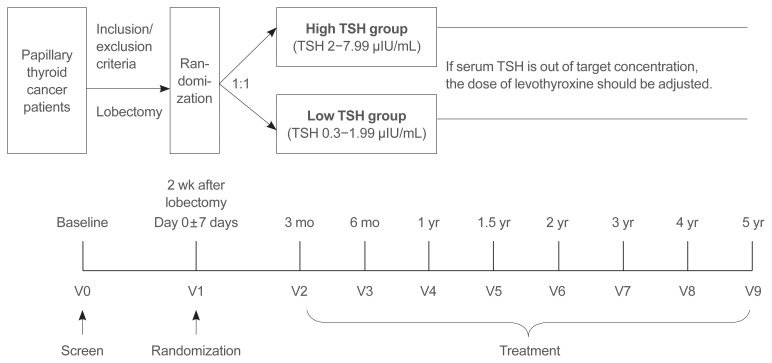
그림 출처: PubMed Central 공개 논문 (PMC8258337)
Conflict of interest statement
CONFLICTS OF INTEREST. No potential conflict of interest relevant to this article was reported.
그 밖의 정보
- 출판 형태
- Clinical Trial Protocol, Journal Article, Research Support, Non-U.S. Gov't
- 저널
- Endocrinology and metabolism (Seoul, Korea) · eISSN 2093-5978
- 전자 출판
- 2021-05-26
- MeSH
- Humans · Multicenter Studies as Topic · Prospective Studies · Quality of Life* · Randomized Controlled Trials as Topic · Thyroid Neoplasms* / drug therapy / surgery · Thyrotropin
- Substances
- Thyrotropin
- 참고문헌
- 29편