
Osteoporos Int. 2025;36(10):1951-1963.
Fracture risks in patients aged 50 years and older with panhypopituitarism: a nationwide cohort study.
제1저자 박승신, 정현묵 · 교신저자 김정희
소속 (11)
- Department of Internal Medicine, Seoul National University College of Medicine, 101 Dae-hak ro, 03080, Seoul, Korea.
- Department of Internal Medicine, Seoul National University Hospital, Seoul, South Korea.
- Pituitary Center, Seoul National University Hospital, Seoul, South Korea.
- Department of Transdisciplinary Medicine, Institute of Convergence Medicine with Innovative Technology, Seoul National University Hospital, Seoul, South Korea.
- Department of Internal Medicine, Seoul National University Bundang Hospital, Seoul, South Korea.
- Division of Endocrinology and Metabolism, Department of Internal Medicine, Boramae Medical Center, Seoul, South Korea.
- Department of Neurosurgery, Seoul National University Hospital, Seoul National University College of Medicine, Seoul, South Korea.
- Department of Medicine, College of Medicine, Seoul National University, Seoul, South Korea.
- Department of Internal Medicine, Seoul National University College of Medicine, 101 Dae-hak ro, 03080, Seoul, Korea. jhee1@snu.ac.kr.
- Department of Internal Medicine, Seoul National University Hospital, Seoul, South Korea. jhee1@snu.ac.kr.
- Pituitary Center, Seoul National University Hospital, Seoul, South Korea. jhee1@snu.ac.kr.
Abstract
UNLABELLED This study investigated fracture risks in 3,877 older adults with panhypopituitarism compared with matched controls using Korean health insurance data. Findings showed higher risks of major osteoporotic, spine, and hip fractures in both men and women with panhypopituitarism compared to controls, with a more pronounced increase in risk among men.
PURPOSE Patients with hypopituitarism are known to have increased cardiovascular risk and mortality; however, data on fracture risk are limited. We aimed to identify gender- and site-specific fracture risks and factors associated with fractures in patients aged ≥ 50 years with panhypopituitarism, compared with age-, sex-, and index year-matched controls.
METHODS Using the Korea National Health Insurance Service (NHIS) Database, we identified 3,877 patients with panhypopituitarism aged ≥ 50 years and 1:10 age-, sex-, and index year-matched controls. Demographics comorbidities, and fracture outcomes, including major osteoporotic fractures (MOFs), vertebral fractures (VFs), non-vertebral fractures (non-VFs), and hip fractures (HFs), were obtained using the International Classification of Disease-10 codes and hospital records.
RESULTS The mean ages of male and female panhypopituitary patients were 63.5 and 63.6 years, respectively. Male patients exhibited a significantly elevated risk of MOFs (hazard ratio [HR] = 2.16, 95% confidence interval [CI] = 1.87-2.48), VFs (HR = 2.13, 95% CI = 1.80-2.51), non-VFs (HR = 2.41, 95% CI = 1.94-3.00), and HFs (HR = 2.28, 95% CI = 1.59-3.27) compared to controls (all P < 0.001). Similarly, female patients demonstrated a significantly increased risk of MOFs (HR = 1.29, 95% CI = 1.16-1.42), VFs (HR = 1.45, 95% CI = 1.29-1.63), and HFs (HR = 1.68, 95% CI = 1.26-2.24) compared to controls (all P < 0.001), but not non-VFs. In addition to known risk factors like age, female sex, and fracture history, cerebrovascular disease, dementia, and low income were also associated with higher MOFs.
CONCLUSION Patients with panhypopituitarism, particularly males, have a higher risk of fracture than matched controls. Comorbidities such as dementia and cerebrovascular disease may further increase the risk of fractures.
© 2025. The Author(s).
Keywords
FractureOsteoporosisPanhypopituitarismPituitary
Figures
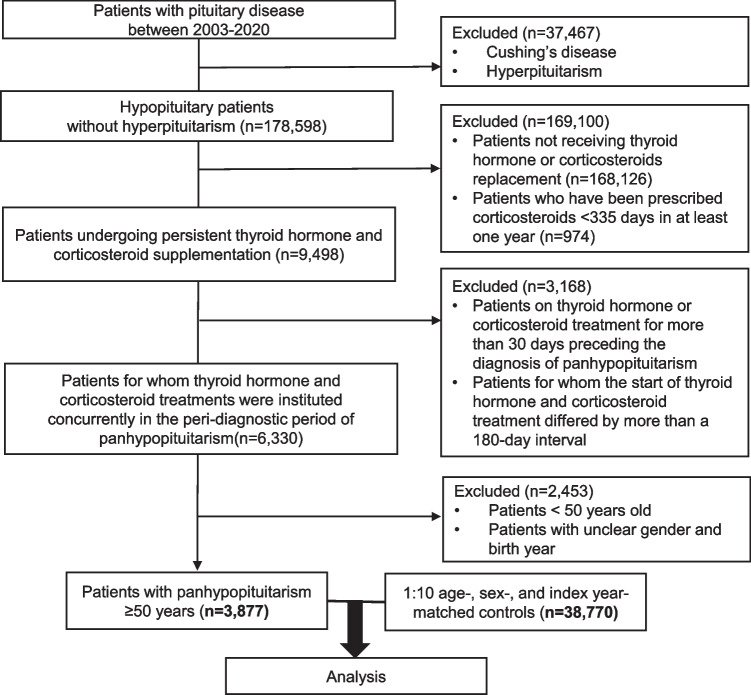
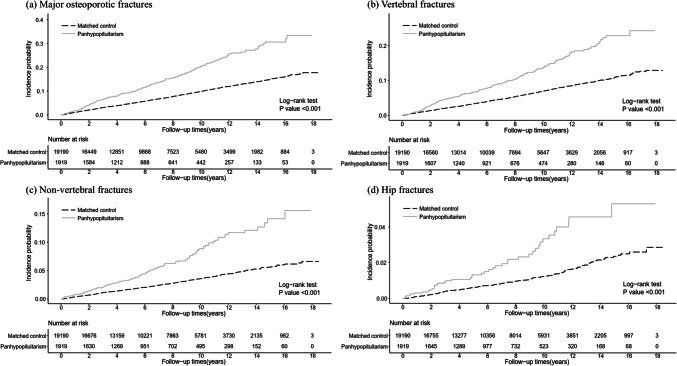
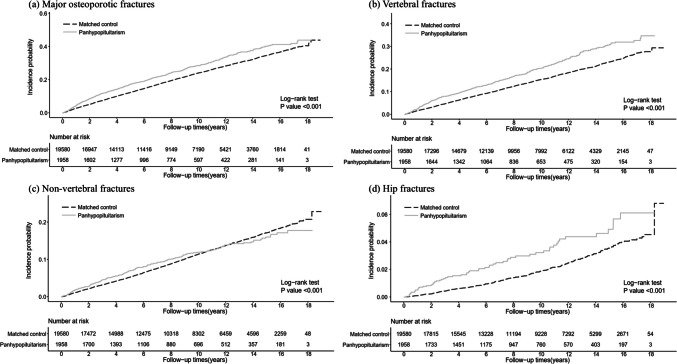
그림 출처: PubMed Central 공개 논문 (PMC12611983)
Conflict of interest statement
Declarations. Conflict of interest: Seung Shin Park, Hyunmook Jeong, Chang Ho Ahn, Min Jeong Park, Sung Hye Kong, Sang Wan Kim, Chan Soo Shin, Yong Hwy Kim, Kwangsoo Kim, and Jung Hee Kim declare that they have no conflict of interest.
그 밖의 정보
- 출판 형태
- Journal Article
- 저널
- Osteoporosis international : a journal established as result of cooperation between the European Foundation for Osteoporosis and the National Osteoporosis Foundation of the USA · eISSN 1433-2965
- 전자 출판
- 2025-07-08
- MeSH
- Humans · Female · Male · Hypopituitarism* / epidemiology / complications · Middle Aged · Aged · Osteoporotic Fractures* / epidemiology / etiology · Republic of Korea / epidemiology · Hip Fractures / epidemiology / etiology · Aged, 80 and over · Spinal Fractures / epidemiology / etiology · Case-Control Studies · Sex Distribution · Risk Assessment / methods · Age Distribution · Risk Factors · Sex Factors
- 연구비
- Korea Health Industry Development Institute HI22C0049
- 참고문헌
- 49편