
Chin J Cancer. 2017;36(1):20.
Proportion and clinical features of never-smokers with non-small cell lung cancer.
제1저자 조재영 · 교신저자 박영식
소속 (3)
- Department of Internal Medicine, Seoul National University Hospital, Seoul, 110-744, Republic of Korea.
- Department of Thoracic and Cardiovascular Surgery, Seoul National University Hospital, Seoul, 110-744, Republic of Korea.
- Department of Internal Medicine, Seoul National University Hospital, Seoul, 110-744, Republic of Korea. mdyspark@gmail.com.
Abstract
BACKGROUND The proportion of never-smokers with non-small cell lung cancer (NSCLC) is increasing, but that in Korea has not been well addressed in a large population. We aimed to evaluate the proportion and clinical features of never-smokers with NSCLC in a large single institution.
METHODS We analyzed clinical data of 1860 consecutive patients who were newly diagnosed with NSCLC between June 2011 and December 2014.
RESULTS Of the 1860 NSCLC patients, 707 (38.0%) were never-smokers. The proportions of women (83.7% vs. 5.6%) and adenocarcinoma (89.8% vs. 44.9%) were higher among never-smokers than among ever-smokers. Significantly more never-smokers were diagnosed at a younger median age (65 vs. 68 years, P < 0.001) and earlier stage (stage I-II, 44.5% vs. 38.9%, P = 0.015) compared with ever-smokers. Epidermal growth factor receptor mutations (57.8% vs. 24.4%, P < 0.001) and anaplastic lymphoma kinase rearrangements (7.8% vs. 2.8%, P < 0.001) were more common in never-smokers, whereas Kirsten rat sarcoma viral oncogene homolog mutations (5.8% vs. 9.6%, P = 0.021) were less frequently encountered in never-smokers than in ever-smokers. Never-smokers showed longer survival after adjusting for the favorable effects of younger age, female sex, adenocarcinoma histology, better performance status, early stage disease, being asymptomatic at diagnosis, received antitumor treatment, and the presence of driver mutations (hazard ratio, 0.624; 95% confidence interval, 0.460-0.848; P = 0.003).
CONCLUSIONS More than one-third of the Korean patients with NSCLC were never-smokers. NSCLC in never-smokers had different clinical characteristics and major driver mutations and resulted in longer overall survival compared with NSCLC in ever-smokers.
Keywords
Epidermal growth factor receptorKRASNever-smokerNon-small cell lung carcinomaPrognosis
Figures
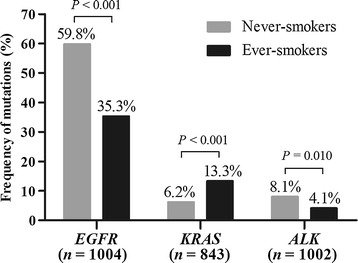
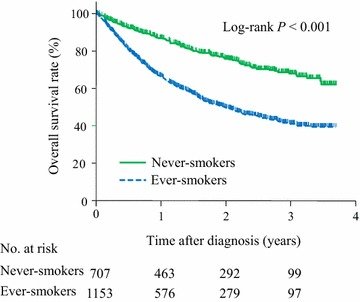
그림 출처: PubMed Central 공개 논문 (PMC5299770)
그 밖의 정보
- 출판 형태
- Journal Article
- 저널
- Chinese journal of cancer · eISSN 1944-446X
- 전자 출판
- 2017-02-08
- MeSH
- Aged · Anaplastic Lymphoma Kinase · Carcinoma, Non-Small-Cell Lung / epidemiology / genetics · ErbB Receptors / genetics · Female · Humans · Kaplan-Meier Estimate · Lung Neoplasms / epidemiology / genetics · Male · Mutation · Proto-Oncogene Proteins p21(ras) / genetics · Receptor Protein-Tyrosine Kinases / genetics · Republic of Korea / epidemiology · Smoking / epidemiology / genetics
- Substances
- KRAS protein, human · ALK protein, human · Alk protein, rat · Anaplastic Lymphoma Kinase · EGFR protein, human · ErbB Receptors · Receptor Protein-Tyrosine Kinases · Proto-Oncogene Proteins p21(ras)
- 참고문헌
- 24편