
Korean J Intern Med. 2020;35(6):1354-1363.
Association between high fatty liver index and development of colorectal cancer: a nationwide cohort study with 21,592,374 Korean.
제1저자 최윤진 · 교신저자 이동호
소속 (4)
- Department of Internal Medicine, Seoul National University Bundang Hospital, Seongnam, Korea.
- Department of Internal Medicine, Korea University Guro Hospital, Seoul, Korea.
- Department of Internal Medicine and Liver Research Institute, Seoul National University College of Medicine, Seoul, Korea.
- Department of Biostatistics, College of Medicine, The Catholic University of Korea, Seoul, Korea.
Abstract
BACKGROUND/AIMS In Korea, the incidence of colorectal cancer (CRC) and nonalcoholic fatty liver disease (NAFLD) has increased due to a westernized lifestyle. This study investigated whether a high fatty liver index that reflects NAFLD correlates with CRC.
METHODS Data from the National Health Insurance Corporation 2009 to 2012 were analyzed. NAFLD disease was defined as a fatty liver index > 60 in the absence of alcohol consumption of ≥ 30 g/day.
RESULTS NAFLD was identified in 2,543,649 (11.8%) of 21,592,374 participants. CRC was identified in 19,785 (0.8%) of participants with NAFLD (fatty liver index ≥ 60) and in 80,871 (0.6%) participants without NAFLD (fatty liver index < 30). Multivariate logistic regression analysis demonstrated an independent association between NAFLD and CRC after adjusting for other confounders (hazard ratio, 1.13; odds ratio, 1.12 to 1.15). In subgroup analyses, fatty liver index ≥ 60 was associated with CRC regardless of body mass index, but the association was more prominent in persons with a normal index. NAFLD, in the absence of diabetes, hypertension, or dyslipidemia, was more highly associated with CRC than when one or more of these conditions are present.
CONCLUSION CRC should be considered as a possibility in patients with fatty liver index ≥ 60, even in the absence of obesity or other metabolic syndromes.
Keywords
Colorectal neoplasmsMetabolic syndromeNon-alcoholic fatty liver disease
Figures

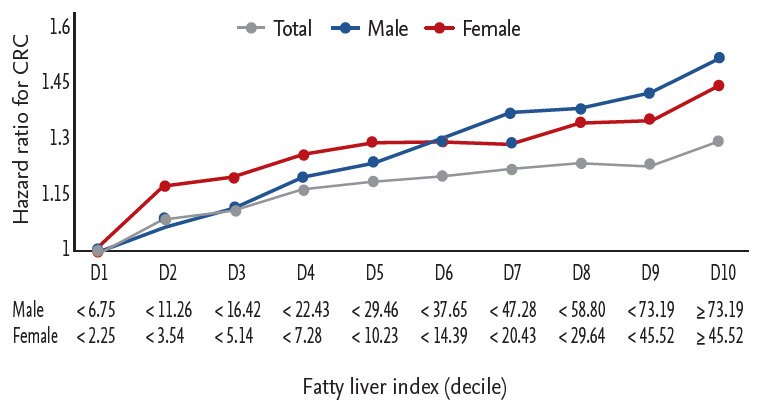

그림 출처: PubMed Central 공개 논문 (PMC7652640)
Conflict of interest statement
No potential conflict of interest relevant to this article was reported.
그 밖의 정보
- 출판 형태
- Journal Article
- 저널
- The Korean journal of internal medicine · eISSN 2005-6648
- 전자 출판
- 2020-04-10
- MeSH
- Adult · Body Mass Index · Cohort Studies · Colorectal Neoplasms* / diagnosis / epidemiology · Female · Humans · Male · Middle Aged · Non-alcoholic Fatty Liver Disease* / diagnosis / epidemiology · Republic of Korea / epidemiology · Risk Factors
- 참고문헌
- 34편