
Endocrinol Metab (Seoul). 2020;35(3):515-525.
Mechanisms of TERT Reactivation and Its Interaction with BRAFV600E.
제1저자 송영신 · 교신저자 박영주
소속 (2)
- Department of Internal Medicine, CHA Bundang Medical Center, CHA University School of Medicine, Seongnam, Korea.
- Department of Internal Medicine, Seoul National University College of Medicine, Seoul, Korea.
Abstract
The telomerase reverse transcriptase (TERT) gene, which is repressed in most differentiated human cells, can be reactivated by somatic TERT alterations and epigenetic modulations. Moreover, the recruitment, accessibility, and binding of transcription factors also affect the regulation of TERT expression. Reactivated TERT contributes to the development and progression of cancer through telomere lengthening-dependent and independent ways. In particular, because of recent advances in high-throughput sequencing technologies, studies on genomic alterations in various cancers that cause increased TERT transcriptional activity have been actively conducted. TERT reactivation has been reported to be associated with poor prognosis in several cancers, and TERT promoter mutations are among the most potent prognostic markers in thyroid cancer. In particular, when a TERT promoter mutation coexists with the BRAFV600E mutation, these mutations exert synergistic effects on a poor prognosis. Efforts have been made to uncover the mechanisms of these synergistic interactions. In this review, we discuss the role of TERT reactivation in tumorigenesis, the mechanisms of TERT reactivation across all human cancers and in thyroid cancer, and the mechanisms of interactions between BRAFV600E and TERT promoter mutations.
Keywords
BRAFEpigenomicsGenomicsTelomeraseThyroid neoplasms
Figures

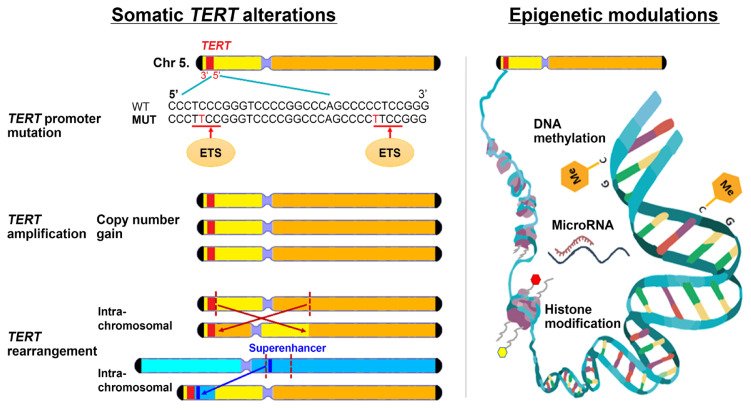
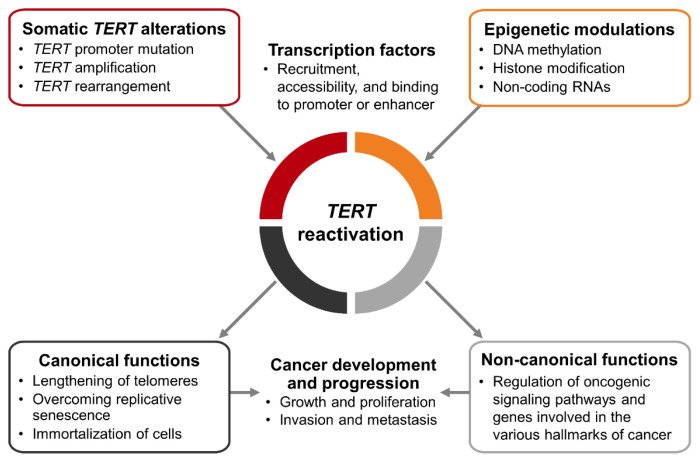
그림 출처: PubMed Central 공개 논문 (PMC7520576)
Conflict of interest statement
CONFLICTS OF INTEREST. No potential conflict of interest relevant to this article was reported.
그 밖의 정보
- 출판 형태
- Journal Article, Research Support, Non-U.S. Gov't, Review
- 저널
- Endocrinology and metabolism (Seoul, Korea) · eISSN 2093-5978
- 전자 출판
- 2020-09-22
- MeSH
- Cell Transformation, Neoplastic · Humans · Mutation · Promoter Regions, Genetic · Proto-Oncogene Proteins B-raf / genetics / metabolism · Telomerase / genetics / metabolism · Telomere Homeostasis* · Thyroid Neoplasms / genetics / metabolism / pathology
- Substances
- BRAF protein, human · Proto-Oncogene Proteins B-raf · TERT protein, human · Telomerase
- 연구비
- Korean Endocrine Society · National Research Foundation of Korea 2019R1A2C2084332 · National Research Foundation of Korea 2020R1C1C1003924 · Ministry of Science and ICT
- 참고문헌
- 82편