
Endocrinol Metab (Seoul). 2020;35(3):628-635.
Stimulated Salivary Cortisol as a Noninvasive Diagnostic Tool for Adrenal Insufficiency.
제1저자 김윤지 · 교신저자 김정희
소속 (3)
- Department of Internal Medicine, Seoul National University Hospital, Seoul National University College of Medicine, Seoul, Korea.
- Division of Endocrinology and Metabolism, Department of Internal Medicine, Mediplex Sejong Hospital, Incheon, Korea.
- Department of Internal Medicine, Seoul Metropolitan Government Seoul National University Boramae Medical Center, Seoul, Korea.
Abstract
BACKGROUND Salivary cortisol is routinely used as a diagnostic test for Cushing syndrome. The diagnostic use of salivary cortisol for adrenal insufficiency (AI), however, is less established. We aimed to investigate the utility of morning basal and adrenocorticotropic hormone-stimulated salivary cortisol in diagnosing AI in Korean adults.
METHODS We prospectively included 120 subjects (female, n=70) from Seoul National University Hospital. AI was defined as a stimulated serum cortisol level of <496.8 nmol/L during the short Synacthen test (SST). Serum and saliva samples were drawn between 8:00 AM and 10:00 AM. Salivary cortisol levels were measured using an enzyme immunoassay kit.
RESULTS Thirty-four patients were diagnosed with AI according to the SST results. Age, sex, body mass index, serum albumin levels, and serum creatinine levels did not significantly differ between the normal and AI groups. Basal and stimulated salivary cortisol levels were positively correlated with basal (r=0.538) and stimulated serum cortisol levels (r=0.750), respectively (all P<0.001). Receiver operating characteristic curve analysis yielded a cutoff level of morning basal salivary cortisol of 3.2 nmol/L (sensitivity, 84.9%; specificity, 73.5%; area under the curve [AUC]=0.822). The optimal cutoff value of stimulated salivary cortisol was 13.2 nmol/L (sensitivity, 90.7%; specificity, 94.1%; AUC=0.959). Subjects with a stimulated salivary cortisol level above 13.2 nmol/L but a stimulated serum cortisol level below 496.8 nmol/L (n=2) had lower serum albumin levels than those showing a concordant response.
CONCLUSION The diagnostic performance of stimulated salivary cortisol measurements after the SST was comparable to serum cortisol measurements for diagnosing AI.
Keywords
Adrenal insufficiencyHydrocortisoneSaliva
Figures
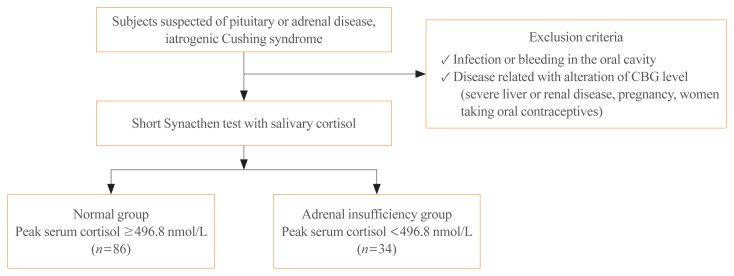
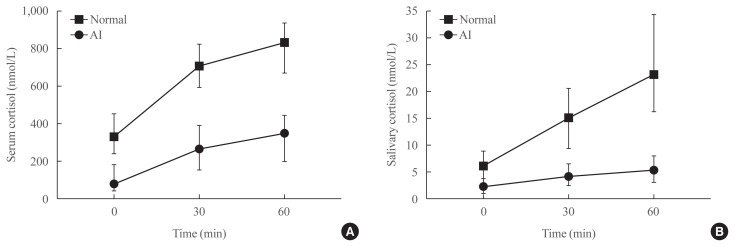
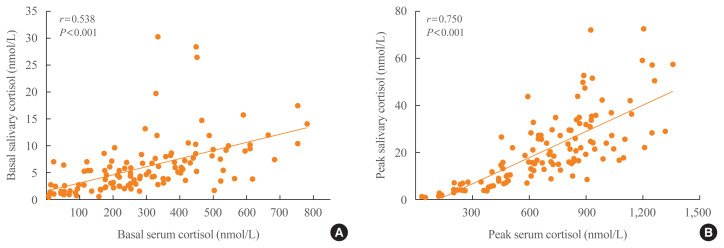
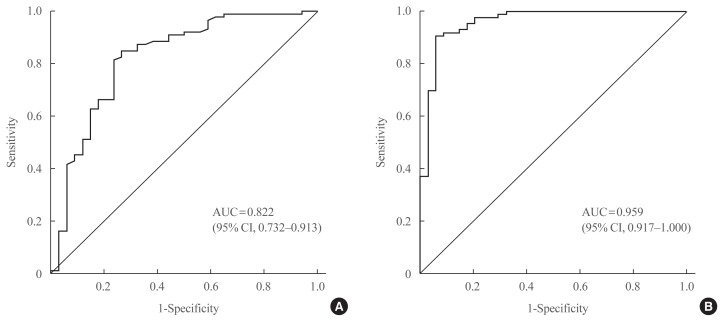
그림 출처: PubMed Central 공개 논문 (PMC7520577)
Conflict of interest statement
CONFLICTS OF INTEREST. No potential conflict of interest relevant to this article was reported.
그 밖의 정보
- 출판 형태
- Journal Article, Research Support, Non-U.S. Gov't
- 저널
- Endocrinology and metabolism (Seoul, Korea) · eISSN 2093-5978
- 전자 출판
- 2020-09-22
- MeSH
- Adrenal Insufficiency / blood / diagnosis / metabolism · Adrenocorticotropic Hormone · Adult · Aged · Area Under Curve · Female · Humans · Hydrocortisone / analysis / blood / metabolism · Linear Models · Male · Middle Aged · Prospective Studies · ROC Curve · Saliva / chemistry / metabolism · Seoul
- Substances
- Adrenocorticotropic Hormone · Hydrocortisone
- 연구비
- Seoul National University Hospital 03-2013-0310
- 참고문헌
- 35편