
J Korean Med Sci. 2020;35(12):e72.
Implementation of Asthma Management Guidelines and Possible Barriers in Korea.
제1저자 조은정 · 교신저자 장윤석
소속 (7)
- Department of Internal Medicine, Pusan National University School of Medicine, Busan, Korea.
- Department of Internal Medicine, Busan Paik Hospital, Inje University College of Medicine, Busan, Korea.
- Department of Internal Medicine, Seoul National University College of Medicine, Seoul, Korea.
- Institute of Allergy and Clinical Immunology, Seoul National University Medical Research Center, Seoul, Korea.
- Department of Internal Medicine, Seoul National University Bundang Hospital, Seongnam, Korea.
- Department of Internal Medicine, Chosun University Medical School, Gwangju, Korea.
- Department of Internal Medicine, Seoul National University Bundang Hospital, Seongnam, Korea. addchang@snu.ac.kr.
Abstract
BACKGROUND There could be a gap between asthma management guidelines and current practice. We evaluated the awareness of and compliance with asthma management guidelines, and the internal and external barriers to compliance, for the first time in Korea.
METHODS From March to September of 2012, 364 physicians treating asthma patients at primary, secondary, and tertiary teaching hospitals were enrolled. They completed a questionnaire on the awareness of and compliance with asthma management guidelines, and the barriers and alternatives to their implementation.
RESULTS Of the 364 physicians, 79.1% were men and 56.9% were primary care physicians. The mean age was 40.5 ± 11.2 years. Most of them were aware of asthma management guidelines (89.3%). However, only a portion (11.0%) of them complied with the guidelines for asthma. Pulmonary function tests for diagnosis of asthma were performed by 20.1% of all physicians and 9.2% of primary care physicians, and by 9.9% of all physicians and 5.8% of primary care physicians for monitoring. Physicians stated that 'asthma monitoring' was the most difficult part of the guidelines, followed by 'environmental control and risk factors.' Only 39.6% (31.9% of the primary care physicians) prescribed an inhaled corticosteroid (ICS) as the first-line treatment for persistent asthma. The internal barriers were physician's preference for oral medications, difficulty in use even with inhaler training, and concern over ICS side effects. The external barriers were possible rejection of medical reimbursement by health insurance, refusal by the patient, cost, and a poor environment for teaching the patient how to use the inhaler. Alternatives proposed by physicians to implement asthma management guidelines were to improve medical reimbursement policies and the level of awareness of such guidelines.
CONCLUSION Compliance with the asthma management guidelines, including ICS prescription, is low despite the awareness of the guidelines. It is necessary to develop a strategy to overcome the internal and external barriers.
© 2020 The Korean Academy of Medical Sciences.
Keywords
AsthmaBarrierGuidelinesImplementationInhaled Corticosteroid
Figures
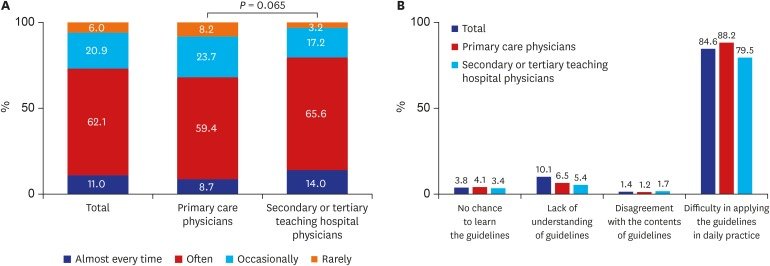
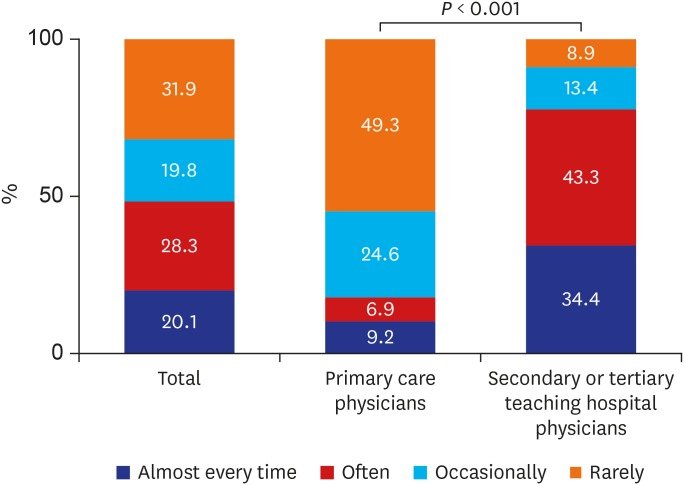
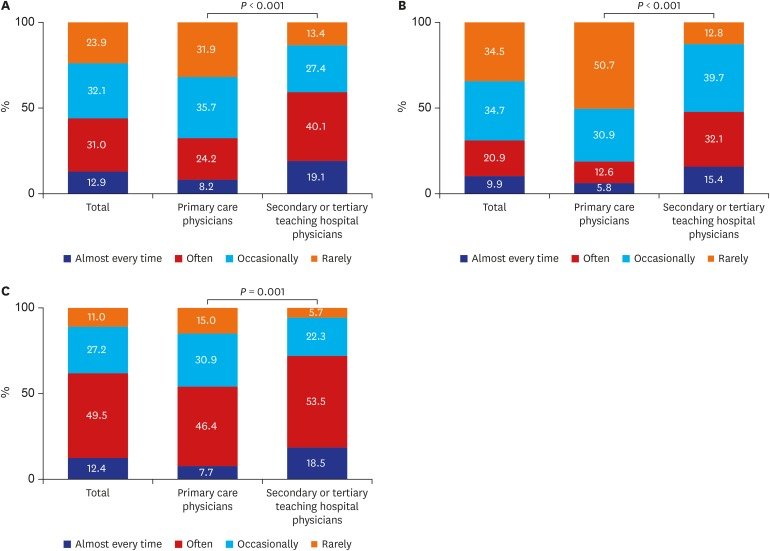
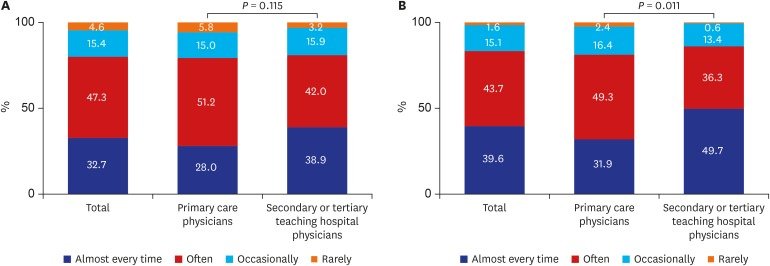
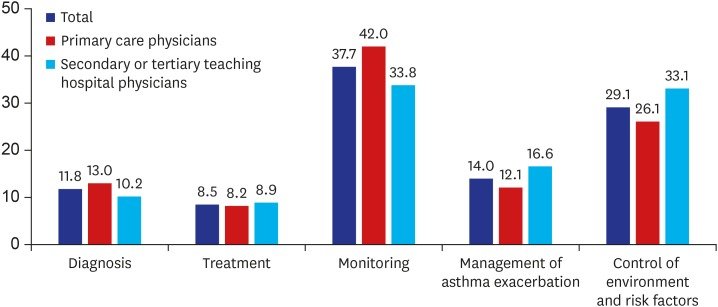
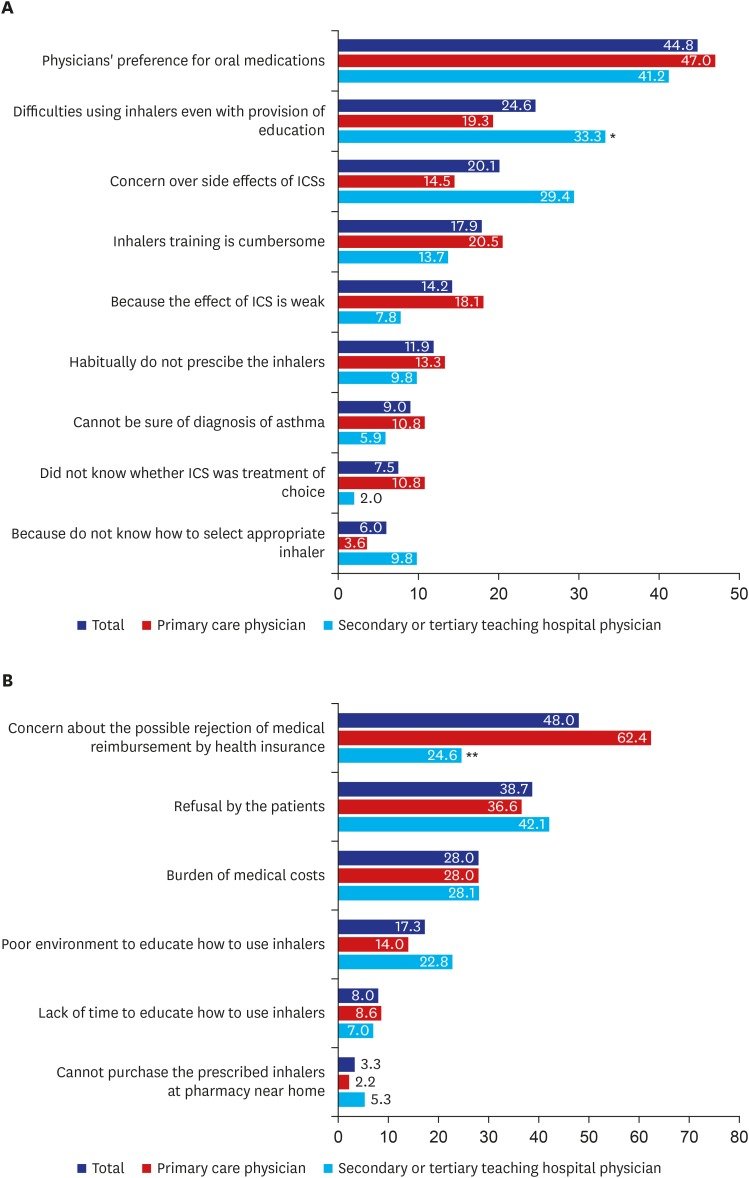
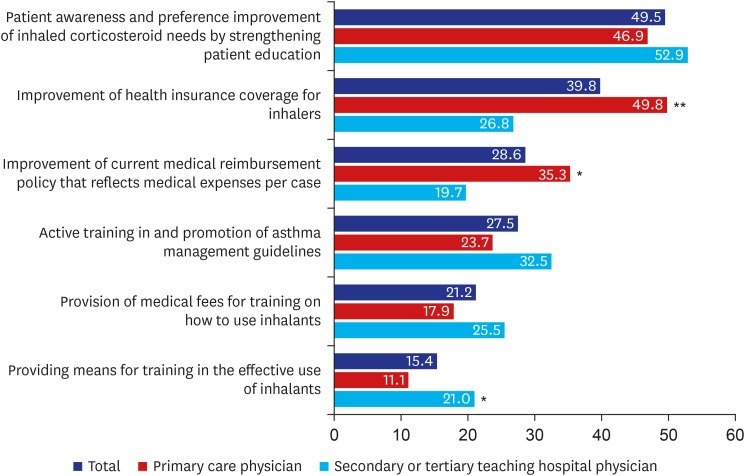
그림 출처: PubMed Central 공개 논문 (PMC7105508)
Conflict of interest statement
The authors have no potential conflicts of interest to disclose.
그 밖의 정보
- 출판 형태
- Journal Article
- 저널
- Journal of Korean medical science · eISSN 1598-6357
- 전자 출판
- 2020-03-30
- MeSH
- Administration, Inhalation · Adrenal Cortex Hormones / administration & dosage · Adult · Asthma* / diagnosis / drug therapy · Attitude of Health Personnel · Disease Management · Female · Guideline Adherence* / statistics & numerical data · Humans · Male · Middle Aged · Physicians · Practice Patterns, Physicians' / statistics & numerical data · Republic of Korea · Respiratory Function Tests
- Substances
- Adrenal Cortex Hormones
- 연구비
- Seoul National University Bundang Hospital · Ministry of Health and Welfare A030001
- 참고문헌
- 28편