
J Korean Med Sci. 2020;35(11):e77.
Clinical Score System to Differentiate Severe Fever with Thrombocytopenia Syndrome Patients from Patients with Scrub Typhus or Hemorrhagic Fever with Renal Syndrome in Korea.
제1저자 허대혁, 강유민 · 교신저자 송경호
소속 (6)
- Department of Internal Medicine, Seoul National University Bundang Hospital, Seongnam, Korea.
- Department of Internal Medicine, Kangwon National University Hospital, Kangwon National University School of Medicine, Chuncheon, Korea.
- Department of Internal Medicine, Seoul National University College of Medicine, Seoul, Korea. khsongmd@snu.ac.kr.
- Department of Internal Medicine, Seoul National University Hospital, Seoul, Korea.
- Department of Internal Medicine, Seoul National University College of Medicine, Seoul, Korea.
- Department of Internal Medicine, Seoul Metropolitan Government-Seoul National University Boramae Medical Center, Seoul, Korea.
Abstract
BACKGROUND Severe fever with thrombocytopenia syndrome (SFTS) is an emerging infectious disease with high mortality in East Asia. This study aimed to develop, for primary care providers, a prediction score using initial symptoms and basic laboratory blood tests to differentiate between SFTS and other endemic zoonoses in Korea.
METHODS Patients aged ≥ 18 years diagnosed with endemic zoonoses during a 3-year period (between January 2015 and December 2017) were retrospectively enrolled from 4 tertiary university hospitals. A prediction score was built based on multivariate logistic regression analyses.
RESULTS Of 84 patients, 35 with SFTS and 49 with other endemic zoonoses were enrolled. In multivariate logistic regression analysis, independent predictors of SFTS included neurologic symptoms (odds ratio [OR], 12.915; 95% confidence interval [CI], 2.173-76.747), diarrhea (OR, 10.306; 95% CI, 1.588-66.895), leukopenia (< 4,000/mm³) (OR, 19.400; 95% CI, 3.290-114.408), and normal C-reactive protein (< 0.5 mg/dL) (OR, 24.739; 95% CI, 1.812-337.742). We set up a prediction score by assigning one point to each of these four predictors. A score of ≥ 2 had 82.9% sensitivity (95% CI, 71.7%-87.5%) and 95.9% specificity (95% CI, 88.0%-99.2%). The area under the curve of the clinical prediction score was 0.950 (95% CI, 0.903-0.997).
CONCLUSION This study finding suggests a simple and useful scoring system to predict SFTS in patients with endemic zoonoses. We expect this strategic approach to facilitate early differentiation of SFTS from other endemic zoonoses, especially by primary care providers, and to improve the clinical outcomes.
© 2020 The Korean Academy of Medical Sciences.
Keywords
Differential DiagnosisHemorrhagic Fever with Renal SyndromePredictionScrub TyphusSevere Fever with Thrombocytopenia Syndrome
Figures
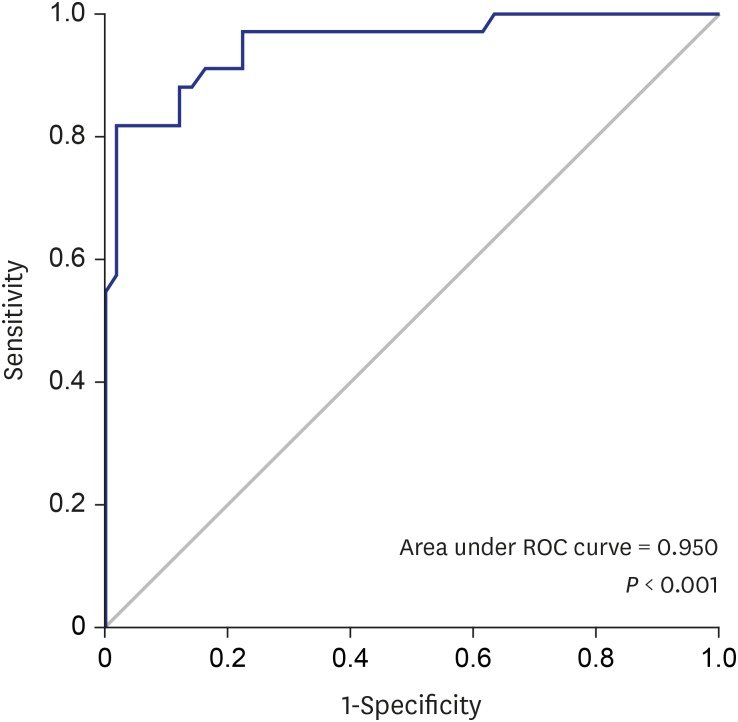
그림 출처: PubMed Central 공개 논문 (PMC7086083)
Conflict of interest statement
The authors have no potential conflicts of interest to disclose.
그 밖의 정보
- 출판 형태
- Journal Article
- 저널
- Journal of Korean medical science · eISSN 1598-6357
- 전자 출판
- 2020-03-23
- MeSH
- Adult · Aged · Animals · C-Reactive Protein / analysis · Diagnosis, Differential · Female · Hemorrhagic Fever with Renal Syndrome / diagnosis · Humans · Male · Middle Aged · Phlebotomus Fever / diagnosis · Phlebovirus · Republic of Korea · Retrospective Studies · Scrub Typhus / diagnosis · Zoonoses / diagnosis
- Substances
- C-Reactive Protein
- 참고문헌
- 23편