
J Korean Med Sci. 2019;34(14):e116.
Clinical Prediction Score for Community-Onset Bloodstream Infections Caused by Extended-Spectrum Beta-Lactamase-Producing Escherichia coli and Klebsiella Species.
제1저자 김문석 · 교신저자 송경호
소속 (3)
- Department of Internal Medicine, Seoul National University Bundang Hospital, Seongnam, Korea.
- Department of Internal Medicine, Seoul National University College of Medicine, Seoul, Korea. khsongmd@snu.ac.kr.
- Department of Internal Medicine, Seoul National University College of Medicine, Seoul, Korea.
Abstract
BACKGROUND This study aimed to identify the predictors and build a prediction score for community-onset bloodstream infections (CO-BSIs) caused by extended-spectrum beta-lactamase (ESBL)-producing Escherichia coli and Klebsiella species.
METHODS All CO-BSIs caused by E. coli and Klebsiella species from 2012 to 2015 were grouped into derivation (BSIs from 2012 to 2014) and validation (BSIs in 2015) cohorts. A prediction score was built using the coefficients of the multivariate logistic regression model from the derivation cohort.
RESULTS The study included 886 CO-BSIs (594 and 292 in the derivation and validation cohorts, respectively). The independent predictors of CO-BSIs caused by ESBL-producing E. coli and Klebsiella species included: 1) identification of ESBL-producing microorganisms from any clinical culture within one year of admission, 2) beta-lactam or fluoroquinolone treatment within 30 days (with 2 or more courses within 90 days; with 1 course within 90 days), 3) hospitalization within one year, 4) the presence of an indwelling urinary catheter at the time of admission. The area under the curve (AUC) of the clinical prediction score was 0.72 (95% confidence interval [CI], 0.68-0.77). In the validation cohort, the AUC was 0.70 (95% CI, 0.63-0.77).
CONCLUSIONS The results of this study suggest a simple and easy-to-use scoring system to predict CO-BSIs caused by ESBL-producing E. coli and Klebsiella species.
© 2019 The Korean Academy of Medical Sciences.
Keywords
Bloodstream InfectionCommunity-Onset InfectionEscherichia coliExtended-Spectrum Beta-LactamaseKlebsiellaPrediction Score
Figures
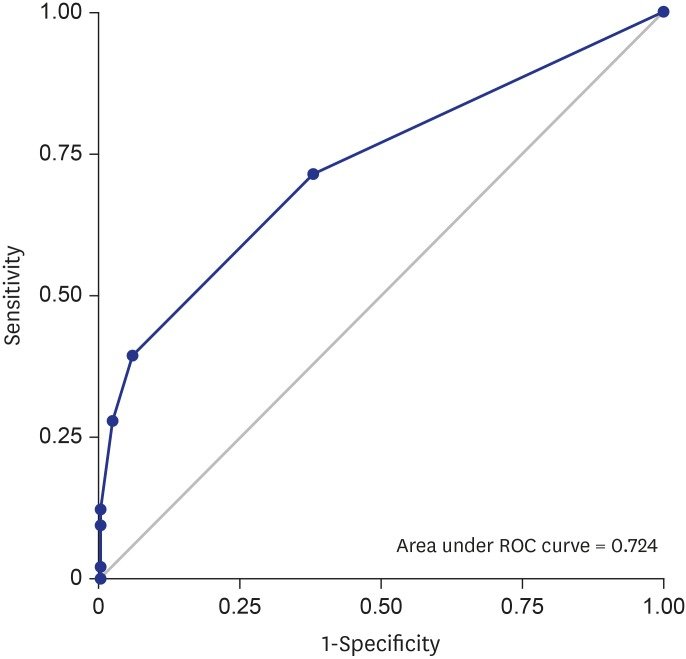
그림 출처: PubMed Central 공개 논문 (PMC6460111)
Conflict of interest statement
The authors have no potential conflicts of interest to disclose.
그 밖의 정보
- 출판 형태
- Journal Article
- 저널
- Journal of Korean medical science · eISSN 1598-6357
- 전자 출판
- 2019-04-15
- MeSH
- Aged · Area Under Curve · Bacteremia / diagnosis / microbiology · Community-Acquired Infections / diagnosis / microbiology · Escherichia coli / enzymology / isolation & purification · Female · Humans · Klebsiella / enzymology / isolation & purification · Logistic Models · Male · Middle Aged · Predictive Value of Tests · Proportional Hazards Models · ROC Curve · Retrospective Studies · Risk Factors · beta-Lactamases / metabolism
- Substances
- beta-Lactamases
- 연구비
- National Bundang Hospital 02-2014-014
- 참고문헌
- 31편