
Korean J Intern Med. 2018;33(1):113-120.
Diagnostic accuracy of manual office blood pressure measurement in ambulatory hypertensive patients in Korea.
제1저자 김세훈,박진주 · 교신저자 최동주
소속 (5)
- Department of Internal Medicine, Seoul National University Bundang Hospital, Seongnam, Korea.
- Department of Internal Medicine, National Medical Center, Seoul, Korea.
- Department of Internal Medicine, Seoul National University Hospital, Seoul, Korea.
- Department of Internal Medicine, Hanyang University Seoul Hospital, Seoul, Korea.
- Department of Internal Medicine, Severance Hospital, Yonsei University College of Medicine, Seoul, Korea.
Abstract
BACKGROUND/AIMS Currently, office blood pressure (OBP) is the most widely used method of measuring blood pressure (BP) in daily clinical practice. However, data on the diagnostic accuracy of OBP in reference to ambulatory blood pressure (ABP) are scarce in Korea.
METHODS In retrospective and prospective cohorts, manual OBP and ABP measurements were compared among ambulatory hypertensive patients. Hypertension was defined as systolic OBP ≥ 140 mmHg and/or diastolic OBP ≥ 90 mmHg, and systolic ABP ≥ 130 mmHg and/or diastolic ABP ≥ 80 mmHg.
RESULTS In the retrospective cohort (n = 903), the mean OBP1 (before ABP measurement) was higher than ABP in both systolic (138 ± 17 mmHg vs. 123 ± 13 mmHg, p < 0.001) and diastolic (84 ± 12 mmHg vs. 78 ± 11 mmHg, p < 0.001) measurements. Interestingly, there was only a weak correlation between OBP and ABP (r2 = 0.038, p < 0.001). The overall discordance rate of OBP compared to ABP, which is the reference method for measuring BP, was 43.9%. The prospective cohort (n = 57) showed similar results. In a subgroup analysis, male patients had higher false negative results (masked or under-treated hypertension) than did female patients (26.1% vs. 17.8%, p = 0.003), whereas female patients had a higher false positive rate (white-coat or over-treated hypertension) than did male patients (28.7% vs. 15.2%, p < 0.001).
CONCLUSIONS The diagnostic accuracy of manual OBP is low in reference to ABP. Men and women have different patterns of discordance. These findings indicate that management of hypertensive patients with manual OBP measurements may be suboptimal and encourages the use of ABP in ambulatory hypertensive patients.
Keywords
Ambulatory blood pressureDiagnostic accuracyManual office blood pressureSex
Figures

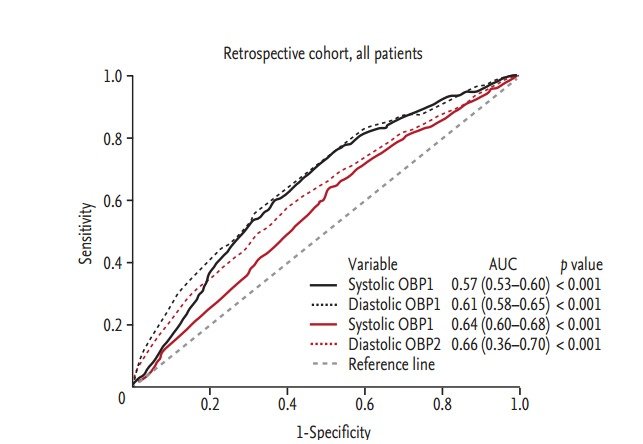
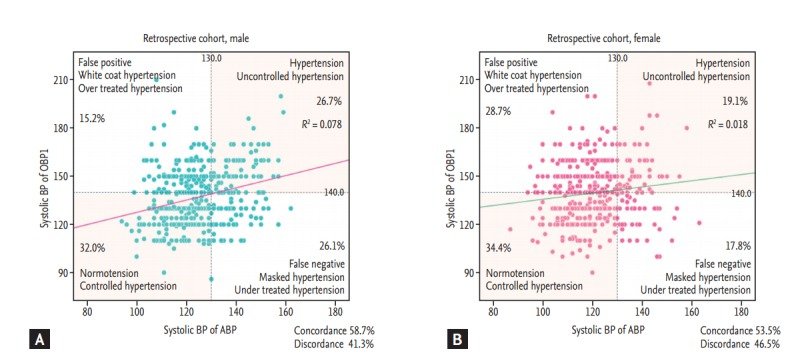
그림 출처: PubMed Central 공개 논문 (PMC5768545)
Conflict of interest statement
No potential conflict of interest relevant to this article was reported.
그 밖의 정보
- 출판 형태
- Journal Article, Research Support, Non-U.S. Gov't
- 저널
- The Korean journal of internal medicine · eISSN 2005-6648
- 전자 출판
- 2017-06-07
- MeSH
- Blood Pressure Determination / methods / standards · Cohort Studies · Female · Humans · Hypertension / diagnosis · Male · Middle Aged · Physicians' Offices · Prospective Studies · Republic of Korea · Retrospective Studies · Sex Factors
- 참고문헌
- 28편