
J Am Heart Assoc. 2020;9(12):e015009.
Phenotyping Heart Failure According to the Longitudinal Ejection Fraction Change: Myocardial Strain, Predictors, and Outcomes.
제1저자 박진주 · 교신저자 조구영
소속 (4)
- Cardiovascular Center & Department of Internal Medicine Seoul National University Bundang Hospital Seongnam Korea.
- Department of Anesthesiology and Intensive Care Medicine Hôpitaux Universitaires Saint Louis Lariboisière APHP University Paris Diderot UMR 942 Inserm Paris France.
- Department of Internal Medicine Seoul National University College of Medicine Seoul National University Hospital Seoul Korea.
- Department of Internal Medicine Chungnam National University Hospital Daejeon Korea.
Abstract
Background Many patients with heart failure (HF) experience changes in left ventricular ejection fraction (LVEF) during follow-up. We sought to evaluate the predictors and outcomes of different HF phenotypes according to longitudinal changes in EF. Methods and Results A total of 2104 patients with acute HF underwent echocardiography at baseline and follow-up. Global longitudinal strain was measured at index admission. HF phenotypes were defined as persistent HF with reduced EF (persistent HFrEF, LVEF ≤40% at baseline and follow-up), heart failure with improved ejection fraction (LVEF≤40% at baseline and improved to >40% at follow-up), heart failure with declined ejection fraction (LVEF>40% at baseline and declined to ≤40% at follow up), and persistent HF with preserved EF (persistent HFpEF, LVEF>40% at baseline and follow-up). Overall, 1130 patients had HFrEF at baseline; during follow-up, 54.2% and 46.8% had persistent HFrEF and heart failure with improved ejection fraction, respectively. Among 975 patients with HFpEF at baseline, 89.5% and 10.5% had persistent HFpEF and heart failure with declined ejection fraction at follow-up, respectively. The 5-year all-cause mortality rates were 43.1%, 33.1%, 24%, and 17% for heart failure with declined ejection fraction, persistent HFrEF, persistent HFpEF, and heart failure with improved ejection fraction, respectively (global log-rank P<0.001). In multivariable analyses, each 1% increase in global longitudinal strain (greater contractility) was associated with 10% increased odds for heart failure with improved ejection fraction among patients with HFrEF at baseline and 7% reduced odds for heart failure with declined ejection fraction among patients with HFpEF at baseline. Conclusions LVEF changed during follow-up. Each HF phenotype according to longitudinal LVEF changes has a distinct prognosis. Global longitudinal strain can be used to predict the HF phenotype. REGISTRATION: URL: https://www.clinicaltrials.gov; Unique identifier: NCT03513653.
Keywords
HFdEFHFiEFejection fraction changeheart failuremyocardial strain
Figures

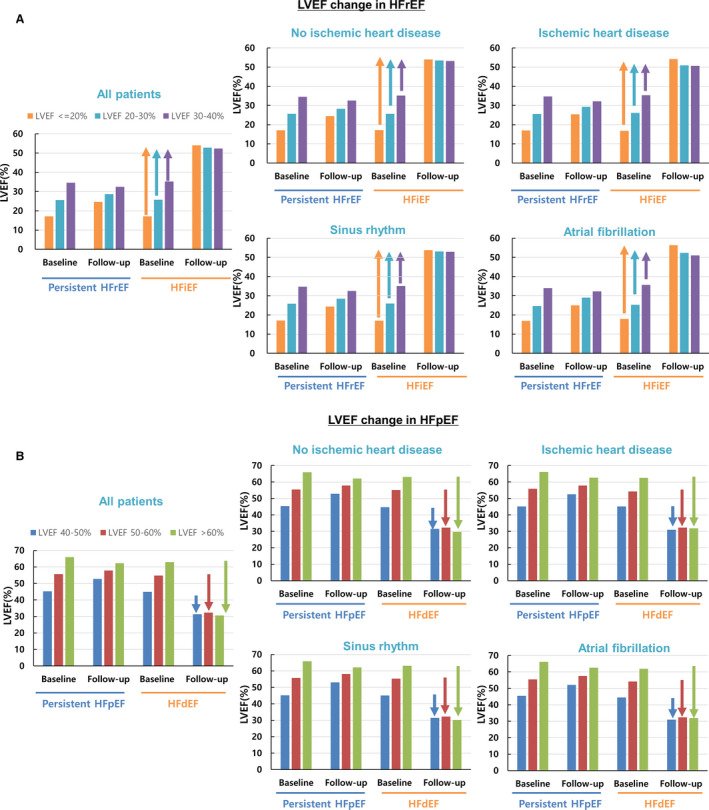


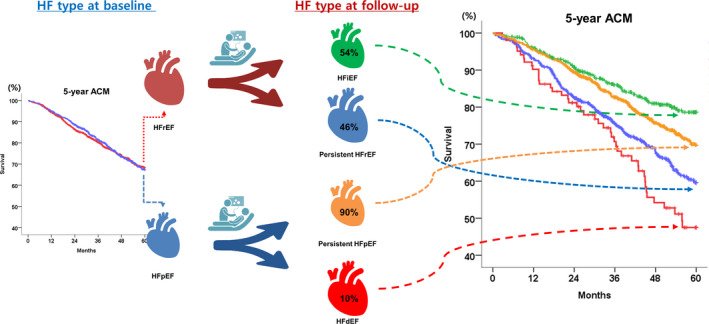
그림 출처: PubMed Central 공개 논문 (PMC7429069)
그 밖의 정보
- 출판 형태
- Journal Article, Multicenter Study
- 저널
- Journal of the American Heart Association · eISSN 2047-9980
- 전자 출판
- 2020-06-10
- MeSH
- Aged · Aged, 80 and over · Disease Progression · Echocardiography · Female · Heart Failure / diagnostic imaging / mortality / physiopathology · Humans · Longitudinal Studies · Male · Middle Aged · Myocardial Contraction* · Phenotype · Prognosis · Republic of Korea · Stroke Volume* · Time Factors · Ventricular Function, Left*
- 데이터
- ClinicalTrials.gov: NCT03513653
- 참고문헌
- 21편