
J Korean Med Sci. 2017;32(2):221-230.
Baseline General Characteristics of the Korean Chronic Kidney Disease: Report from the KoreaN Cohort Study for Outcomes in Patients With Chronic Kidney Disease (KNOW-CKD).
제1저자 강은정 · 교신저자 오국환
소속 (9)
- Department of Internal Medicine, Seoul National University Hospital, Seoul, Korea.
- Department of Preventive Medicine, Seoul National University College of Medicine, Seoul, Korea.
- Medical Research Collaborating Center, Seoul National University Hospital and Seoul National University College of Medicine, Seoul, Korea.
- Division of Nephrology, Department of Internal Medicine, Kangbuk Samsung Hospital, Sungkyunkwan University School of Medicine, Seoul, Korea.
- Department of Internal Medicine, The Catholic University of Korea, Seoul St. Mary's Hospital, Seoul, Korea.
- Department of Internal Medicine, Gachon University, Gil Hospital, Incheon, Korea.
- Department of Internal Medicine, Dongguk University Gyeongju Hospital, Gyeongju, Korea.
- Department of Internal Medicine, Seoul National University Boramae Medical Center, Seoul, Korea.
- Department of Internal Medicine, Seoul National University Hospital, Seoul, Korea. khoh@snu.ac.kr.
Abstract
The KoreaN Cohort Study for Outcomes in Patients With Chronic Kidney Disease (KNOW-CKD) was developed to investigate various clinical courses and risk factors for progression of Korean chronic kidney disease (CKD). The KNOW-CKD study consists of nine clinical centers in Korea, and patients aged between 20 and 75 years with CKD from stage 1 to 5 (predialysis) were recruited. At baseline, blood and urine samples were obtained and demographic data including comorbidities, drugs, quality of life, and health behaviors were collected. Estimated glomerular filtration rate (eGFR) was calculated by 4-variable Modification of Diet in Renal Disease (MDRD) equation using isotope dilution mass spectrometry (IDMS)-calibrated serum creatinine measured at a central laboratory. As a dynamic cohort, a total of 2,341 patients were enrolled during the enrollment period from 2011 until 2015, among whom 2,238 subjects were finally analyzed for baseline profiles. The mean age of the cohort was 53.7 ± 12.2 year and 61.2% were men. Mean eGFR was 50.5 ± 30.3 mL/min/1.73 m². The participants with lower eGFR had a tendency to be older, with more comorbidities, to have higher systolic blood pressure (BP) and pulse pressure, with lower income level and education attainment. The patients categorized as glomerulonephritis (GN) were 36.2% followed by diabetic nephropathy (DN, 23.2%), hypertensive nephropathy (HTN, 18.3%), polycystic kidney disease (PKD, 16.3%), and other unclassified disease (6.1%). The KNOW-CKD participants will be longitudinally followed for 10 years. The study will provide better understanding for physicians regarding clinical outcomes, especially renal and cardiovascular outcomes in CKD patients.
Keywords
Chronic Kidney DiseaseCohortDiabetesEpidemiologyGlomerulonephritisHypertensionPolycystic Kidney Disease
Figures

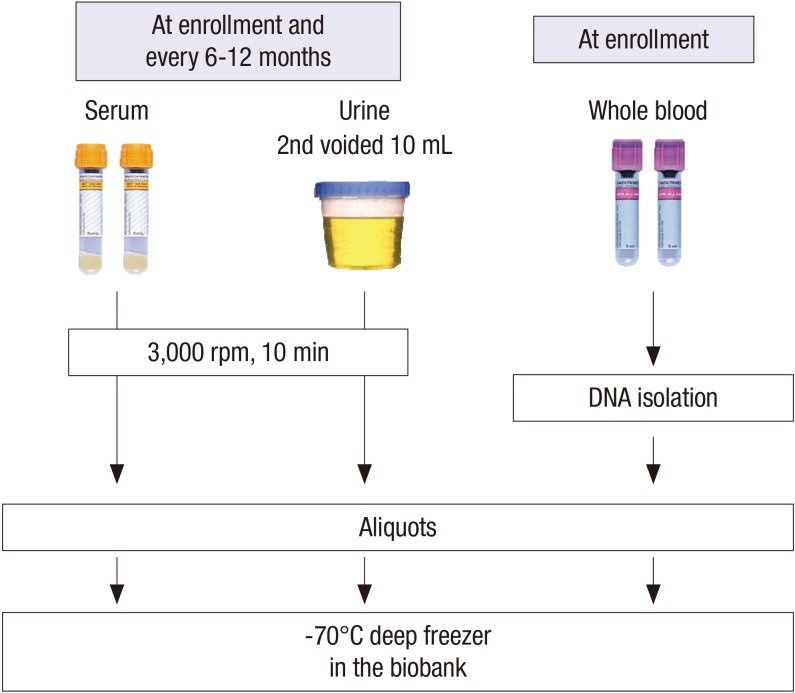
그림 출처: PubMed Central 공개 논문 (PMC5219987)
Conflict of interest statement
The authors have no potential conflicts of interest to disclose.
그 밖의 정보
- 출판 형태
- Journal Article
- 저널
- Journal of Korean medical science · eISSN 1598-6357
- MeSH
- Adult · Age Factors · Aged · Asian People · Cohort Studies · Creatinine / blood · Demography · Diabetic Nephropathies / complications · Female · Glomerular Filtration Rate · Glomerulonephritis / complications · Humans · Hypertension, Renal / complications · Male · Middle Aged · Nephritis / complications · Polycystic Kidney Diseases / complications · Renal Insufficiency, Chronic / etiology / pathology · Republic of Korea · Risk Factors · Severity of Illness Index
- Substances
- Creatinine
- 참고문헌
- 24편