
Korean J Intern Med. 2017;32(2):261-268.
Ultrasound-guided percutaneous portal transplantation of peripheral blood monocytes in patients with liver cirrhosis.
제1저자 유수종 · 교신저자 윤정환
소속 (3)
- Department of Internal Medicine and Liver Research Institute, Seoul National University College of Medicine, Seoul, Korea.
- Department of Internal Medicine, Seoul Metropolitan Government Seoul National University Boramae Medical Center, Seoul, Korea.
- Department of Radiology and Institute of Radiation Medicine, Seoul National University College of Medicine, Seoul, Korea.
Abstract
BACKGROUND/AIMS Liver transplantation offers the only definite cure for cirrhosis but lacking donors is problem. Stem cell therapy is attractive in this setting. In this study, we aimed to explore the safety and efficacy of ultrasound-guided percutaneous portal transplantation of peripheral blood monocyte cell (PBMC) in cirrhotic patients.
METHODS A total of nine decompensated cirrhotic patients were randomized into three groups: group 1 (n = 3) was control group, group 2 (n = 3) received granulocyte-colony stimulating factor (G-CSF) mobilization for 3 days, and group 3 (n = 3) received G-CSF mobilized PBMCs by leukapheresis and PBMC transplantation through ultrasound-guided percutaneous portal vein puncture. Liver function and clinical features were evaluated.
RESULTS At baseline, the Child-Turcotte-Pugh and the model for end-stage liver disease scores were comparable in study groups. Compared with group 1, there was a tendency to improve liver function in group 3 at 6 months after treatment. Treatment was tolerable and no complications were encountered related to the G-CSF mobilization or percutaneous portal administration of PBMCs. Imaging studies showed patent portal veins at the end of the study period.
CONCLUSIONS Autologous PBMC transplantation through ultrasound-guided percutaneous portal vein puncture could be considered as a safe alternative treatment for decompensated cirrhotic patients.
Keywords
Granulocyte colony-stimulating factorLeukocytes, mononuclearLiver cirrhosis
Figures

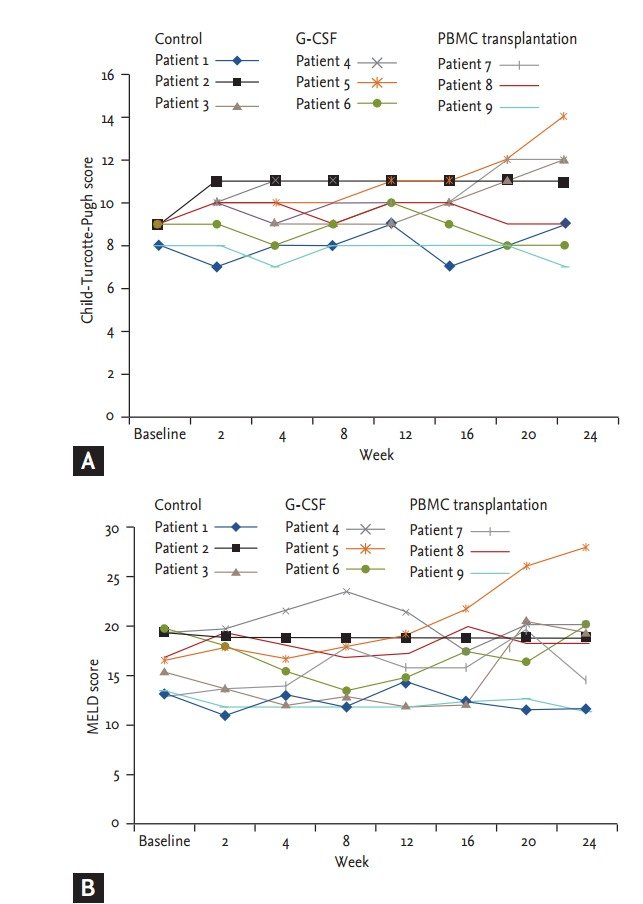
그림 출처: PubMed Central 공개 논문 (PMC5339463)
Conflict of interest statement
No potential conflict of interest relevant to this article was reported.
그 밖의 정보
- 출판 형태
- Journal Article, Randomized Controlled Trial
- 저널
- The Korean journal of internal medicine · eISSN 2005-6648
- 전자 출판
- 2016-04-05
- MeSH
- Adult Stem Cells / transplantation · Aged · Female · Granulocyte Colony-Stimulating Factor / administration & dosage · Hematopoietic Stem Cell Mobilization / methods · Humans · Liver Cirrhosis / therapy · Male · Middle Aged · Monocytes / transplantation · Portal Vein / diagnostic imaging · Punctures / methods · Ultrasonography
- Substances
- Granulocyte Colony-Stimulating Factor
- 참고문헌
- 39편