
Clin Mol Hepatol. 2026;32(1):339-352.
Aspirin and hepatocellular carcinoma risk in metabolic dysfunction-associated steatotic liver disease: nationwide cohort study with genetic risk analysis.
제1저자 안주희, 허문행, 신현재, 박민경 · 교신저자 김윤준
소속 (7)
- Division of Data Science, College of Intelligent Software Convergence, University of Suwon, Hwaseong, Korea.
- Institute of Health and Environment, Seoul National University, Seoul, Korea.
- Department of Internal Medicine and Liver Research Institute, Seoul National University College of Medicine, Seoul, Korea.
- Department of Internal Medicine, Seoul National University Bundang Hospital, Seoul National University College of Medicine, Seoul, Korea.
- Department of Public Health Sciences, Graduate School of Public Health, Seoul National University, Seoul, Korea.
- RexSoft Inc., Seoul, Korea.
- Interdisciplinary Program for Bioinformatics, College of Natural Sciences, Seoul National University, Seoul, Korea.
Abstract
BACKGROUND/AIMS The association between aspirin use and hepatocellular carcinoma (HCC) risk in patients with metabolic dysfunction-associated steatotic liver disease (MASLD) remains unclear. This study evaluated the effect of aspirin on HCC development in MASLD patients using Korean National Health Insurance Service (NHIS) and UK Biobank (UKB) databases.
METHODS A retrospective cohort analysis was conducted using the NHIS database with a 3-year landmark design. Baseline characteristics were balanced using inverse probability of treatment weighting (IPTW) and 1:3 propensity score matching (PSM). Additionally, Mendelian randomization analysis was performed in the UKB cohort using a genomic risk score (GRS) for salicylic acid, based on genetic variants related to aspirin metabolism, as a proxy for aspirin use.
RESULTS In the NHIS cohort, 6,584,155 eligible patients were included, of whom 1,723,435 had MASLD. After PSM, aspirin use was associated with a significantly lower risk of HCC compared to no aspirin use, in both the overall population (adjusted subdistribution hazard ratio [ASHR]=0.86; 95% confidence interval [CI] 0.78-0.95; P=0.002) and MASLD group (ASHR=0.86; 95% CI 0.75-0.99; P=0.036). Similar results were reproduced in the IPTW population and several sensitivity and subgroup analyses. In the UKB cohort, individuals in the top 95% of GRS had a significantly lower risk of HCC compared to those in the bottom 5%, in both the overall population (ASHR=0.61; 95% CI 0.39-0.95; P=0.028) and MASLD group (ASHR=0.47; 95% CI 0.29-0.76; P=0.002).
CONCLUSIONS Findings from both population-based and genetic analyses suggest a possible protective association between aspirin use and HCC in patients with MASLD, which warrants further validation.
Keywords
AspirinFatty liverLiver cancerSalicylic acidUK Biobank
Figures

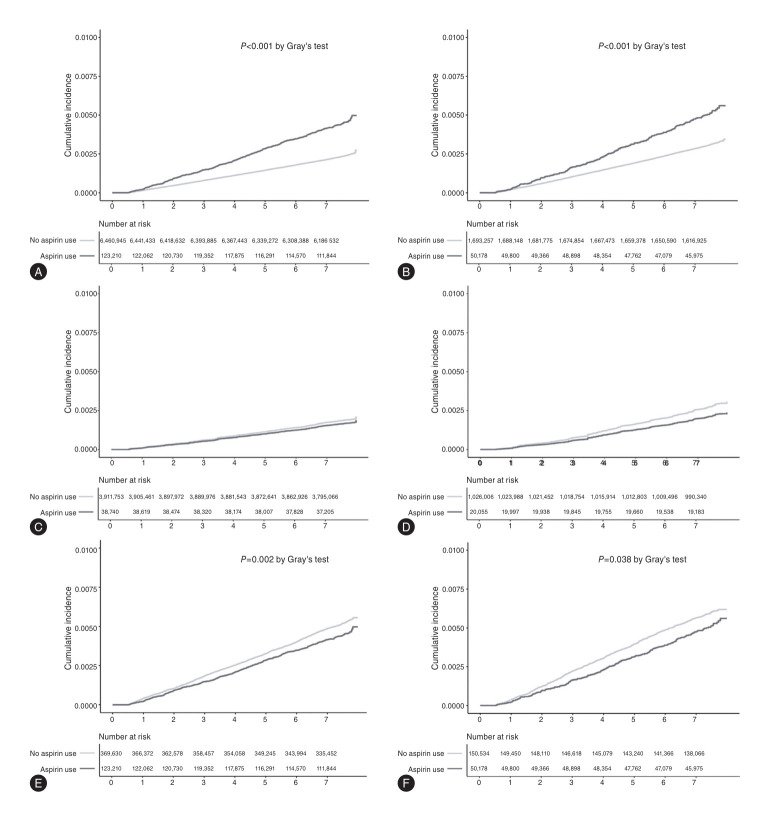

그림 출처: PubMed Central 공개 논문 (PMC12835774)
Comment · 정정
Conflict of interest statement
Conflicts of Interest . Juhee Ahn: Nothing to declare; Moon Haeng Hur: Nothing to declare; Hyunjae Shin: Nothing to declare; Min Kyung Park: Nothing to declare; Sungho Won: Nothing to declare; Jeayeon Park: Nothing to declare; Yunmi Ko: Nothing to declare; Youngsu Park: Nothing to declare; Yun Bin Lee: Receives research grants from Samjin Pharmaceuticals and Yuhan Pharmaceuticals; Eun Ju Cho: Nothing to declare; Jeong-Hoon Lee: Receives research grants from Yuhan Pharmaceuticals and GreenCross Cell, and lecture fees from GreenCross Cell, Daewoong Pharmaceuticals, and Gilead Korea; Su Jong Yu: Receives research grants from Yuhan Pharmaceuticals and Daewoong Pharmaceuticals; Jung-Hwan Yoon: Receives research grants from Bayer, Daewoong Pharmaceuticals, and Bukwang Pharmaceutical; Yoon Jun Kim: Receives research grants from BTG, Boston Scientific, AstraZeneca, Gilead Sciences, Samjin, BL&H, and Bayer, and lecture fees from Roche, Abbvie, Eisai, Boston Scientific, BMS, BTG, Bayer, MSD, Novo Nordisk, Green-Cross Cell, Boehringer Ingelheim, and Gilead Sciences.
그 밖의 정보
- 출판 형태
- Journal Article
- 저널
- Clinical and molecular hepatology · eISSN 2287-285X
- 전자 출판
- 2025-11-25
- MeSH
- Humans · Carcinoma, Hepatocellular* / epidemiology / etiology · Aspirin* / therapeutic use · Liver Neoplasms* / epidemiology / etiology · Male · Female · Middle Aged · Retrospective Studies · Risk Factors · Aged · Fatty Liver* / complications · Republic of Korea / epidemiology · Mendelian Randomization Analysis · Polymorphism, Single Nucleotide · Databases, Factual · Adult
- Substances
- Aspirin
- 연구비
- Korean Association for the Study of the Liver · Korean Liver Foundation · Dong-A ST Co. · Yuhan Corporation · Samjin Pharmaceuticals · Yuhan Pharmaceuticals · GreenCross Cell · Daewoong Pharmaceuticals · Gilead Korea · Bukwang Pharmaceutical · BTG · BioCentury · Bayer · MSD · Novo Nordisk · GreenCross Cell · Boehringer Ingelheim · Gilead Sciences
- 참고문헌
- 40편