
Korean J Intern Med. 2016;31(4):643-50.
Differences among skeletal muscle mass indices derived from height-, weight-, and body mass index-adjusted models in assessing sarcopenia.
제1저자 김경민 · 교신저자 임수
소속 (1)
- Department of Internal Medicine, Seoul National University Bundang Hospital, Seongnam, Korea.
Abstract
Aging processes are inevitably accompanied by structural and functional changes in vital organs. Skeletal muscle, which accounts for 40% of total body weight, deteriorates quantitatively and qualitatively with aging. Skeletal muscle is known to play diverse crucial physical and metabolic roles in humans. Sarcopenia is a condition characterized by significant loss of muscle mass and strength. It is related to subsequent frailty and instability in the elderly population. Because muscle tissue is involved in multiple functions, sarcopenia is closely related to various adverse health outcomes. Along with increasing recognition of the clinical importance of sarcopenia, several international study groups have recently released their consensus on the definition and diagnosis of sarcopenia. In practical terms, various skeletal muscle mass indices have been suggested for assessing sarcopenia: appendicular skeletal muscle mass adjusted for height squared, weight, or body mass index. A different prevalence and different clinical implications of sarcopenia are highlighted by each definition. The discordances among these indices have emerged as an issue in defining sarcopenia, and a unifying definition for sarcopenia has not yet been attained. This review aims to compare these three operational definitions and to introduce an optimal skeletal muscle mass index that reflects the clinical implications of sarcopenia from a metabolic perspective.
Keywords
Appendicular skeletal muscle massFrailtyMuscle massMuscle mass indexSarcopenia
Figures

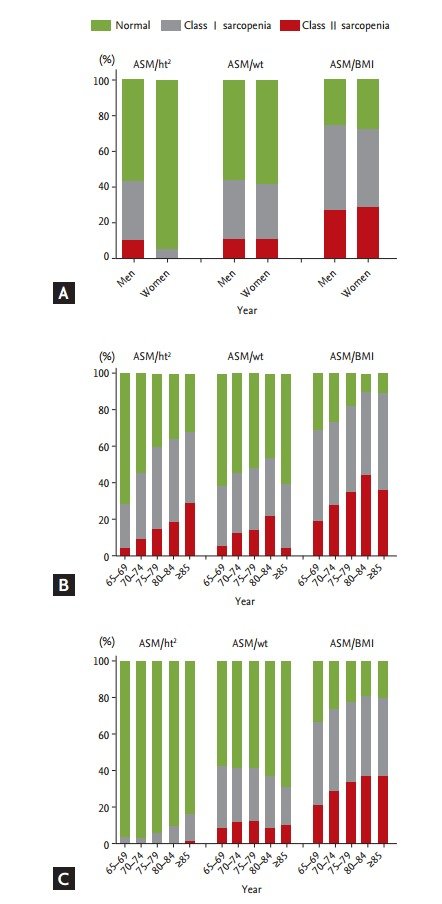
그림 출처: PubMed Central 공개 논문 (PMC4939509)
Conflict of interest statement
No potential conflict of interest relevant to this article was reported.
그 밖의 정보
- 출판 형태
- Journal Article, Review
- 저널
- The Korean journal of internal medicine · eISSN 2005-6648
- 전자 출판
- 2016-06-22
- MeSH
- Age Factors · Aged · Aged, 80 and over · Body Height* · Body Mass Index* · Body Weight* · Consensus · Female · Frail Elderly · Geriatric Assessment · Humans · Male · Models, Biological* · Muscle Strength · Muscle, Skeletal / pathology / physiopathology · Organ Size · Predictive Value of Tests · Prevalence · Prognosis · Reproducibility of Results · Republic of Korea / epidemiology · Sarcopenia / diagnosis / epidemiology / pathology / physiopathology · Severity of Illness Index · Sex Factors
- 참고문헌
- 40편