
Sci Rep. 2019;9(1):3465.
Interpretation of EBV infection in pan-cancer genome considering viral life cycle: LiEB (Life cycle of Epstein-Barr virus).
제1저자 송효진 · 교신저자 윤성수, 고영일
소속 (11)
- Cancer Research Institute, Seoul National University College of Medicine, Seoul, Republic of Korea.
- Center for Medical Innovation, Seoul National University Hospital, Seoul, Republic of Korea.
- Department of Internal Medicine, Seoul National University Hospital, Seoul, Republic of Korea.
- Genome Opinion, Ansan, Gyeonggi-do, Republic of Korea.
- Department of Pathology, Seoul National University Hospital, Seoul, Republic of Korea.
- Center for RNA Research, Institute for Basic Science, Seoul, Republic of Korea.
- School of Biological Sciences, Seoul National University, Seoul, Republic of Korea.
- Cancer Research Institute, Seoul National University College of Medicine, Seoul, Republic of Korea. ssysmc@snu.ac.kr.
- Department of Internal Medicine, Seoul National University Hospital, Seoul, Republic of Korea. ssysmc@snu.ac.kr.
- Center for Medical Innovation, Seoul National University Hospital, Seoul, Republic of Korea. go01@snu.ac.kr.
- Department of Internal Medicine, Seoul National University Hospital, Seoul, Republic of Korea. go01@snu.ac.kr.
Abstract
We report a novel transcriptomic analysis workflow called LiEB (Life cycle of Epstein-Barr virus) to characterize distributions of oncogenic virus, Epstein-Barr virus (EBV) infection in human tumors. We analyzed 851 The Cancer Genome Atlas whole-transcriptome sequencing (WTS) data to investigate EBV infection by life cycle information using three-step LiEB workflow: 1) characterize virus infection generally; 2) align transcriptome sequences against a hybrid human-EBV genome, and 3) quantify EBV gene expression. Our results agreed with EBV infection status of public cell line data. Analysis in stomach adenocarcinoma identified EBV-positive cases involving PIK3CA mutations and/or CDKN2A silencing with biologically more determination, compared to previous reports. In this study, we found that a small number of colorectal adenocarcinoma cases involved with EBV lytic gene expression. Expression of EBV lytic genes was also observed in 3% of external colon cancer cohort upon WTS analysis. Gene set enrichment analysis showed elevated expression of genes related to E2F targeting and interferon-gamma responses in EBV-associated tumors. Finally, we suggest that interpretation of EBV life cycle is essential when analyzing its infection in tumors, and LiEB provides high capability of detecting EBV-positive tumors. Observation of EBV lytic gene expression in a subset of colon cancers warrants further research.
Figures
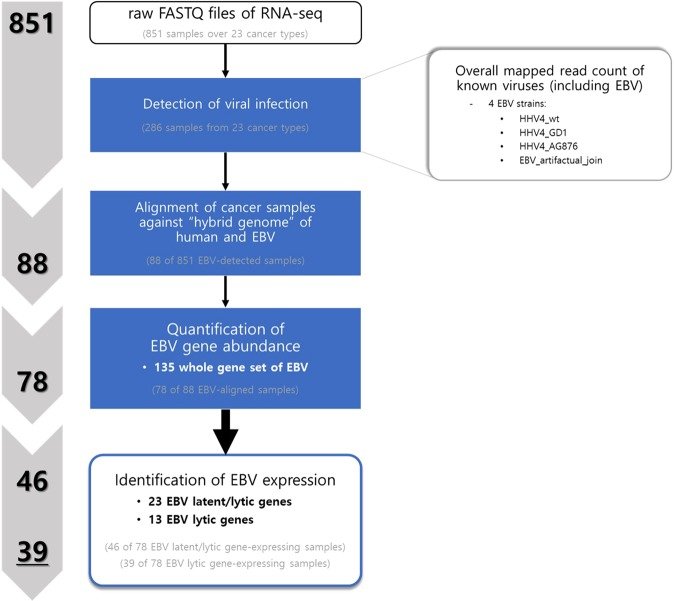
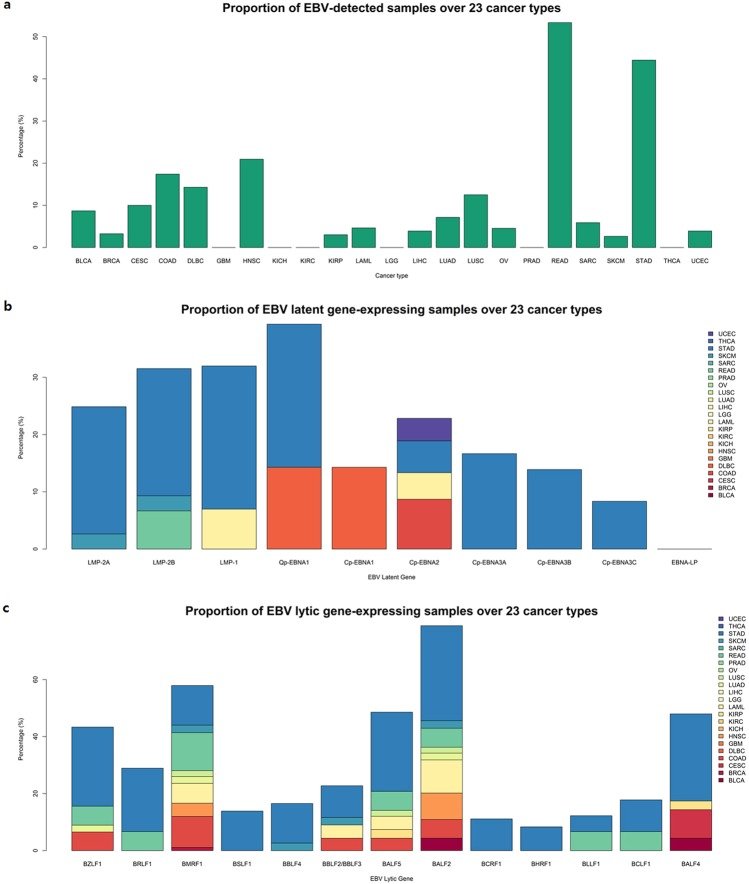
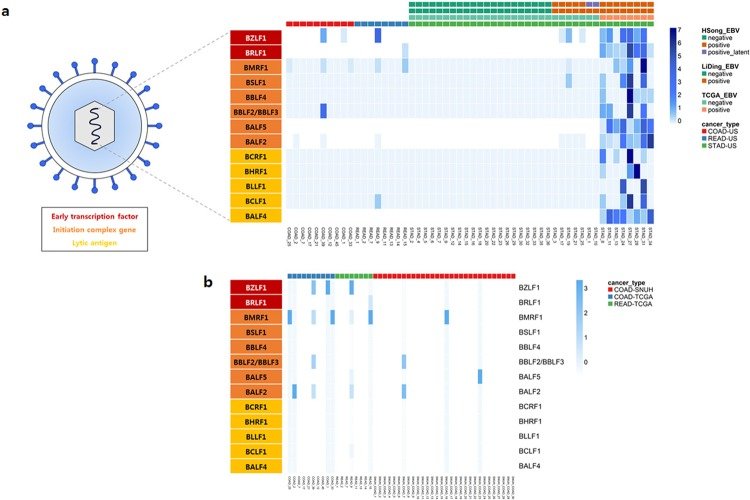
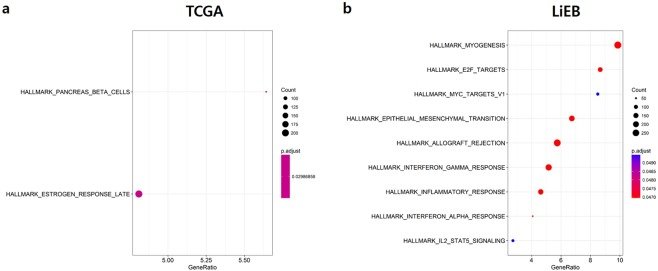
그림 출처: PubMed Central 공개 논문 (PMC6401378)
Conflict of interest statement
The authors declare no competing interests.
그 밖의 정보
- 출판 형태
- Journal Article, Research Support, Non-U.S. Gov't
- 저널
- Scientific reports · eISSN 2045-2322
- 전자 출판
- 2019-03-05
- MeSH
- Cell Transformation, Viral · Epstein-Barr Virus Infections / complications / diagnosis / virology · Gene Expression Profiling · Genome, Human* · Herpesvirus 4, Human / physiology · High-Throughput Nucleotide Sequencing · Humans · Life Cycle Stages · Molecular Diagnostic Techniques · Mutation · Neoplasms / diagnosis / etiology · Reproducibility of Results · Transcriptome
- 참고문헌
- 53편