
Clin Mol Hepatol. 2024;30(3):487-499.
Evolutionary changes in metabolic dysfunction-associated steatotic liver disease and risk of hepatocellular carcinoma: A nationwide cohort study.
제1저자 정석송 · 교신저자 김원, 박상민
소속 (12)
- Department of Biomedical Informatics, Korea University College of Medicine, Seoul, Korea.
- Department of Biomedical Sciences, Seoul National University College of Medicine, Seoul, Korea.
- Department of Family Medicine, College of Medicine, Chung-Ang University Gwangmyeong Hospital, Chung-Ang University College of Medicine, Gwangmyeong, Korea.
- Division of Gastroenterology and Hepatology, Mayo Clinic, Rochester, MN, USA.
- Department of Internal Medicine, Seoul National University Hospital, Seoul, Korea.
- Department of Family Medicine, Life Clinic, Seoul, Korea.
- Department of Internal Medicine, Hanyang University Hospital, Seoul, Korea.
- Division of Gastroenterology and Hepatology, Department of Internal Medicine, Seoul Metropolitan Government Seoul National University Boramae Medical Center, Seoul, Korea.
- Department of Liver Surgery, Renji Hospital, School of Medicine, Shanghai Jiao Tong University, Shanghai, China.
- The International Cooperation Laboratory on Signal Transduction, Eastern Hepatobiliary Surgery Hospital, Shanghai, China.
- National Center for Liver Cancer, Shanghai, China.
- Department of Internal Medicine, Seoul National University College of Medicine, Seoul, Korea.
Abstract
BACKGROUND/AIMS To determine the association between evolutionary changes in metabolic dysfunction-associated steatotic liver disease (MASLD) status and the risk of hepatocellular carcinoma (HCC) in a nationwide population-based cohort.
METHODS Information on study participants was derived from the Korea National Health Insurance Service database. The study population consisted of 5,080,410 participants who underwent two consecutive biennial health screenings between 2009 and 2012. All participants were followed up until HCC, death, or 31 December 2020. The association of evolutionary changes in MASLD status, as assessed by the fatty liver index and cardiometabolic risk factors, including persistent non-MASLD, resolved MASLD, incident MASLD, and persistent MASLD, with HCC risk was evaluated using multivariable-adjusted Cox proportional hazards regression.
RESULTS Among the 5,080,410 participants with 39,910,331 person-years of follow-up, 4,801 participants developed HCC. The incidence of HCC in participants with resolved, incident, and persistent MASLD was approximately 2.2-, 2.3-, and 4.7-fold higher, respectively, than that in those with persistent non-MASLD among the Korean adult population. When stratifying the participants according to the evolutionary change in MASLD status, persistent (adjusted hazard ratio [aHR], 2.94; 95% confidence interval [CI], 2.68-3.21; P<0.001), incident (aHR, 1.85; 95% CI, 1.63-2.10; P<0.001), and resolved MASLD (aHR, 1.33; 95% CI, 1.18-1.50; P<0.001) had an increased risk of HCC compared to persistent non-MASLD.
CONCLUSION The evolutionary changes in MASLD were associated with the differential risk of HCC independent of metabolic risk factors and concomitant medications, providing additional information on the risk of HCC stratification in patients with MASLD.
Keywords
Cohort studiesEpidemiologyFatty liverLiver neoplasms
Figures
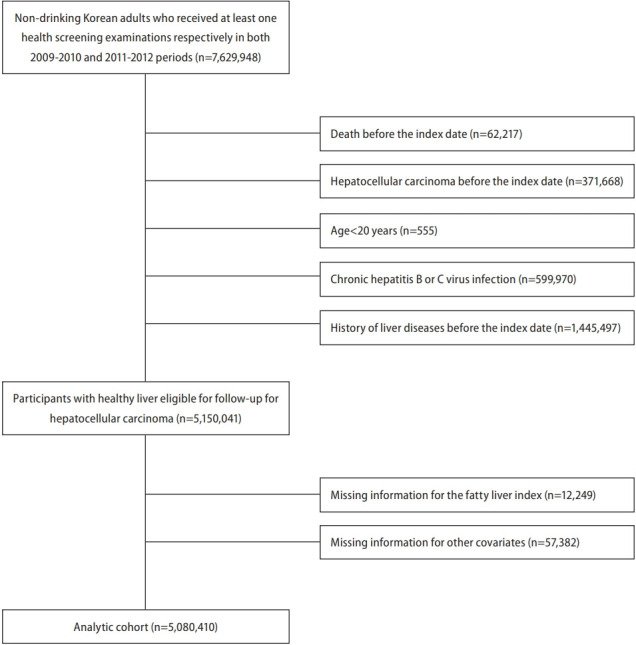
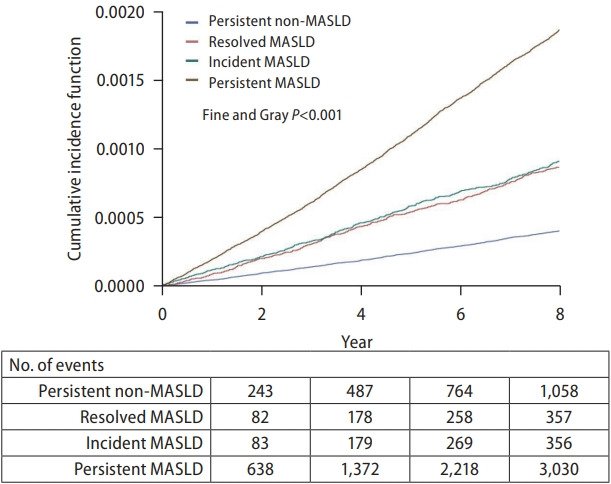
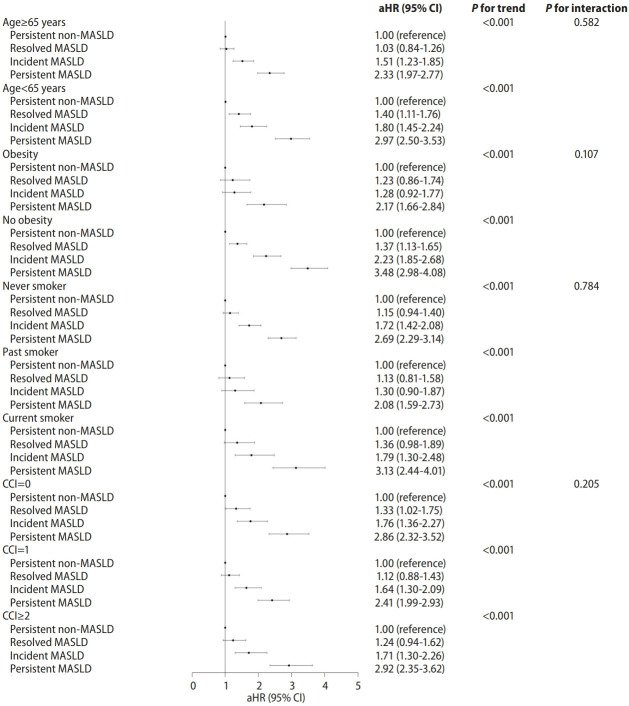
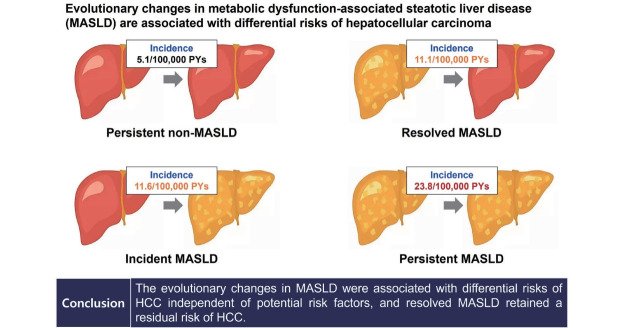
그림 출처: PubMed Central 공개 논문 (PMC11261234)
Comment · 정정
Conflict of interest statement
Conflicts of Interest . The authors have no conflicts to disclose.
그 밖의 정보
- 출판 형태
- Journal Article
- 저널
- Clinical and molecular hepatology · eISSN 2287-285X
- 전자 출판
- 2024-05-07
- MeSH
- Humans · Carcinoma, Hepatocellular* / pathology / diagnosis / complications · Liver Neoplasms* / diagnosis / pathology / complications · Male · Female · Middle Aged · Risk Factors · Republic of Korea / epidemiology · Adult · Incidence · Proportional Hazards Models · Fatty Liver / complications / diagnosis · Aged · Cohort Studies
- 연구비
- Ministry of Science and ICT · Institute for Information & Communications Technology Planning & Evaluation · National Research Foundation of Korea 2021R1F1A1063346 · National Research Foundation of Korea 2021R1A2C2005820 · National Research Foundation of Korea 2021M3A9E4021818 · National Research Foundation of Korea RS-2023-00237783 · Korea Health Industry Development Institute · Ministry of Health and Welfare HI21C0538 · Korea National Institute of Health 2022ER090202 · Seoul National University Hospital 04-2021-0370
- 참고문헌
- 44편